Addison's disease & adrenal insufficiency
On this page
Addison's disease, also known as primary adrenal insufficiency or hypoadrenalism, is a relatively rare disorder resulting from destruction of the adrenal cortex.
Adrenal insufficiency that originates from the pituitary is termed secondary adrenal insufficiency. In this type of adrenal insufficiency there is insufficient ACTH production by the pituitary to stimulate the adrenal glands. It is most commonly seen as a result of long term (>3 weeks) glucocorticoid therapy.
Cortisol deficiency leads to increased production of adrenocorticotrophic hormone (ACTH) because negative feedback to the pituitary gland is reduced.
Addison's disease can result in the following biochemical disturbances:
Symptoms of Addison's disease
UK Epidemiology
Almost 9000 people in the UK have been diagnosed with this disorder and it can affect people of any age, although it mostly occurs in women and in those between the ages of 30-50
Diagnosis of Addison's disease
The diagnosis is often suspected when patients have low cortisol and electrolyte abnormalities consistent with Addison's.
Diagnostic conformation is typically via the adrenocorticotrophic hormone stimulation (Synacthenµ) test.
Other investigations are often required to establish the cause & include:
Addisonian crisis
Addisonian or adrenal crisis is a potentially fatal condition resulting from acute deficiency of the glucocorticoid cortisol and, to a lesser extent, the mineralocorticoid aldosterone.
For those with Addison's disease the risk of developing Addisonian Crisis is relatively high. One study showed 8% of people with Addison's disease needed annual hospital admission for adrenal crisis whilst another showed >20% of patients with chronic adrenal insufficiency will have more than one adrenal crisis during their lifetime.
The ED clinician should be aware that Addisonian crisis may be the first presentation of a patient with previously undiagnosed Addison's disease.
There is no fixed consensus on diagnostic criteria as most symptoms are non-specific:
Investigations
Management
Hydrocortisone
Adults: Administer parenteral hydrocortisone 100mg stat (IM preferable) and repeat 6 hourly until the patient is haemodynamically stable and clinical improvement (alternative 200mg/24hrs by continuous IV infusion).
Infants and children: Administer initial parenteral injection of 50mg hydrodortisone/m2 (usually 25mg in infants and 50mg in children) followed by 50mg/24h in infants and 100mg/24h in children.
Children: Fluid requirements are lower in children and quantities should be adjusted appropriately. Fluid boluses in children are typically calculated at 10-20ml/kg.
Adrenal insufficiency that originates from the pituitary is termed secondary adrenal insufficiency. In this type of adrenal insufficiency there is insufficient ACTH production by the pituitary to stimulate the adrenal glands. It is most commonly seen as a result of long term (>3 weeks) glucocorticoid therapy.
Addison's disease
Metabolic disturbance
In Addison's disease there is reduced production of glucocorticoids (primarily cortisol), mineralocorticoids (primarily aldosterone) and adrenal androgens.Cortisol deficiency leads to increased production of adrenocorticotrophic hormone (ACTH) because negative feedback to the pituitary gland is reduced.
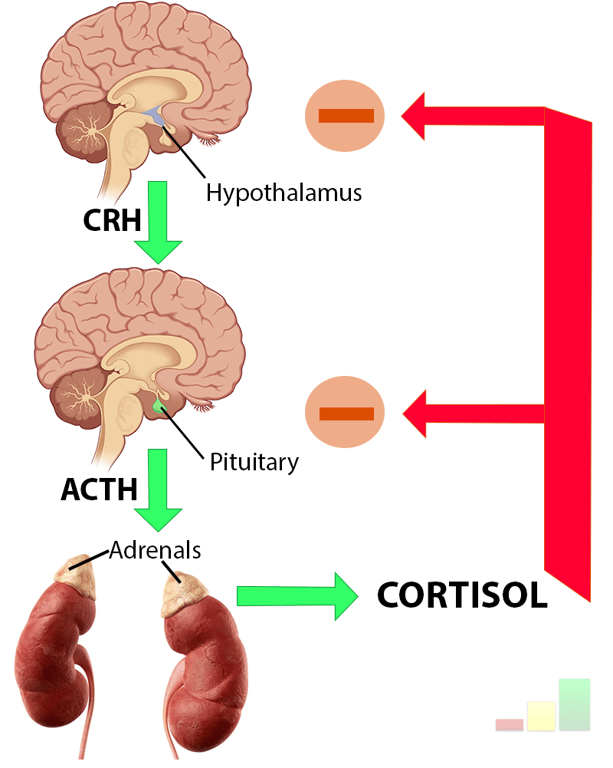 | |
Cortisol negative feedback loop on corticotrophin-releasing hormone (CRH) and adrenocorticotrophic hormone (ACTH). Click on image to enlarge
Addison's disease can result in the following biochemical disturbances:
- Hyperkalaemia (due to aldosterone deficiency)
- Hyponatraemia (due to aldosterone deficiency)
- Hypercalcaemia (mechanism unclear - thought to be primarily due to increased tubular calcium reabsorption in volume depletion)
- Hypoglycaemia (due to loss of glucocorticoid's glucogenic effects)
Symptoms of Addison's disease
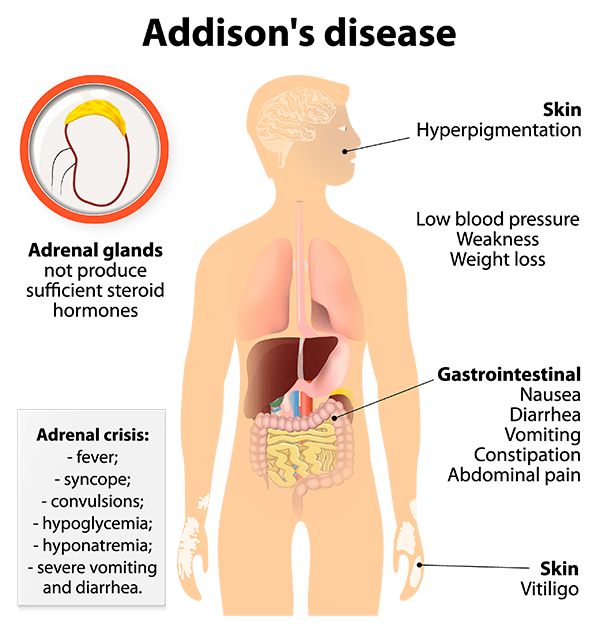 | |
Illustration of the clinical features of Addison's disease. Click on image to enlarge
UK Epidemiology
Almost 9000 people in the UK have been diagnosed with this disorder and it can affect people of any age, although it mostly occurs in women and in those between the ages of 30-50
Cause
Autoimmune destruction of the adrenal glands is the commonest cause of primary adrenal insufficiency (primary hypoadrenalism or Addisons's disease) in the UK and developed countries accounting for around 90% of cases.Causes of primary and secondary adrenal insufficiency (hypoadrenalism)
Primary adrenal insufficiency causes:
Primary adrenal insufficiency causes:
- Autoimmune adrenalitis
- Tuberculosis (most common cause of Addison's worldwide)
- Adrenal metastases (e.g. bronchial carcinoma)
- Meningococcal septicaemia (Waterhouse-Friderichsen syndrome)
- HIV
- CMV
- Antiphospholipid syndrome
- Amyloidosis
- Haemochromatosis
- Congenital adrenal hyperplasia & other genetic causes
- pituitary disorders (e.g. tumours, irradiation, infiltration)
- long term glucocorticoid therapy
Diagnosis of Addison's disease
The diagnosis is often suspected when patients have low cortisol and electrolyte abnormalities consistent with Addison's.
Diagnostic conformation is typically via the adrenocorticotrophic hormone stimulation (Synacthenµ) test.
Other investigations are often required to establish the cause & include:
- Adrenal autoantibodies
- Chest X-ray or abdominal X-ray may show adrenal or lung calcification consistent with previous TB infection. Quantiferon or mantoux tests may also be used to screen for TB.
- CT scan of the adrenal glands
- MRI scan of hypothalamus and pituitary where central causes of adrenal insufficiency are suspected.
- Hypothalamic-pituitary axis hormones: TSH, prolactin, FSH/LH.
- Genetic screening for adrenoleukodystrophy (males only as X-linked)
Addisonian crisis
Addisonian or adrenal crisis is a potentially fatal condition resulting from acute deficiency of the glucocorticoid cortisol and, to a lesser extent, the mineralocorticoid aldosterone.
For those with Addison's disease the risk of developing Addisonian Crisis is relatively high. One study showed 8% of people with Addison's disease needed annual hospital admission for adrenal crisis whilst another showed >20% of patients with chronic adrenal insufficiency will have more than one adrenal crisis during their lifetime.
The ED clinician should be aware that Addisonian crisis may be the first presentation of a patient with previously undiagnosed Addison's disease.
Precipitating factors of crisis
Addisonian crisis occurs when the physiological demand for these hormones exceeds the ability of adrenal glands to produce them| Precipitating causes of Addisonian crisis |
|---|
| Infection Dehydration Surgery Trauma Physiological stress/pain Pregnancy Hypoglycaemia Acute withdrawal of long term steroids |
Presentation of Addisonian crisis
Signs and symptoms include:- Malaise.
- Fatigue.
- Nausea or vomiting.
- Abdominal pain.
- Low-grade fever.
- Muscle pains and cramps.
- Dehydration which may progress to hypotension and hypovolaemic shock.
- Confusion which may progress to loss of consciousness and coma.
There is no fixed consensus on diagnostic criteria as most symptoms are non-specific:
Investigations
- FBC, U+Es & CRP
- Venous blood gas
- Septic screen (CXR, urine & blood cultures) if sepsis suspected
- Cortisol is often the initial investigation
- Paired sample of cortisol and ACTH before starting hydrocortisone (if possible but should not delay appropriate treatment)
Management
Hydrocortisone
Adults: Administer parenteral hydrocortisone 100mg stat (IM preferable) and repeat 6 hourly until the patient is haemodynamically stable and clinical improvement (alternative 200mg/24hrs by continuous IV infusion).
Infants and children: Administer initial parenteral injection of 50mg hydrodortisone/m2 (usually 25mg in infants and 50mg in children) followed by 50mg/24h in infants and 100mg/24h in children.
Fluids
Adults: Administer 1 litre IV 0.9% saline stat and continue saline resuscitation at an appropriate rate until haemodynamic stability and correction of any electrolyte disturbance and AKI. ICU support may be required to maintain blood pressure and provide monitoringChildren: Fluid requirements are lower in children and quantities should be adjusted appropriately. Fluid boluses in children are typically calculated at 10-20ml/kg.
Close monitoring of sodium levels is required during fluid resus as osmotic demyelination syndrome may occur if sodium rises too quickly