Thyroid physiology
On this page
Basic thyroid gland anatomy
The thyroid gland is an endocrine organ positioned in the anterior neck spanning C5-T1 vertebral levels. It has two lobes connected by an isthmus. The isthmus lies anterior to the 2nd-4th tracheal rings.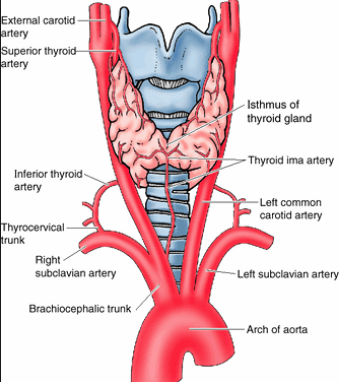 | |
Illustration of the thyroid and its blood supply
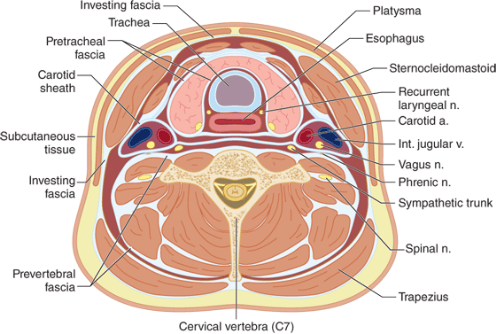 | |
Cross sectional anatomy of the thyroid
Basic thyroid physiology
The hypothalamus in the brain secretes thyrotropin-releasing hormone (TRH) which stimulates the anterior pituitary to secrete thyroid-stimulating hormone (TSH).
TSH stimulates the thyroid gland to produce thyroxine (T4) and triiodothyronine (T3). T3 and T4 act on a wide variety of tissues functioning to regulate use of energy sources, protein synthesis and control the body's sensitivity to other hormones.
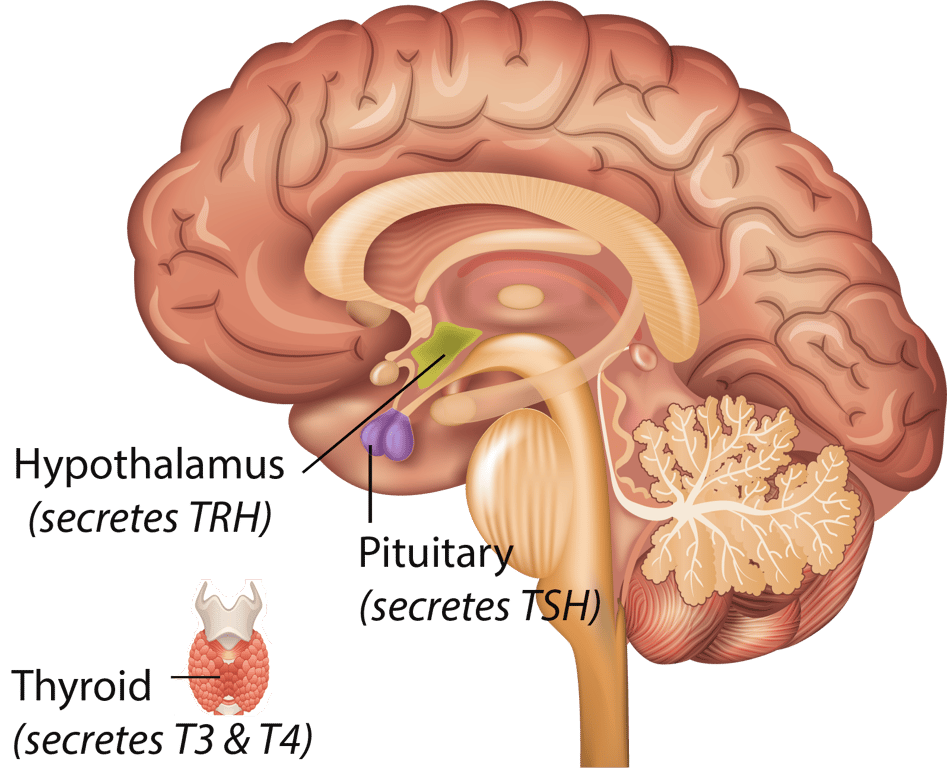 | |
TRH is synthesised in the hypothalamus. TSH secreted by the pituitary. The thyroid gland produces T3 (triiodothyronine) & T4 (thyroxine). Click on image to enlarge
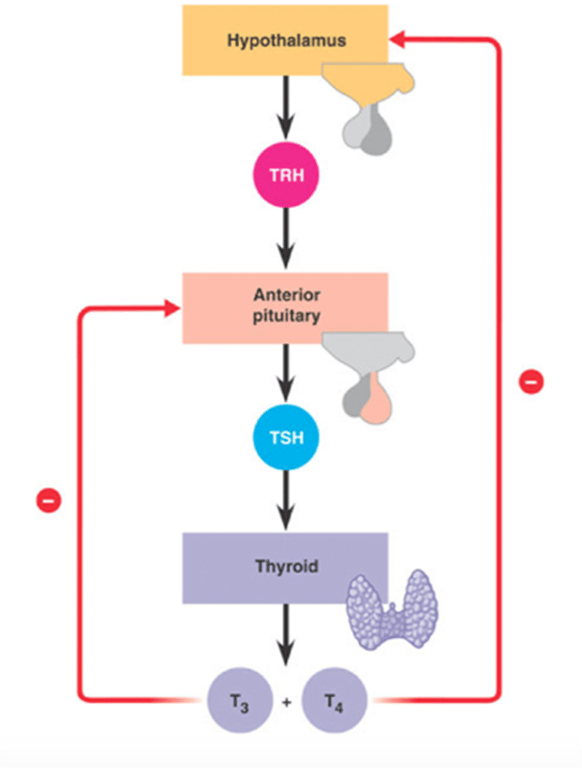 | |
Thyroid physiology and negative feedback loop. TRH stimulates the pituitary to produce TSH. TSH stimulates the thyroid to produce T3 & T4. T3 and T4 inhibit TSH and TRH production. Click on image to enlarge
Thyroid hormone synthesis
Thyroid tissue is comprised of cell clusters called follicles which surround a gel matrix called colloid. The main component of this colloid is the glycoprotein thyroglobulin. Thyroglobulin acts as nucleus for the manufacture of thyroid hormones and stores them pending release from from the thyroid.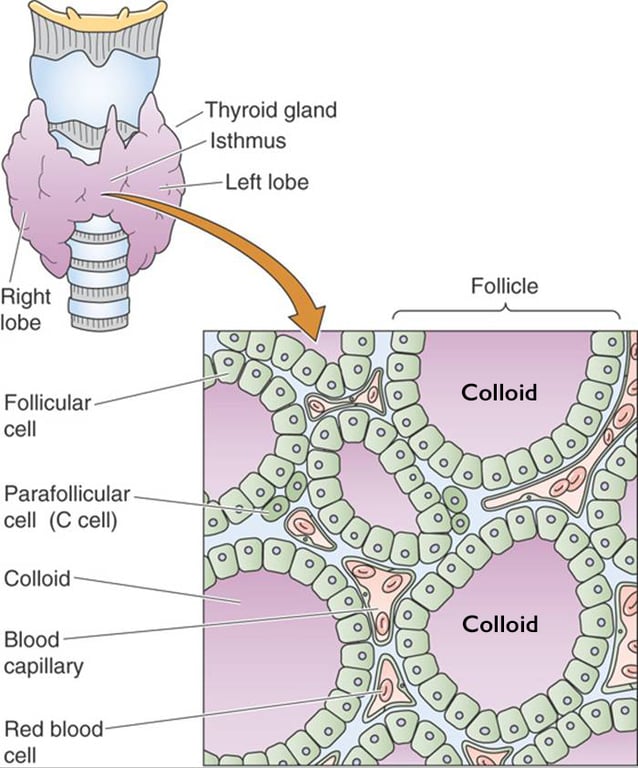 | |
Thyroid gland hsitological structure. Click on image to enlarge
The thyroid follicular cells accumulate iodide ions (I-) which is pumped into the follicular cells by active transport via the Na/I symporter. These iodide ions are used to iodinate the amino acid tyrosine to T1 (mono-iodotyrosine) or T2 (di-iodotyrosine). These T1 and T2 tyrosine residues are attached to thyroglobulin. Further coupling of T2 to these residues under the action of thyroperoxidase results in the formation of T3 (T2 coupled to T1) and T4 (T2 coupled to T2) which initially remain bound to thyroglobulin.
As thyroid hormones are highly lipophilic they would escape the gland rapidly were they not bound to thyroglobulin. Under the action of TSH thyroglobulin molecules are moved from the colloid into the follicle cells (by a process called pinocytosis) and here lysozymal proteases liberate the tyrosine residues (T1, T2, T3 and T4) from thyroglobulin. Once liberated T1 and T2 are enzymatically de-iodinated before they are able to leave the cell whereas T3 and T4 leave the cell and enter the circulation.
The majority (>99%) of T3 and T4 released into the circulation becomes bound to protein (most commonly thyroxine-binding protein). Only the free unbound T3 and T4 is able to cross cell membranes and bind to thyroid receptors. Thyroid receptors are present in most tissues with particularly high levels in the liver.
Only the free unbound T3 and T4 is metabolically active
The thyroid gland secretes much more T4 than T3 yet T3 is much more biologically active (potent) than T4. Much of the T4 secreted into the circulation will be converted to T3 by deiodinase enzymes in the peripheral tissues. T4's main role is therefore considered by many to be purely a a pro-hormone to T3.
The thyroid gland typically secretes T4 and T3 in a ratio of 13:1
Thyroid hormone functions
Basal levels of T3 and T4 are essential to maintain a normal basal metabolic rate. The thyroid hormones have a number of physiological functions:- Promote thermogenesis (heat production by increasing metabolic rate of cells aka calorigenesis)
- Increase cardiac output via enhancing effects of adrenaline
- Enhance the effects of the sympathetic nervous system
- Promote glucose metabolism, lipolysis and protein turnover (synthesis and breakdown)
- Maintain normal adult nervous system function
- Maintain normal sensitivity of respiratory centres to change in O2 and CO 2 concentration & maintain normal cell oxygen use
- Promote normal muscle development and function, skeletal growth and maturation
- Promote normal gastrointestinal motility, tone, enzyme secretion
- Maintain hydration and secretory function of the skin
Thyroid hormone key points
- Synthesis of active thyroid hormones requires iodine (~1mg per week)
- The thyroid gland typically secretes T4 and T3 in a ratio of 13:1
- T4 is converted peripherally to the active form T3, which is ~3-4 times more potent than T4.
- Thyroxine is largely protein bound, only free thyroxine is biologically active.
- Thyrotropin-releasing hormone (TRH) produced by the hypothalamus stimulates the anterior pituitary to produce thyroid stimulating hormone (TSH) which stimulates thyroxine production by the thyroid gland.
Hypothyroidism & hyperthyroidism
Table 1: Causes of thyroid disorders
| Hypothyroidism | Thyrotoxicosis | |
|---|---|---|
| Most common cause | Autoimmune thyroiditis
| Graves' disease
|
| Other causes | Subacute thyroiditis (de Quervain's)
Riedel thyroiditis
Postpartum thyroiditis Drugs
Iodine deficiency
| Toxic multinodular goitre
Drugs
|
It should be remembered that a lot of the conditions mentioned above don't always cause either hypothyroidism or hyperthyroidism, there is sometimes some overlap, as shown below:
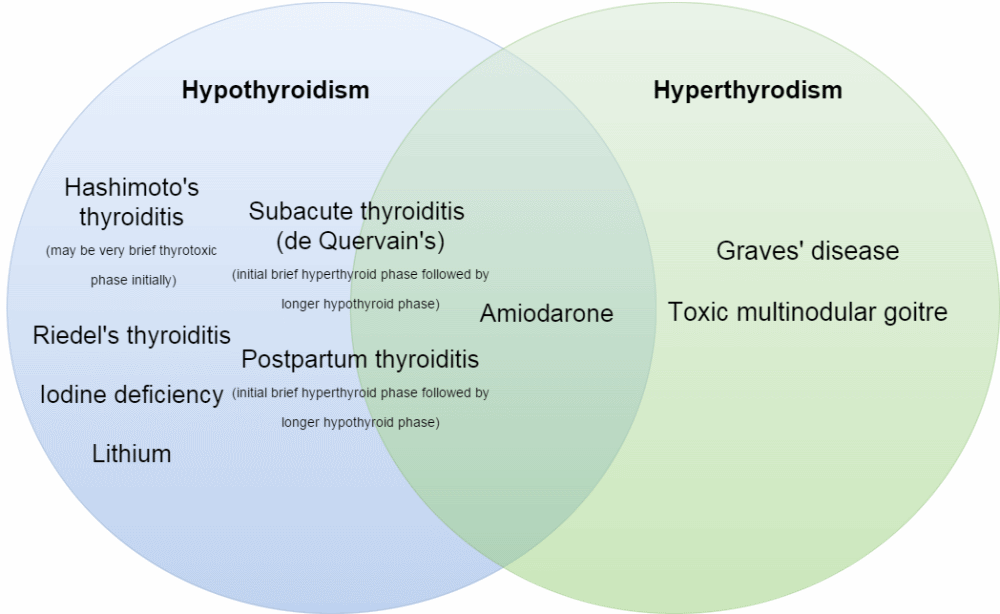 | |
Venn diagram showing how different causes of thyroid dysfunction may manifest. Note how many causes of hypothyroidism may have an initial thyrotoxic phase.
Symptoms and signs
Thyroid disorders can present in a large variety of ways. Often (but not always) the symptoms present are the opposite depending on whether the thyroid gland is under or over active, for example hypothyroidism may result in weight gain whilst thyrotoxicosis normally leads to weight loss. Common or prominent symptoms are in bold.
Table 2: Signs & symptoms of thyroid disorders
| Feature | Hypothyroidism | Thyrotoxicosis |
|---|---|---|
| General | Weight gainLethargy Cold intolerance | Weight loss'Manic', restlessness Heat intolerance Exophthalmus |
| Cardiac | Diastolic hypertension | Palpitations, may even provoke arrhythmias e.g. atrial fibrillation |
| Skin | Dry (anhydrosis), cold, yellowish skin Non-pitting oedema (e.g. puffy hands and face) Dry skin Thinning and loss of hair Loss of lateral aspect of eyebrows Dystrophic nails | Increased sweating Pretibial myxoedema: erythematous, oedematous lesions above the lateral malleoli Thyroid acropachy: clubbing |
| Gastrointestinal | Decreased appetite Constipation | Increased appetite Diarrhoea |
| Gynaecological | Menorrhagia | Oligomenorrhea |
| Neurological | Decreased deep tendon reflexes Carpal tunnel syndrome | AnxietyTremor |