Cord syndromes
The diagram belows shows the cross-sectional anatomy of the spinal cord:
Simplified visualisation of cord sensory and motor tracts:
Illustrated overview of cord syndromes:
Central cord syndrome
Anterior cord syndrome / anterior spinal artery syndrome
Brown-Sequard syndrome
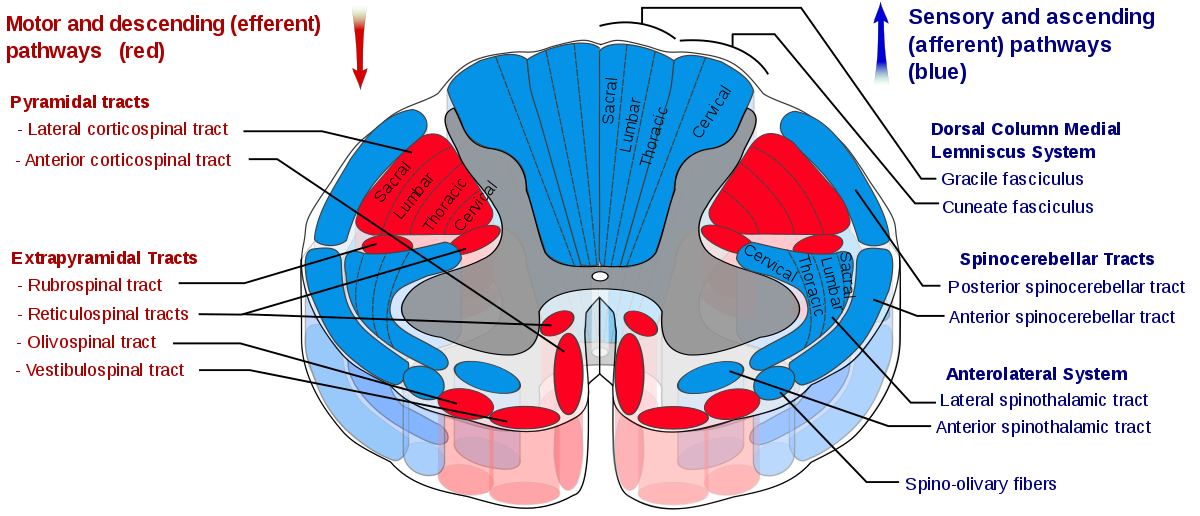 | |
| Wikipedia | |
Simplified visualisation of cord sensory and motor tracts:
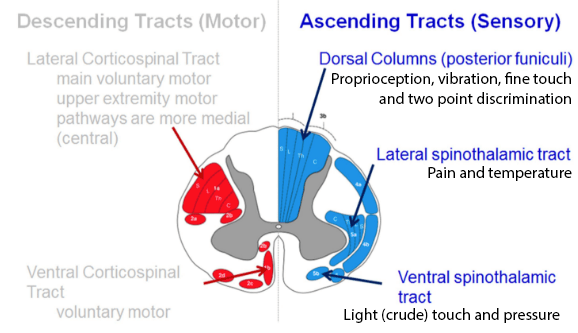 | |
| Cord syndrome | Tracts affected | Clinical notes |
|---|---|---|
| Brown-Sequard syndrome (spinal cord hemisection) | All tracts on one side of cord i.e 1. Lateral corticospinal tract 2. Dorsal columns 3. Lateral spinothalamic tract | These result in the follwoing paired deficits 1. Ipsilateral spastic paresis below lesion 2. Ipsilateral loss of proprioception and vibration sensation 3. Contralateral loss of pain and temperature sensation |
| Central cord | 1. Lateral corticospinal tract 2. lateral spinothalamic tract 3. Dorsal columns | The picture can be variable depending on extent of oedema and haemorrhage. Upper limb weakness is > lower limb weakness (due to motor fibres for upper limb travelling more centrally in cord) Sensory loss variable with proprioception, vibration and deep touch sensation often less affected than pain and temperature sensation as bulk of dorsal column based in periphery of cord |
| Anterior cord syndrome | 1. Lateral spinothalamic tract 2. Corticospinal tract | Complete motor paralysis below the level of the lesion due to involvement of the corticospinal tracts. Loss of pain and temperature at and below the level of injury due to involvement of lateral spinothalamic tract. Sparing of posterior columns results in intact two point discrimination, proprioception and vibration sense |
Illustrated overview of cord syndromes:
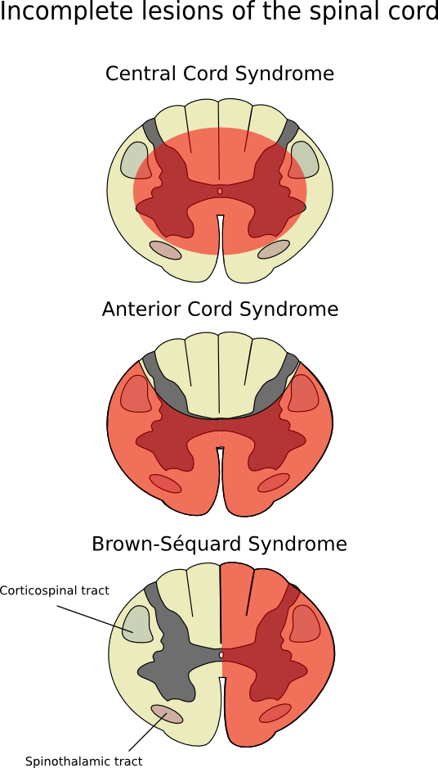 | |
| Wikipedia | |
Central cord syndrome
- Typically caused by hyperextension injuries in those with pre-existing cervical spondylosis.
- Most common form of incomplete spinal cord injury
- Motor deficit: upper limb motor weakness > lower limb (due to lower limb tracts being more peripherally based)
- Bladder dysfunction common
- Variable sensory and reflex deficits
- Pain and temperature most affected sensory modalities
- Proprioception and vibration more likely to be preserved
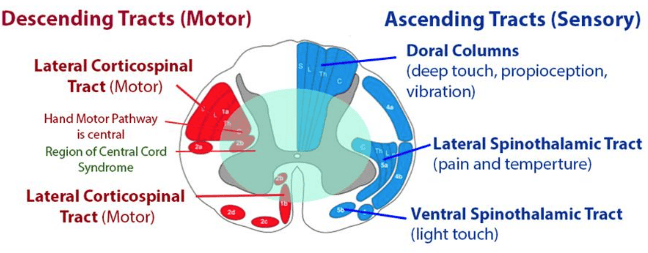 | |
Central cord syndrome
Anterior cord syndrome / anterior spinal artery syndrome
- Typically the result of stenosis to the anterior spinal artery and resulting cord infarction.
- May also occur secondary to direct compression of anterior cord
- Worse prognosis of incomplete spinal cord injuries.
- Results in paralysis below level of lesion with loss of pain and temperature sensation but preserved proprioception and vibration sense
Brown-Sequard syndrome
- Complete cord hemisection
- Typically the result of penetrating trauma
- Very rare
- Excellent prognosis
- Ipsilateral motor deficit and loss of proprioception and vibration sense below level of lesion
- Contralateral deficit in pain and temperature due to crossing of spinothalamic tracts two levels below