Campylobacter jejuni
On this page
Campylobacter jejuni key points
- Common cause of travellers diarrhoea
- Gram negative curved rods
- Transmitted primarily via fecal-oral route via ingestion of contaminated meat (particularly poultry)
- Incubation period typically 2-5 days (Public Health England, CDC)
- Illness typically lasts 1 week
- Features include watery, sometimes bloody, diarrhoea associated with abdominal cramps, fever, malaise and headache
Background
Campylobacter is a Gram-negative, curved or spiral-shaped bacilli that are motile due to a single polar flagellum. They are microaerophilic organisms, requiring reduced oxygen levels for optimal growth. Among the various species, Campylobacter jejuni is the primary pathogen responsible for human disease, particularly causing bacterial gastroenteritis.
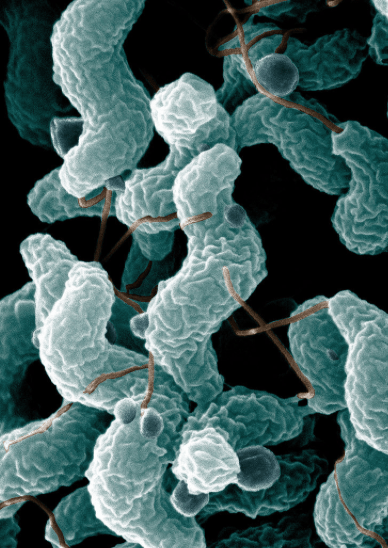 | |
Campylobacter jejuni
Transmission
The most common source of infection is consumption of undercooked or contaminated poultry. Other significant sources include unpasteurised milk, untreated water, and contact with infected animals, particularly livestock and domestic pets. Infections are also associated with travel to endemic regions.
Transmitted primarily via fecal-oral route via ingestion of contaminated meat (particularly poultry)
Incubation period typically 2-5 days
Incubation period typically 2-5 days
Epidemiology
In the United Kingdom, Campylobacter is the most common bacterial cause of foodborne gastroenteritis, with around 50,000 laboratory-confirmed cases reported annually in England. Taking into account undiagnosed cases the actual disease burden is likely to be significantly higher. Infections often show a seasonal peak during the summer months.Pathophysiology
After surviving the acidic environment of the stomach, C. jejuni colonises the intestinal mucosa, primarily in the jejunum, ileum, and colon. It adheres to and invades the epithelial cells, provoking a local inflammatory response. This leads to mucosal damage and results in diarrhoea. Unlike some enterotoxigenic bacteria (e.g. Vibrio cholerae, ETEC), C. jejuni does not act primarily via secretory toxin production.. In some individuals, the immune response triggered by the infection can cross-react with host tissues, contributing to post-infectious autoimmune complications.Clinical Features
Patients often present with an acute illness characterised by :- Diarrhoea: may be watery or bloody, accompanied by abdominal cramps
- Fever
- Malaise
- Nausea +/- vomiting
The illness is usually self-limiting, resolving within a week.
Diagnosis
- Stool culture
- More rapid diagnostic methods such as PCR are increasingly used in some laboratories
Management
- Conservative management with focus on maintaining hydration
- Antibiotics reserved for those whose symptoms are severe (high fever, bloody and/or high-output diarrhoea) or the person is immunocompromised. Clarithromycin 250-500 mg twice daily for 5-7 days, within 3 days of onset of illness is advised by NICE.
Infection control measures include maintaining strict hand hygiene, avoiding the consumption of undercooked poultry, ensuring safe food handling practices, and avoiding unpasteurised dairy products and untreated water. In hospital or care settings, standard precautions should be taken, with isolation considered in cases of profuse diarrhoea.
Complications
Most patients recover fully without complication. A minority may develop complications which include:- Reactive arthritis
- Guillain–Barré syndrome ( *exam favourite - 30% of cases GBS caused by campylobacter)
- Irritable bowel syndrome (post-infectious)
- Bacteraemia (particularly in immunocompromised individuals)
Guillain–Barré syndrome and Campylobacter jejuni
Guillain–Barré syndrome (GBS) is estimated to occur in around 1 in 1000 people following Campylobacter jejuni infection.
Guillain-Barré Syndrome (GBS) typically develops within 1 to 3 weeks after a Campylobacter infection with approximately 30% of GBS cases associated with recent Campylobacter jejuni infection.