Threadworms
On this page
Background
Threadworm (Enterobius vermicularis), also known as pinworm, is a common parasitic worm that infests the human intestine. Threadworms have a white, thread-like appearance with adult males measuring around 4mm in length and adult females around 10 mm in length. Threadworm eggs are not visible to the naked eye but may be seen using microscopy.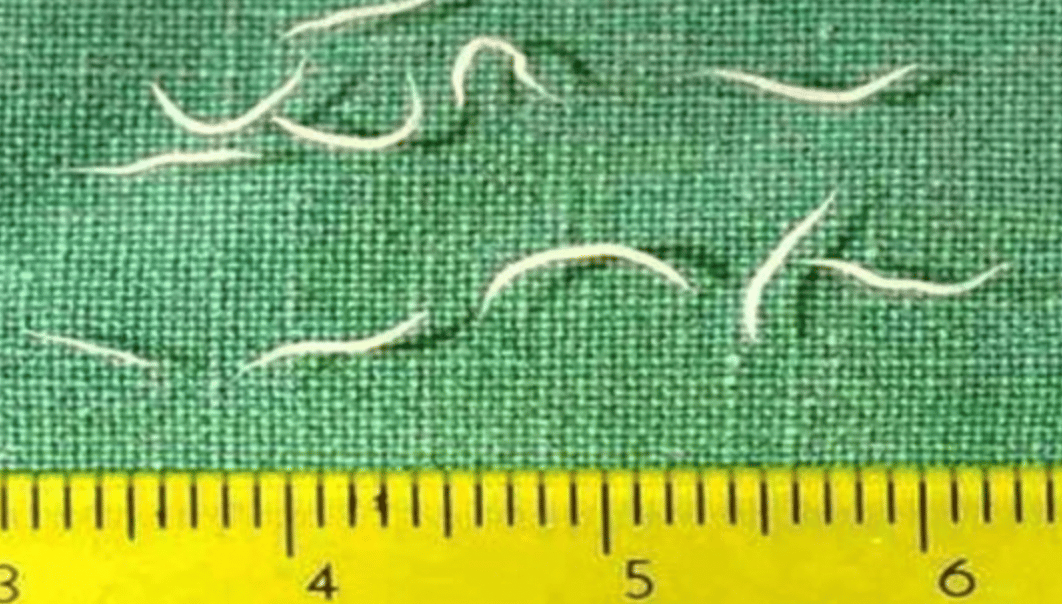 | |
Appearance of threadworms next to ruler for size appreciation. Click on image to enlarge
Transmission
Occurs via the faecal-oral route. Humans are the only host.
Infection cycle
- Threadworm eggs are ingested via hand-to-mouth transfer after scratching or by handling contaminated surfaces e.g. bedding. Rarely transmission may occur by inhaling and then swallowing eggs in environmental dust e.g. after shaking contaminated bed linen
- Once ingested, larvae hatch from the eggs in the small intestine before establishing themselves in the large intestine reaching maturity in approximately two weeks. Adult worms live for up to six weeks.
- The mature adult female worm migrates to the anus and lays thousands of eggs on the peri-anal skin (typically at night) causing itching.
- Adult threadworms only survive for about 6 weeks and infection must be maintained by swallowing fresh eggs. There is no extraintestinal phase of the transmission cycle, and therefore, signs of systemic infection are uncommon.
Clinical features
- Pruritus ani: Typically intense and worse at night.
- Pruritus vulvae
- May be asymptomatic
- Small white thread-like worms visible on perianal skin or in stools.
- Secondary bacterial infection can occur
Diagnosis
Investigation is often not required with diagnosis made on history of patient (or patient's parents) seeing moving worms in stools.
If testing is required the adhesive tape test is the preferred method. Transparent wide hypo-allergenic adhesive tape is applied to the perianal skin first thing in the morning, before wiping or bathing. It does not have to be left on overnight. The tape is then placed on a slide or put in a specimen container for later microscopic examination.
Management
Threadworm infection is typically managed via treatment with the anthelmintic medication mebendazole and hygiene measures. Drug treatment is not essential. Mebendazole is typically given as a single dose, a second repeat dose may be given 2 weeks later if infection persists (note this is more often due to reinfection rather than treatment failure). Consider treating all household contacts (unless contraindicated) as threadworms are highly transmissible. Note that mebendazole kills adult threadworms but does not kill eggs which remain viable for up to 2 weeks.Mebendazole is not licensed for children under 2 years old and should not be given to pregnant or breastfeeding women. In these cases treatment is with hygiene measures alone for 6 weeks.
Children with threadworm do not need to be kept off school or nursery
Hygiene measures include:
- Wash hands thoroughly with soap and warm water after using the toilet, changing nappies, and before handling food.
- Cut fingernails regularly, avoid biting nails and scratching around the anus.
- Shower or bath each morning washing the perianal area, to remove eggs from the skin.
- Change bed linen and nightwear daily for several days after treatment.
- Washing/drying in a hot cycle will kill threadworm eggs.
- Thoroughly dust and vacuum (including vacuuming mattresses) and clean the bathroom by 'damp-dusting' surfaces, washing the cloth frequently in hot water.
Key Points
- Threadworms inhabit the large intestine.
- Perianal scratching is often the only symptom. Most commonly scratching occurs at night as females migrate to the anus to lay eggs.
- Diagnosis may be made using the adhesive tape test where D shaped eggs are identified on microscopy.
- Scratching contaminates the fingers which can then spread eggs via the feacal-oral route.
- Treatment of the whole family with mebendazole is the usual treatment method. Repeat dose after 2 weeks may be required.