Local anaesthesia
On this page
Local anaesthesia
Local anaesthetic may be applied topically or infiltrated locally under the skin to establish a field block.Lidocaine, bupivicaine and prilocaine are the most commonly used local anaesthetic agents used in the ED. Local anaesthetic drugs act by causing a reversible block to conduction along nerve fibres. The potency of an anaesthetic, time to onset and risk of toxicity are influenced by several factors including pH, pKa, lipid solubility, protein binding and vaso-activity.
Lidocaine, bupivicaine and prilocaine prolong the inactivation of the fast voltage-gated Na+ channels in the neuronal cell membrane which inhibits the influx of Na+ ions and prevents nerve depolarisation. Action potentials will not propagate as the voltage-gated sodium channels reman closed whilst blocked.
Mechanism of action:
Reversable blockade of sodium channels.Local anaesthetic summary
| Anaesthetic | Onset | Duration of action | Maximum dose |
|---|---|---|---|
| Lidocaine | Rapid (<2 minutes) | 30 minutes to 2 hours | 3mg/kg |
| Lidocaine with adrenaline | Rapid (<2 minutes) | 30 minutes to 3 hours | 7mg/kg |
| Bupivicaine | Slow (approx 5 minutes) | 2 to 8 hours | 2mg/kg |
| Prilocaine | Rapid (<2 minutes) | 30 minutes to 3 hours | 6mg/kg |
| Prilocaine with adrenaline | Rapid (<2 minutes) | 30 minutes to 3 hours | 8mg/kg |
Local anaesthetics cause dilatation of blood vessels. The addition of a vasoconstrictor such as adrenaline/epinephrine to the local anaesthetic preparation diminishes local blood flow, slowing the rate of absorption and thereby prolonging the anaesthetic effect.
Local anaesthetics with adrenaline should not be used on digits or appendages as there is an associated risk of ischaemic necrosis
Local anaesthetics with adrenaline should not be used on digits or appendages as there is an associated risk of ischaemic necrosis
Lidocaine
Lidocaine hydrochloride is the most commonly used local anaesthetic in the UK. Lidocaine has a rapid onset, is effectively absorbed from mucous membranes and is a useful surface anaesthetic in concentrations up to 10%. Except for surface anaesthesia and dental anaesthesia, solutions used do not usually exceed 1% in strength. The duration of the block with adrenaline/epinephrine is typically around 90 minutes.As a sodium channel blocker lidocaine is classed as a 1b anti-arrhythmic drug (using the Vaughan Williams classification - though knowledge of this classification is beyond the scope of the exam) and is an alternative to amiodarone in the treatment of ventricular tachycardia or ventricular fibrillation according to the ALS algorithm.
Prilocaine
Prilocaine hydrochloride is a local anaesthetic which has similar properties to lidocaine hydrochloride (see table above). It was preferred in regional anaesthetic blocks due to reported lower risk of systemic toxicity (reports of supply problems with preservative-free solution mean lidocaine is often used instead).Bupivicaine
Bupivacaine hydrochloride has a longer duration of action than other local anaesthetics. It has a slow onset of action, taking up to 30 minutes for full effect. It is often used in spinal anaesthesia and is particularly suitable for continuous epidural analgesia in labour, or for postoperative pain relief. In severe hepatic and renal impairment bupivacaine should be used with caution.EMLA
EMLA is a topical local anaesthetic made from a 50/50 mixture of 2.5% prilocaine and 2.5% lidocaine.Local anaesthetic toxicity
Local anaesthetic may enter the systemic circulation and in high enough doses cause toxic side effects.Clinicians administering local anaesthetic must be aware of the signs and symptoms of local anaesthetic systemic toxicity (LAST) and know how to act on them if recognised.
Local anaesthetic systemic toxicity has significant effects on the central nervous (CNS) and cardiovascular systems (CVS).
Early signs include:
- Circumoral and/or tongue numbness
- Metallic taste.
- Lightheaded or dizziness
- Visual and auditory disturbances (difficulty focusing and tinnitus)
- Disorientation.
- Drowsiness
This can rapidly progress to more significant signs and symptoms including:
- Seizures
- Coma
- Respiratory depression
- Apnoea.
- Blue mucous membranes (seen in methaemoglobinaemia. Associated with Prilocaine use)
- Cardiovascular dysfunction: bradycardia, hypotension, atrial and ventricular dysrhythmias, conduction blocks, cardiovascular collapse, asystole
75% of patients will develop signs of toxicity within 5 minutes but these signs can develop up
to 30 minutes post LA administration hence observation is advised for at least 30 minutes post LA administration.
to 30 minutes post LA administration hence observation is advised for at least 30 minutes post LA administration.
Management
Treatment is largely supportive. If arrest occurs CPR should be commenced. ALS arrest and peri-arrest protocols should be followed but avoid using lidocaine as an anti-arrhythmic. A prolonged resuscitation should be anticipated (>1 hour).In severe local anaesthetic toxicity with cardiac arrest 20% lipid emulsion is advised
Local anaesthetic toxicity may be treated with intralipid (20% lipid emulsion)
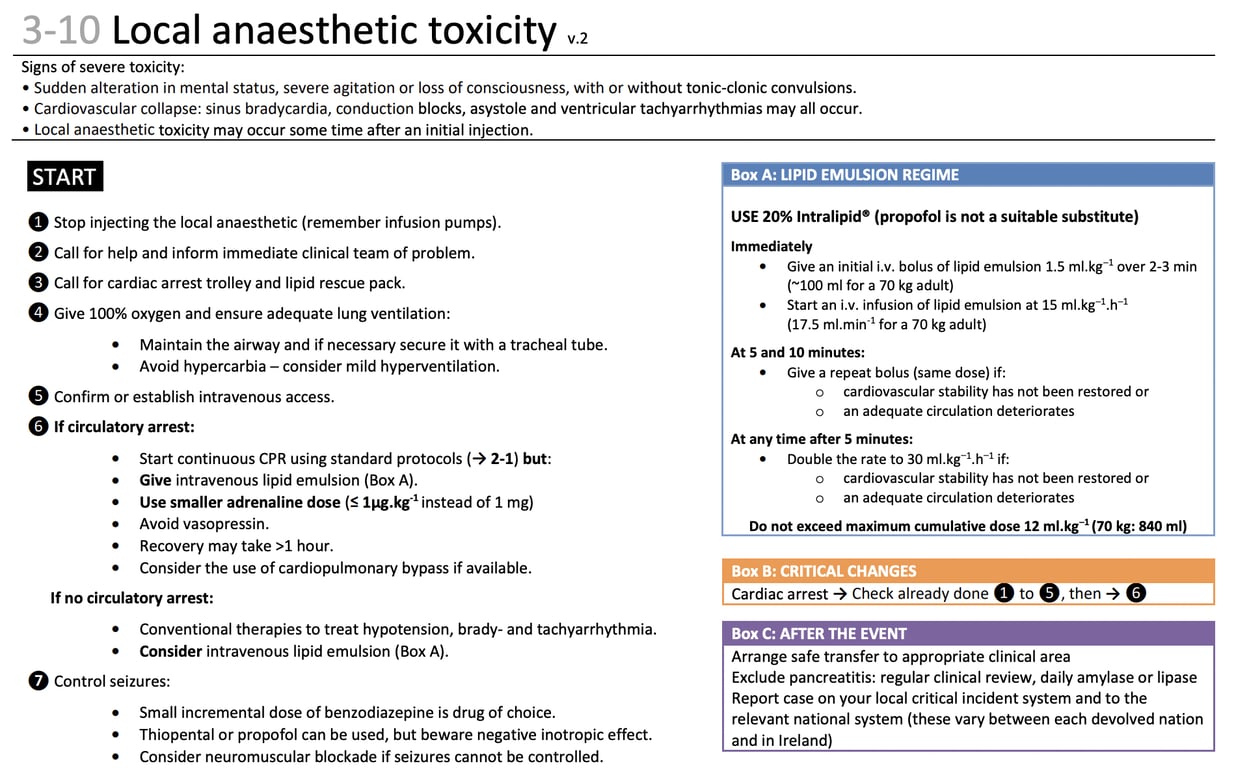 | |
Association of Anaesthetists 2023 management of local anaesthetic toxicity. Click on image to enlarge