Autonomic nervous system
The autonomic nervous system (ANS) is a division of the nervous system that acts largely unconsciously to regulate bodily functions.
The ANS provides the efferent pathway or effector component for homeostatic reflexes. The ANS allows the integration and modulation of function by central mechanisms in the brain in response to various stimuli.
Divisions of the autonomic nervous system
The ANS is divided into sympathetic and parasympathetic systems. These two systems generally act antagonistically to each other as shown below:
The two systems have some similarities:
Postganglionic neurotransmitters depend on the target organ.
The sympathetic preganglionic neurones are located in the lateral horns of spinal segments T1-L2. The sympathetic system is sometimes referred to as thoracolumbar outflow for this reason. They exit the cord via the ventral horns.
Sympathetic ganglia are generally located in the sympathetic chains either side of the vertebral column. This means postganglionic neurones are generally long to cover the distance from ganglion to target organ.
Sympathetic postganglionic neurones release noradrenaline where they terminate in their target organ. Noradrenaline is a catecholamine which activates adrenergic receptors.
A subset of sympathetic neurones release acetylcholine at their effector e.g. sweat glands. These are known as sympathetic cholinergic neurones.
Parasympathetic system
The parasympathetic system is often thought of as co-ordinating 'rest and digest' responses.
Parasympathetic preganglionic neurones originate in the brain stem and are transmitted via cranial nerves III, VII, IX and X. They also originate from S2-S4 sacral segments of the spinal cord. The parasympathetic system is sometimes referred to as craniosacral outflow for this reason.
Parasympathetic ganglia are often located in or near their target organs so postganglionic neurones are typically short.
Parasympathetic postganglionic neurones release acetylcholine (Ach)which act on cholinergic muscarinic receptors. The actions of the parasympathetic system are shown below:
Neurotransmitter summary
The ANS provides the efferent pathway or effector component for homeostatic reflexes. The ANS allows the integration and modulation of function by central mechanisms in the brain in response to various stimuli.
Divisions of the autonomic nervous system
The ANS is divided into sympathetic and parasympathetic systems. These two systems generally act antagonistically to each other as shown below:
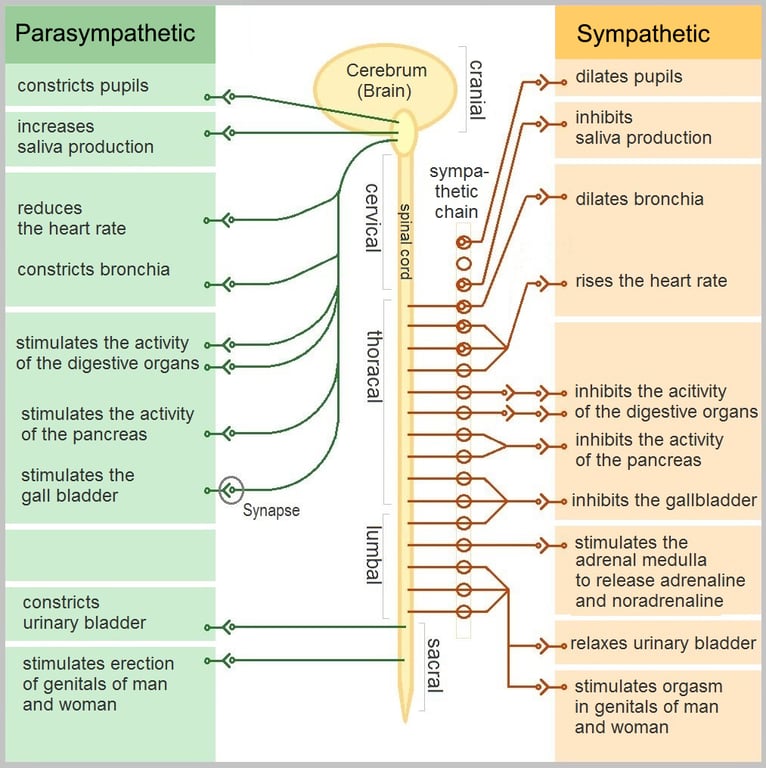 | |
Function of the ANS. Click on image to enlarge
The two systems have some similarities:
- Both contain preganglionic neurones originating in the central nervous system that synapse with unmyelinated postganglionic neurones in the peripheral ganglia.
- Postganglionic neurones terminate in, and innervate, their target organs.
- Preganglionic neurones of both systems release acetylcholine which acts on cholinergic nicotinic receptors in the postganglionic fibre.
Postganglionic neurotransmitters depend on the target organ.
Sympathetic system
The sympathetic system is often thought of as co-ordinating 'flight or flight' responses.The sympathetic preganglionic neurones are located in the lateral horns of spinal segments T1-L2. The sympathetic system is sometimes referred to as thoracolumbar outflow for this reason. They exit the cord via the ventral horns.
Sympathetic ganglia are generally located in the sympathetic chains either side of the vertebral column. This means postganglionic neurones are generally long to cover the distance from ganglion to target organ.
Sympathetic postganglionic neurones release noradrenaline where they terminate in their target organ. Noradrenaline is a catecholamine which activates adrenergic receptors.
A subset of sympathetic neurones release acetylcholine at their effector e.g. sweat glands. These are known as sympathetic cholinergic neurones.
Adrenergic receptors are G-protein coupled receptors that are of two main classes: α and β.
α and β receptors are further sub-classified to α 1, α 2, β 1, β 2 etc. Activation of α receptors is often associated with muscle contraction. Activation of β receptors is associated with smooth muscle relaxation but increased heart rate such as may be seen clinically when administering salbutamol.
α and β receptors are further sub-classified to α 1, α 2, β 1, β 2 etc. Activation of α receptors is often associated with muscle contraction. Activation of β receptors is associated with smooth muscle relaxation but increased heart rate such as may be seen clinically when administering salbutamol.
The adrenal gland is unique in that it is directly innervated by sympathetic preganglionic neurones.
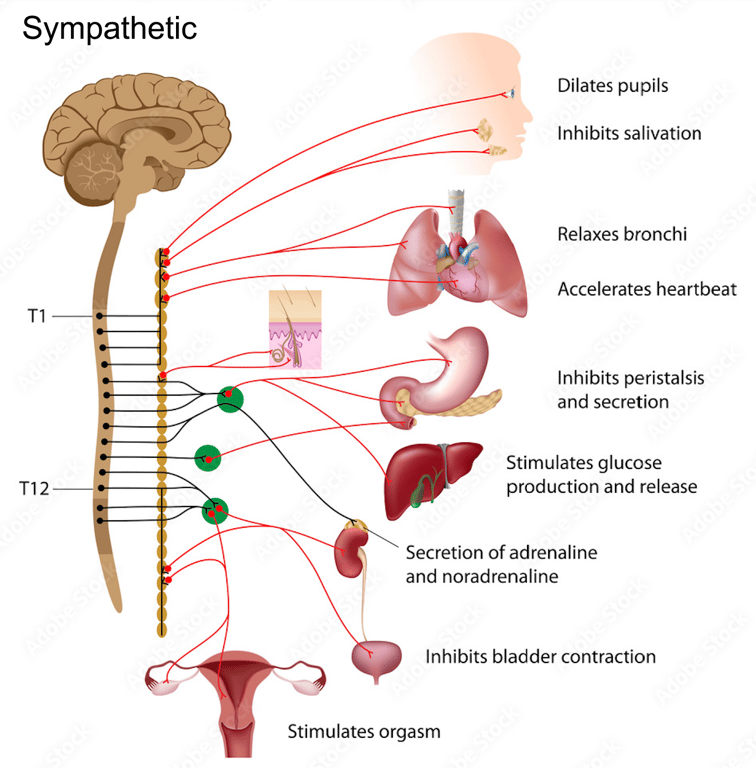 | |
Function of the sympathetic division of the ANS. Click on image to enlarge
Parasympathetic system
The parasympathetic system is often thought of as co-ordinating 'rest and digest' responses.
Parasympathetic preganglionic neurones originate in the brain stem and are transmitted via cranial nerves III, VII, IX and X. They also originate from S2-S4 sacral segments of the spinal cord. The parasympathetic system is sometimes referred to as craniosacral outflow for this reason.
Parasympathetic ganglia are often located in or near their target organs so postganglionic neurones are typically short.
Parasympathetic postganglionic neurones release acetylcholine (Ach)which act on cholinergic muscarinic receptors. The actions of the parasympathetic system are shown below:
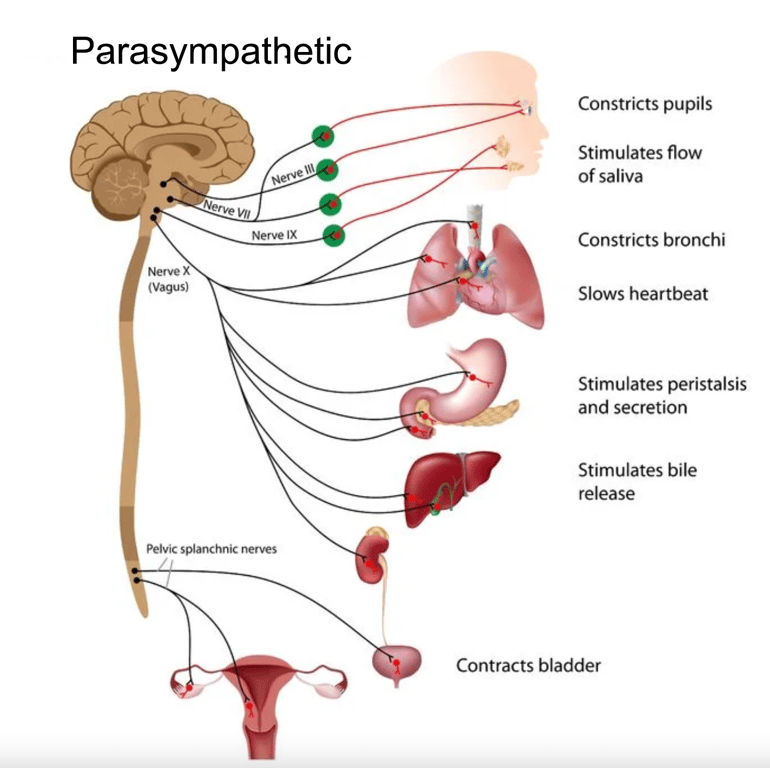 | |
Function of the parasympathetic division of the ANS. Click on image to enlarge
Neurotransmitter summary
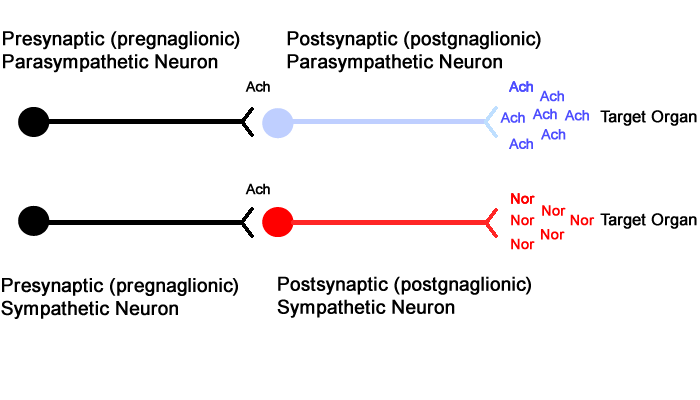 | |
Neurotransmitter summary. Click on image to enlarge