Salmonella enterica
On this page
Background
Salmonella is a Gram-negative, facultatively anaerobic, rod-shaped bacilli within the enterobacteriaceae family of bacteria. It includes numerous species and subspecies, of which Salmonella enterica is the primary human pathogen.The classification and naming systems of Salmonella can seem confusing. S. enterica comprises 6 main sub species (one of which is also called enterica i.e Salmonella enterica subsp. enterica) which may then be further classified according to serotype (or serovar). There are over 2,500 serovars. The full name of a serotype for example may be 'Salmonella enterica subsp. enterica serotype Typhimurium' which may then be abbreviated to Salmonella Typhimurium. (see image below)
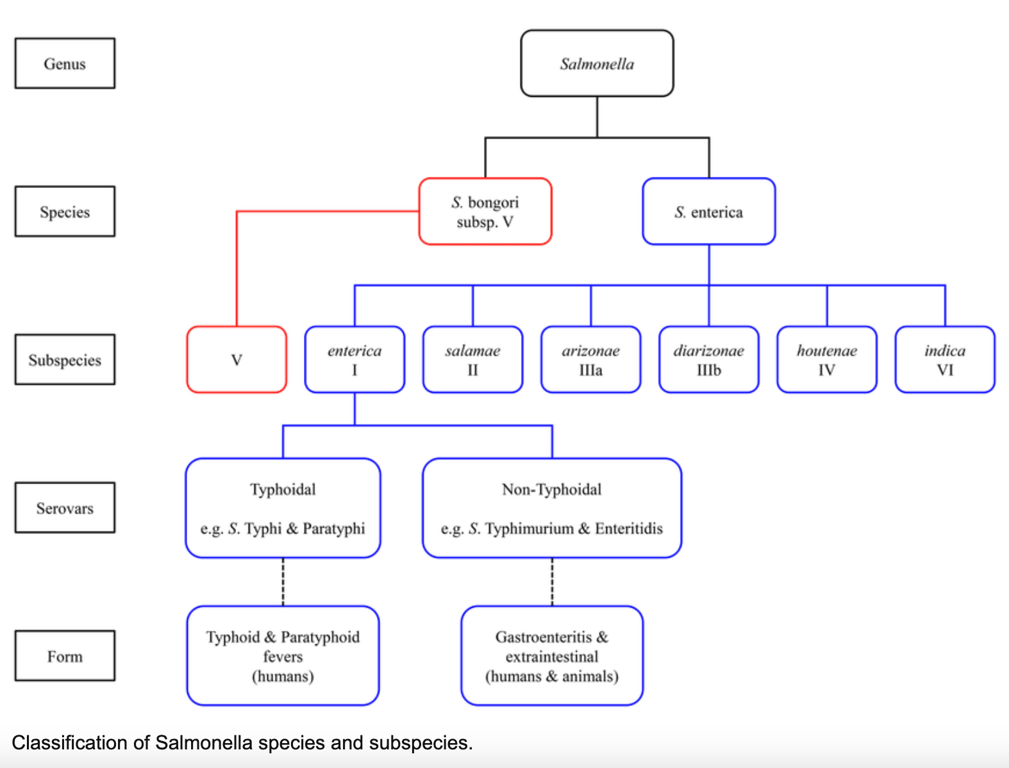 | |
Salmonella classification. Click on image to enlarge
Clinically Salmonella typically causes one of 3 disease types in humans:
- Gastroenteritis
- Enteric fever
- Extra-intestinal (invasive) infections e.g. osteomyelitis
Transmission
Transmission occurs primarily through the faecal-oral route. Common sources include:
- Undercooked poultry, eggs, and other animal products
- Contaminated water
- Contact with infected animals, including reptiles, livestock, and pets
- Asymptomatic human carriers, especially for typhoidal strains.
- Person-to-person spread, though uncommon
Incubation period varies by strain:
- Gastroenteritis: typically 6–72 hours
- Enteric fever (typhoid/paratyphoid): typically 7–14 days
Clinical features
Gastroenteritis (non-typhoidal Salmonella):
- Sudden onset of fever, diarrhoea, abdominal cramps, nausea, and sometimes vomiting
- Diarrhoea may be watery or occasionally bloody
- Typically self-limiting in immunocompetent individuals, lasting 3–7 days
- Prolonged fever, malaise, abdominal discomfort, headache, dry cough, and constipation (diarrhoea can also occur)
- Relative bradycardia, hepatosplenomegaly, and rose spots (faint salmon-pink macules on the trunk) may be observed
- Untreated cases may persist for weeks and result in serious complications
- Osteomyelitis (especially in sickle cell disease)
- Bacteraemia/septicaemia, especially in immunocompromised individuals
- Endovascular infections, such as mycotic aneurysms
Complications
- Dehydration and electrolyte abnormalities
- Intestinal perforation (especially in typhoid)
- Chronic carrier state (more common after typhoid fever, thought to affect 2-4% of patients)
- Sepsis, abscess formation, and osteomyelitis, particularly in infants or those with co-morbidities
Diagnosis
- Stool culture (gastroenteritis)
- Blood cultures (suspected enteric fever)
- Serology is not recommended in the UK
- Additional samples (e.g. urine, pus, CSF) may be needed for invasive disease
Management
Uncomplicated gastroenteritis does not usually require antibiotics as it is self-limiting. Rehydration therapy (oral or IV) is the cornerstone of management
Antibiotics are indicated for:
- Severe or invasive disease
- Infants <6 months, immunocompromised, or those with prosthetic devices
- Enteric fever or systemic Salmonella infection
First-line antibiotics (based on local susceptibility) include:
- Ciprofloxacin: typically used for non-typhoidal illnesses
- Cefotaxime: used in both typhoidal and non-typhoidal illness
- Azithromycin: typically used for typhoidal (enteric fever) illnesses
For enteric fever treatment typically lasts 7–14 days
Salmonella is a notifiable disease in the UK
Prevention
- Food safety: appropriate cooking of meat and eggs, good hand hygiene practices
- Avoidance of contaminated water or food when travelling to endemic areas
- Typhoid vaccination covers S. Typhi
- Infection control measures: isolation of hospitalised patients with diarrhoea, handwashing and appropriate PPE.
- Public health notification
Enteric fever
Enteric fever is a systemic infection characterised by prolonged fever, malaise, abdominal discomfort, and systemic involvement. It encompasses typhoid fever (due to S. Typhi) and paratyphoid fever (due to S. Paratyphi).
The infection follows ingestion of contaminated food or water containing S. Typhi or Paratyphi. The key stages include:
The clinical features of enteric fever typically develop 1–2 weeks post-exposure.
Enteric fever is a systemic infection characterised by prolonged fever, malaise, abdominal discomfort, and systemic involvement. It encompasses typhoid fever (due to S. Typhi) and paratyphoid fever (due to S. Paratyphi).
The infection follows ingestion of contaminated food or water containing S. Typhi or Paratyphi. The key stages include:
- Following ingestion the organism survives exposure to gastric acid in the stomach and reaches the small intestine.
- Salmonella bacteria adhere to and invade M cells overlying Peyer’s patches in the terminal ileum. They penetrate the mucosa and are engulfed by macrophages.
- S. Typhi resists intracellular killing within macrophages and uses them to disseminate via lymphatics into the bloodstream (primary bacteraemia) then seeds in reticuloendothelial organs (liver, spleen, bone marrow, and gallbladder).
- After multiplying in these organs, bacteria re-enter the bloodstream (secondary bacteraemia) and spread throughout the body which is when fever and clinical illness becomes evident.
- Organism re-enters the intestinal tract via bile, leading to mucosal inflammation and possibly ulceration and perforation of Peyer’s patches.
The clinical features of enteric fever typically develop 1–2 weeks post-exposure.