Thyroid dysfunction
On this page
Thyroid dysfunction is typically classified according to whether the thyroid is under active (hypothyroid) or over active (hyperthyroid).
Normal ranges for thyroid function tests are*:
TSH: 0.4-4.5 milliunits per litre
FT4 (Free T4): 9-25 picomoles per litre
FT3 (Free T3): 3.5-7.8 picomoles per litre
*note the ranges may vary slightly between NHS trusts
Primary: Insufficient thyroid hormone production due to iodine deficiency or an abnormality within the thyroid gland.
Primary hypothyroidism may be further classified as overt (high TSH, low T4) or subclinical hypothyroidism (high TSH normal T4) depending on thyroid function tests.
Secondary: The result of insufficient thyroid stimulation due to a pituitary or hypothalamic disorder
*Myxoedema coma is a potentially fatal complication & is considered in more detail below
Myxoedema coma
This is a rare life-threatening complication of untreated severe hypothyroidism. A trigger factor (infection, stress or physiological insult e.g. stroke) will increase the bodies active thyroid (T3 and T4) requirement but the body is unable to respond.
Patients will therefore develop worsening hypothyroidism and present with lethargy, bradycardia, hypothermia, hypotension, hypoventilation, altered mental state, seizures and/or coma.
Investigations will often reveal:
Management of myxoedema coma typically involves the patient being admitted to HDU/ITU for monitoring whilst receiving fluid replacement, correction of electrolyte abnormalities, mechanical ventilation (if required), warming (if hypothermia present), thyroid replacement therapy & treatment of precipitating causes such as infection.
Management
Lifelong treatment with levothyroxine is typically required. Monitoring can be done via checking TSH levels are adequately suppressed.
Endocrine referral is appropriate for those with suspected secondary causes of hypothyroidism.
Thyrotoxicosis is the clinical manifestation of excess circulating thyroid hormones due to any cause, including hyperthyroidism.
Primary hyperthyroidism occurs when thyrotoxicosis is caused by an abnormality of the thyroid gland itself such as Graves' disease. It may be further classified as overt (low TSH, High T3 or T4) or subclinical (low TSH, normal T3 or T4).
Secondary hyperthyroidism is the term used when thyroid over stimulation is caused by excessive thyroid-stimulating hormone (TSH).
*Thyroid storm is a potentially fatal complication and is considered in more detail below
Thyroid Storm
Thyrotoxic crisis or thyroid storm is a rare and potentially life-threatening complication of hyperthyroidism. It may be precipitated by a trigger such as acute infection, trauma, pregnancy, surgery including thyroidectomy, stroke or abruptly stopping antithyroid medication.
Clinically patients present with fever, tachycardia, agitation, hyperthermia, hypertension, atrial fibrillation, heart failure, jaundice, delirium, and coma.
Mortality is estimated at about 10% due to hyperthermia, cardiac arrhythmias, multi-organ failure, and sepsis.
Management
Normal ranges for thyroid function tests are*:
TSH: 0.4-4.5 milliunits per litre
FT4 (Free T4): 9-25 picomoles per litre
FT3 (Free T3): 3.5-7.8 picomoles per litre
*note the ranges may vary slightly between NHS trusts
Hypothyroidism
Definition
Hypothyroidism is the clinical condition resulting from thyroid hormone (T3 and T4) deficiency.Classification
Hypothyroidism may be classed as primary (95% of cases) or secondary (5% of cases)Primary: Insufficient thyroid hormone production due to iodine deficiency or an abnormality within the thyroid gland.
Primary hypothyroidism may be further classified as overt (high TSH, low T4) or subclinical hypothyroidism (high TSH normal T4) depending on thyroid function tests.
Secondary: The result of insufficient thyroid stimulation due to a pituitary or hypothalamic disorder
Complications
- Dyslipidaemia
- Metabolic syndrome
- Coronary heart disease (CHD) and stroke
- Heart failure
- Subfertility & infertility
- impaired special senses (taste, vision and hearing)
- Myxoedema coma*
*Myxoedema coma is a potentially fatal complication & is considered in more detail below
Myxoedema coma
This is a rare life-threatening complication of untreated severe hypothyroidism. A trigger factor (infection, stress or physiological insult e.g. stroke) will increase the bodies active thyroid (T3 and T4) requirement but the body is unable to respond.
Patients will therefore develop worsening hypothyroidism and present with lethargy, bradycardia, hypothermia, hypotension, hypoventilation, altered mental state, seizures and/or coma.
Investigations will often reveal:
- Electrolytes disturbance: most commonly hypoglycemia & hyponatremia
- Type 2 respiratory failure: hypoxaemia and hypercapnia
- ECG changes: Most commonly prolonged QT interval & flattened or inverted T waves
- Abnormal CXR: widened cardiac silhouette due to pericardial effusion
Management of myxoedema coma typically involves the patient being admitted to HDU/ITU for monitoring whilst receiving fluid replacement, correction of electrolyte abnormalities, mechanical ventilation (if required), warming (if hypothermia present), thyroid replacement therapy & treatment of precipitating causes such as infection.
Investigations
- Thyroid function tests (TSH and free T4)
- FBC, B12, HbA1c, coeliac screen, lipid profile, thyroid peroxidase antibodies
- Ultrasound of neck (if focal nodularity palpable or malignancy suspected)
Management
Lifelong treatment with levothyroxine is typically required. Monitoring can be done via checking TSH levels are adequately suppressed.
Endocrine referral is appropriate for those with suspected secondary causes of hypothyroidism.
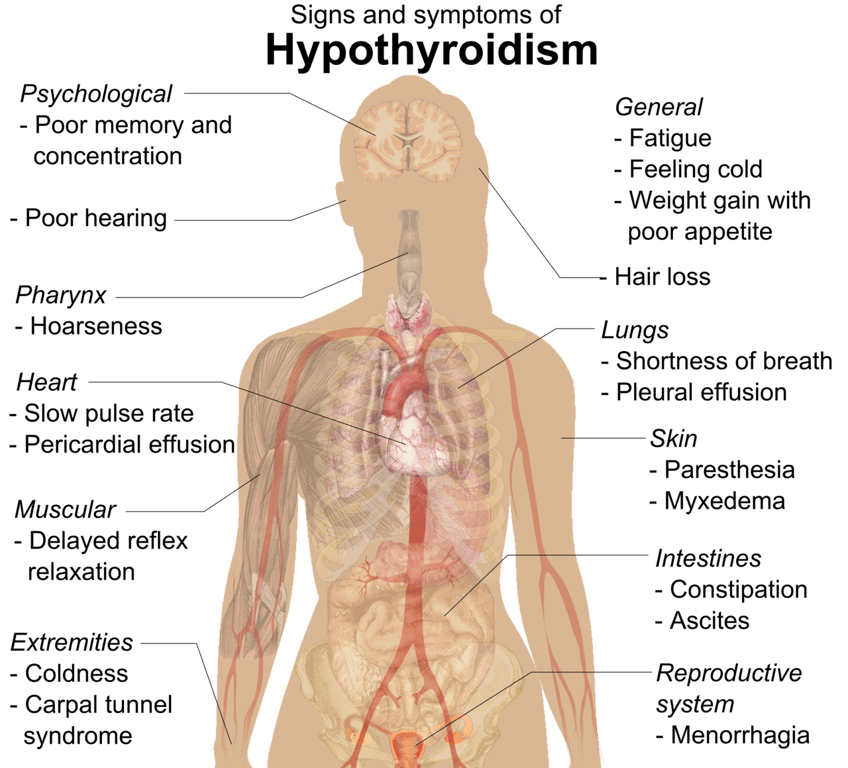 | |
Illustration of key signs and symptoms in hypothyroidism. Click on image to enlarge
Hyperthyroidism
Definitions
Hyperthyroidism is a biochemical diagnosis which occurs when there is pathologically increased thyroid hormone production and secretion by the thyroid glandThyrotoxicosis is the clinical manifestation of excess circulating thyroid hormones due to any cause, including hyperthyroidism.
Classification
Like hypothyroidism, hyperthyroidism may be classified as primary or secondary.Primary hyperthyroidism occurs when thyrotoxicosis is caused by an abnormality of the thyroid gland itself such as Graves' disease. It may be further classified as overt (low TSH, High T3 or T4) or subclinical (low TSH, normal T3 or T4).
Secondary hyperthyroidism is the term used when thyroid over stimulation is caused by excessive thyroid-stimulating hormone (TSH).
Complications
- Graves orbitopathy
- Compression of oesophagus or trachea by goitre
- Thyrotoxic periodic paralysis
- Arrhythmia especially atrial fibrillation
- Heart failure
- Osteoporosis
- Mood disorders including psychosis
- Increased obstetric complications including miscarriage and intrauterine growth restriction
- Thyroid storm*
*Thyroid storm is a potentially fatal complication and is considered in more detail below
Thyroid Storm
Thyrotoxic crisis or thyroid storm is a rare and potentially life-threatening complication of hyperthyroidism. It may be precipitated by a trigger such as acute infection, trauma, pregnancy, surgery including thyroidectomy, stroke or abruptly stopping antithyroid medication.
Clinically patients present with fever, tachycardia, agitation, hyperthermia, hypertension, atrial fibrillation, heart failure, jaundice, delirium, and coma.
Mortality is estimated at about 10% due to hyperthermia, cardiac arrhythmias, multi-organ failure, and sepsis.
Management of thyroid storm:
- Gain IV access & send bloods for TSH, T4, T3, U&E, FBC, LFT, glucose and calcium
- Perform septic screen
- Obtain ECG
- Inform HDU and endocrinology team
- IV fluids: consider central venous monitoring to help guide fluid status.
- Monitor blood glucose levels 4 hourly.
- Consider cooling measures for hyperthermia
- Treat precipitants e.g. infection or dehydration
- Beta-blocker (e.g. Propranolol 1mg IV over 1 minute): reduce heart rate and block effects of thyroid hormones. (Calcium channel blockers may be considered if beta blockade is contraindicated e.g. in patients with asthma)
- Antithyroid drugs: Propylthiouracil 200mg tds PO / NG / PR to stop release and production of thyroid hormones (more suitable than carbimazole in emergency situations as it also prevents peripheral T4 - T3 interconversion)
- Steroids: IV Hydrocortisone 200mg, followed by prednisolone 20mg tds PO. Prevents peripheral conversion of T4 to T3 and is particularly effective in Graves' disease.
- Iodine solution: give 60 minutes following the first dose of propyl-thiouracil as Lugol's iodine 5-10 drops orally. NOTE iodine must only ever be given once organification has been blocked by propylthiouracil, otherwise it may exacerbate thyrotoxicosis. After propylthiouracil treatment, iodide will prevent further release of pre-formed thyroid hormones.
- Chlorpromazine 50-100mg IM may be given if emergency sedation is required.
- Cholestyramine 3g po tds may also be given to aid clearance of thyroid hormones by blocking their enterohepatic circulation.
Investigations
- Thyroid function tests (TSH and free T4)
- If TSH suppressed and T4 normal then test T3 (T3 toxicosis occurs in 5% of patients)
- Autoantibodies: thyroid peroxidase, antithyroglobulin & TSH-receptor antibodies (often not available but highly sensitive). Positive autoantibodies help to differentiate autoimmune disease from toxic nodular hyperthyroidism)
- Ultrasound thyroid
- Thyroid uptake scans: locate hot (overactivity) and cold (no activity) spots.
- Inflammatory markers (CRP, ESR).
Management
- All patients with new thyrotoxicosis should be referred to secondary care for investigation and further management
- If malignancy suspected or compression symptoms from goitre present then referral to a thyroid surgeon is indicted
- Beta blockers can be used for immediate symptom control (calcium channel blockers are an alternative for those intolerant to beta blockers)
- Antithyroid drugs carbimazole or propylthiouracil should only be initiated on specialist advice.
- Radio-iodine and subtotal thyroidectomy are other treatment options
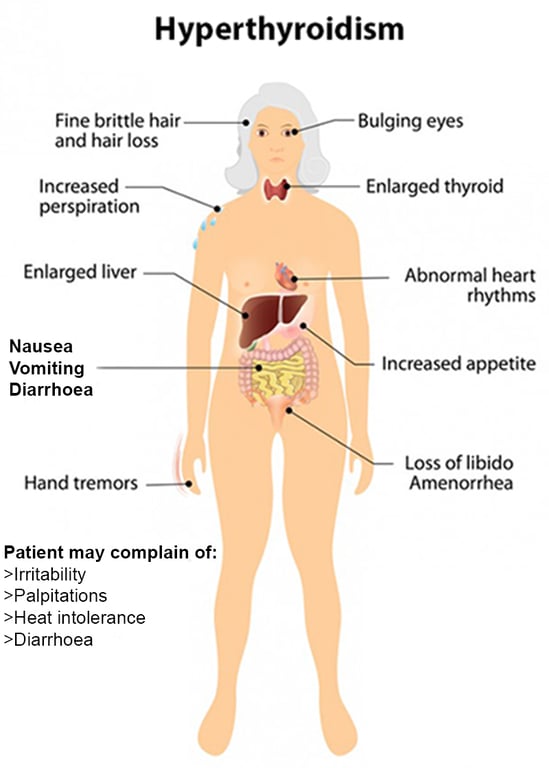 | |
Illustration of key signs and symptoms in hyperthyroidism. Click on image to enlarge