Red blood cells
On this page
Red blood cells (RBC's or erythrocytes) contain haemoglobin and their primary function is the transport of respiratory gases.
Red blood cells are biconcave discs with an approximate diameter of 6- 8µm. RBC's uniquely lack a cell nucleus, an adaptation that allows them to contain more oxygen carrying haemoglobin. Having no nucleus means RBC's cannot self repair with a typical lifespan of 100-120 days. The shape and flexibility of red blood cells allow them to deform easily and pass through capillaries.
Erythropoietin (EPO) is a glycoprotein hormone secreted mainly by the kidneys in adults. In the fetus EPO is also produced in the liver. EPO is produced in response to cellular hypoxia and stimulates proliferation and differentiation of red cell precursors.
As red cells differentiate they transform from large nucleated cells to small cells containing haemoglobin and eventually the nucleus fragments. The earliest immature red blood cells are called reticulocytes which circulate for 1-2 days before maturing into erythrocytes. They are called reticulocytes because they contain a reticulum (a reticular mesh network of ribosomal RNA) which is visible under a microscope and stains with methylene blue, cresyl blue and Romanowsky stain.
Red blood cell destruction
Red blood cells typically circulate for around 120 days before they are destroyed by macrophages in the liver and spleen.
The haem (or heme) group is converted into bilverdin then bilirubin. Iron is recycled via the transport protein transferrin or stored as ferritin. Increased red cell destruction may lead to elevated bilirubin levels and jaundice.
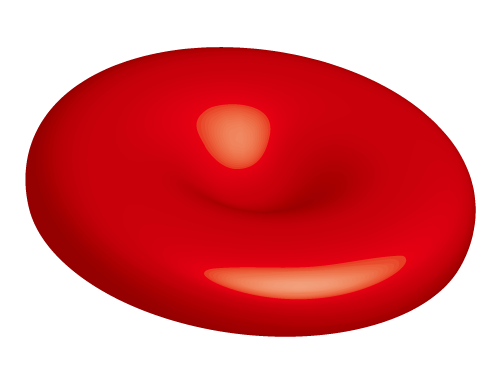 | |
Red blood cell. click on image to enlarge
Red blood cells are biconcave discs with an approximate diameter of 6- 8µm. RBC's uniquely lack a cell nucleus, an adaptation that allows them to contain more oxygen carrying haemoglobin. Having no nucleus means RBC's cannot self repair with a typical lifespan of 100-120 days. The shape and flexibility of red blood cells allow them to deform easily and pass through capillaries.
Erythropoiesis
Erythropoiesis is the process by which RBC's are formed. The bone marrow produces committed stem cells (colony forming unit-erythroid or CFU-E). In adults these stem cells are produced only in the bone marrow whilst in the fetus the spleen and liver also serve as sites of production. The spleen holds a reserve of RBC's that can be released in the event of blood loss.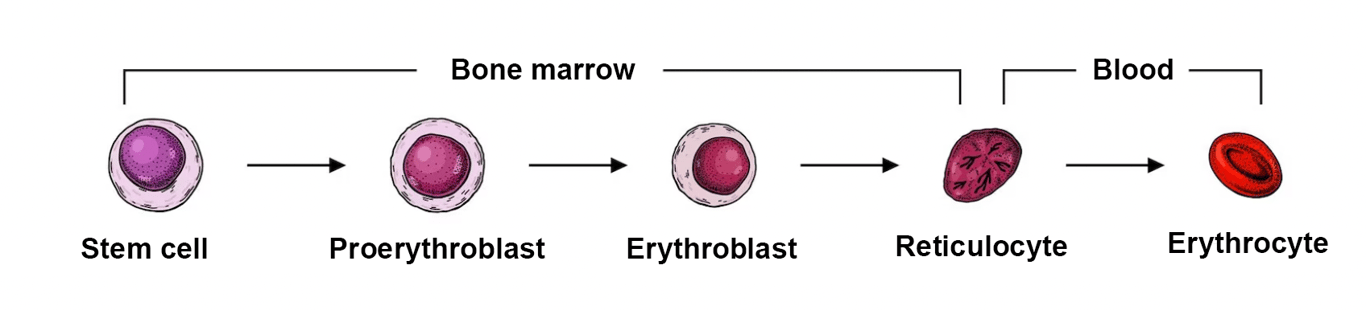 | |
Erythropoiesis. click on image to enlarge
Erythropoietin (EPO) is a glycoprotein hormone secreted mainly by the kidneys in adults. In the fetus EPO is also produced in the liver. EPO is produced in response to cellular hypoxia and stimulates proliferation and differentiation of red cell precursors.
As red cells differentiate they transform from large nucleated cells to small cells containing haemoglobin and eventually the nucleus fragments. The earliest immature red blood cells are called reticulocytes which circulate for 1-2 days before maturing into erythrocytes. They are called reticulocytes because they contain a reticulum (a reticular mesh network of ribosomal RNA) which is visible under a microscope and stains with methylene blue, cresyl blue and Romanowsky stain.
Reticulocytes normally account for 0.5-2% of circulating red blood cells. A high reticulocyte count may be seen in a number of conditions such as hypoxia and anaemia.
Haemoglobin
Haemoglobin synthesis requires iron, folate and vitamin B12. Each haemoglobin molecule contains 4 protein chains. Each protein chain contains a ring-like heme group containing an iron atom. Normal adult haemoglobin contains two alpha and two beta chains.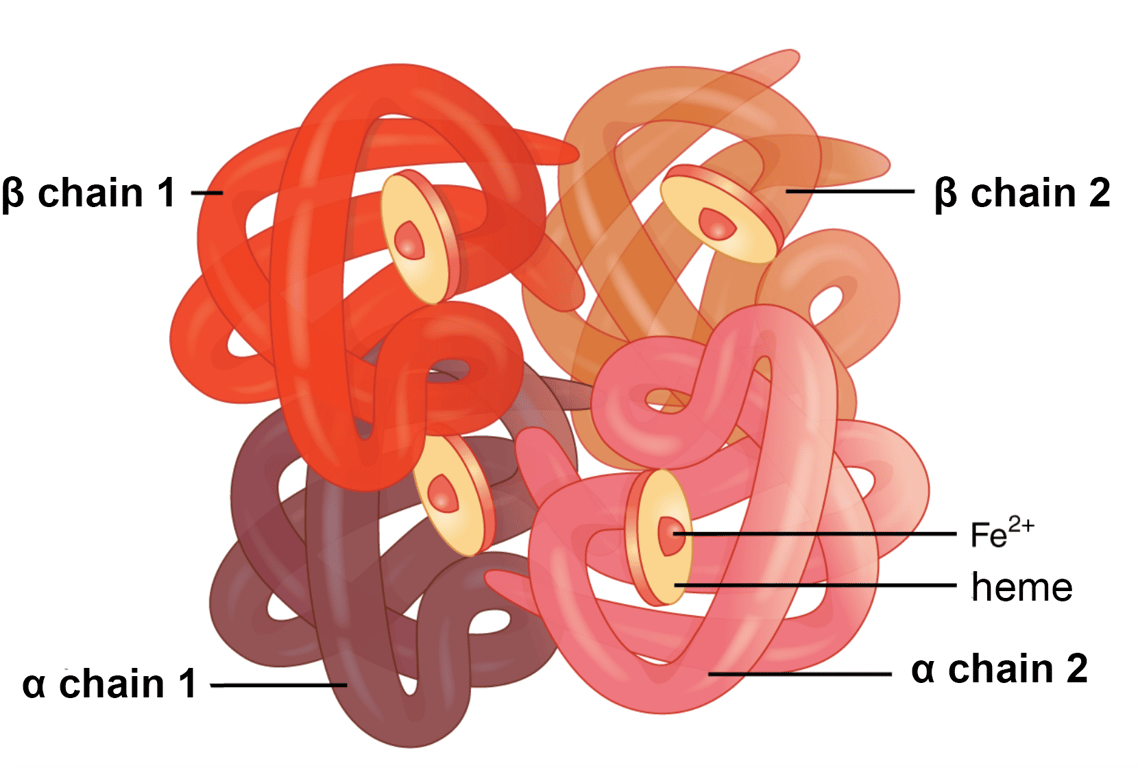 | |
Normal adult haemoglobin structure. click on image to enlarge
Red blood cell destruction
Red blood cells typically circulate for around 120 days before they are destroyed by macrophages in the liver and spleen.
The haem (or heme) group is converted into bilverdin then bilirubin. Iron is recycled via the transport protein transferrin or stored as ferritin. Increased red cell destruction may lead to elevated bilirubin levels and jaundice.