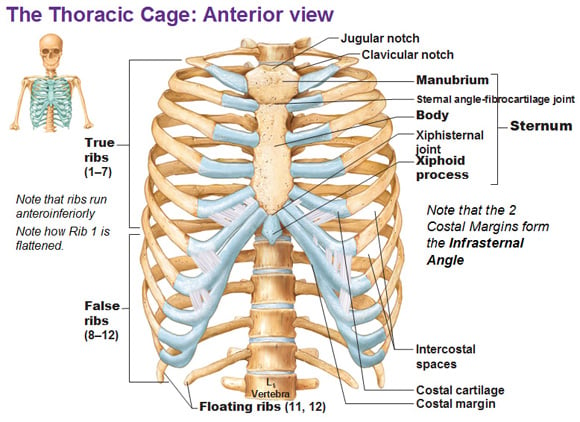
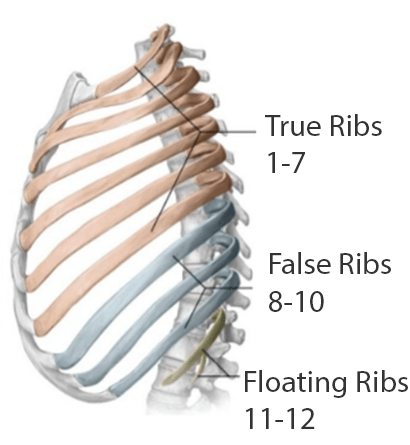
Image illustrating the structure of the ribcage The ribs can be classed as true ribs or false ribs. True ribs articulate directly with the vertebral bodies and ribs. False ribs do not articulate directly with the ribs and may be further divided into false or floating.
Typical and atypical ribs
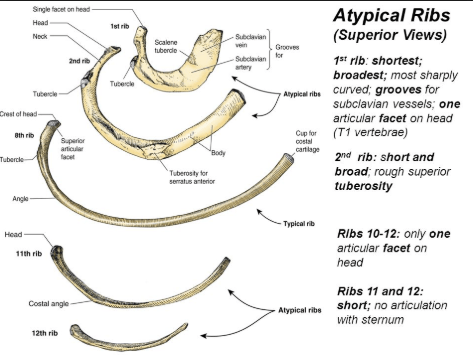
- The typical ribs are ribs 3-9
- The atypical ribs are 1, 2, 10, 11 and 12
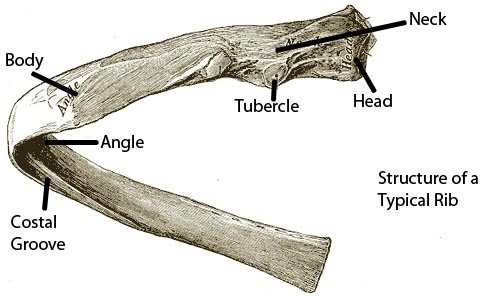
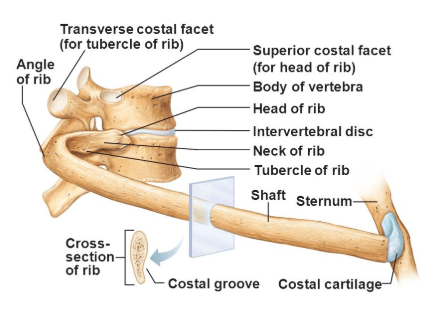
Typical ribs should have the following
- Head with 2 facets
- Neck with tubercle
- Shaft (or body) which is smooth and has a costal end that articulates with the costal cartilage. Contains a costal groove to the undersurface.
Image illustrating typical rib anatomy and typical articulationsAtypical rib summary| Rib | reason atypical |
|---|
| 1 | - short and thick
- only one facet as no thoracic vertebrae above to articulate with
- no costal groove
- it has two tubercles
- grooves for subclavian vessels
- extra tuberosity for scalene attachment
|
| 2 | - has an extra tuberosity for serratus attachment
|
| 10 | - single facet on its head for articulation with the T10 vertebra
|
| 11 | - single facet on its head for articulation with the T11 vertebra
- no anterior articulation - floating rib
- no costal groove
|
| 12 | - single facet on its head for articulation with the T12 vertebra
- no anterior articulation - floating rib
- no costal groove
|