Renal physiology: Glucose threshold
Glucose
- Glucose is reabsorbed by the proximal tubule of the kidney
- The proximal tubule has a limit as to how much glucose it can reabsorb. The maximum rate of reabsorption is termed Tm (tubular transport maximum).
- As glucose concentration approaches Tm transport mechanisms start to become saturated and glucose begins to appear in the urine. The glucose concentration at which glucose appears in the urine, i.e glycosuria, is termed the renal threshold
- The renal threshold for glucose is approximately 10-11 mmol/L (180 mg/dl)
- The Tm for glucose is approximately 21 mmol/min
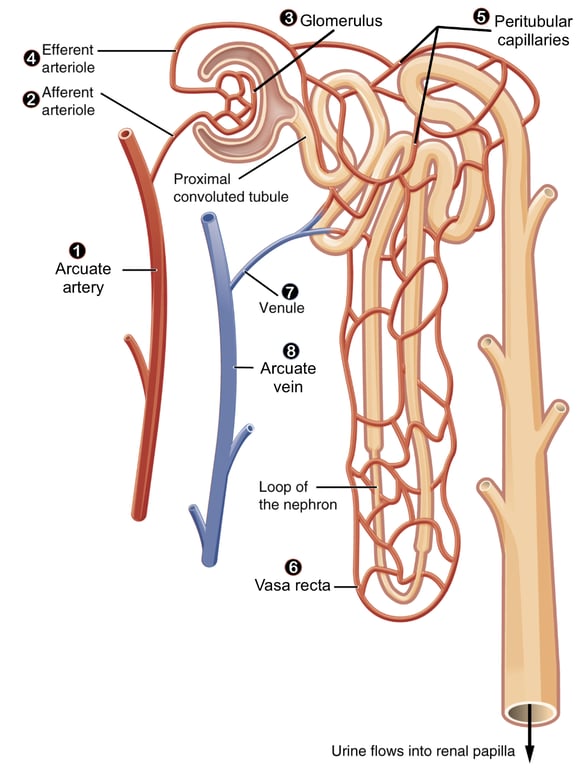 | |
Nephron structure. Click on image to enlarge
Splay and saturation
For glucose the renal threshold is usually slightly lower than Tm.
Splay refers to the difference between renal threshold, concentration at which a substance appears in the urine, and saturation or Tm. The plasma level of glucose at which splay occurs is around the renal threshold of 10-11 mmol/L. Renal splay occurs due to variation in tubular transport maxima between nephrons.
Saturation refers to the threshold at which renal reabsorption carriers are exhausted. This corresponds to a glucose load of around 375 mg/min. This glucose load is often termed glucose flux and corresponds to a plasma glucose level of around 300 mg/dl which equates to 16.7 mmol/l