Cardiovascular physiology: Brain circulation
The circulation to the brain is considered a special circulation which contains some unique features.
Maintaining perfusion of the brain is essential as disruption will lead to loss of consciousness and if perfusion is not rapidly restored may lead to hypoxic brain injury and/or death.
The key constituents of the BBB include:
This arrangement permits some substances to cross the BBB by passive diffusion and some to cross via selective and active transport. This ensures tight control of what crosses the BBB whilst allowing vital substances essential to neural function to reach the CNS.
The key benefit of the BBB is the prevention of potentially harmful substances entering the CNS which includes pathogens and immune complex molecules such as signalling molecules and antibodies. One of the key disadvantages is administration of drugs such as antibiotics which may not be able to cross the BBB.
Increasing levels of carbon dioxide (CO2) or potassium (K+) cause vasodilation and hyperaemia.
The same principle can be applied in reverse to explain fainting in hyperventilation as 'blowing off CO2' results in cerebral vasoconstriction and reduced cerebral blood flow.
Maintaining perfusion of the brain is essential as disruption will lead to loss of consciousness and if perfusion is not rapidly restored may lead to hypoxic brain injury and/or death.
The brain receives around 15% of cardiac output and has a dense capillary network
The blood brain barrier (BBB)
The blood-brain barrier (BBB) is a highly selective semi-permeable membrane composed of endothelial cells. These endothelial cells have very tight junctions and are non-fenestrated. The BBB prevents blood solutes non-selectively crossing into the extracellular fluid of the CNS.The key constituents of the BBB include:
- Endothelial cells of the capillary wall
- Glial cells (astrocyte end-feet ensheathing the capillary)
- Pericytes (embedded in the capillary basement membrane)
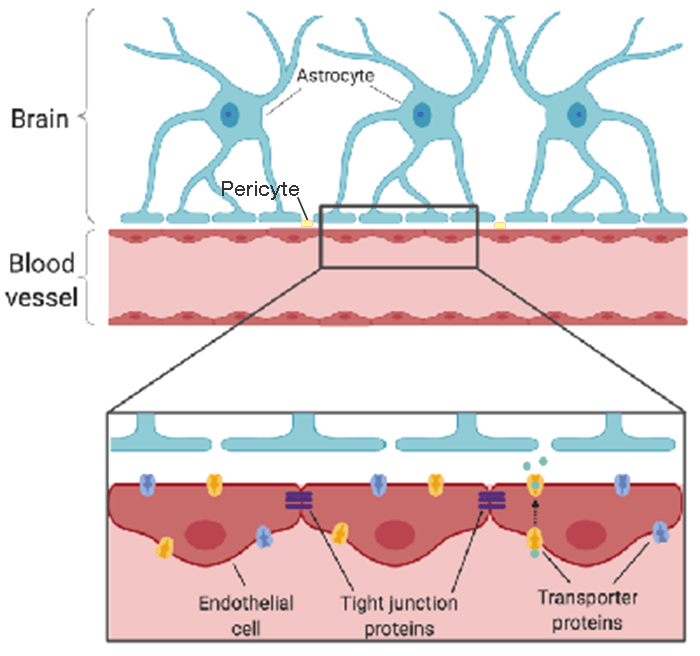 | |
This arrangement permits some substances to cross the BBB by passive diffusion and some to cross via selective and active transport. This ensures tight control of what crosses the BBB whilst allowing vital substances essential to neural function to reach the CNS.
Tight junctions between endothelial cells help prevent non-selective passage of substances from the blood into the CNS
The key benefit of the BBB is the prevention of potentially harmful substances entering the CNS which includes pathogens and immune complex molecules such as signalling molecules and antibodies. One of the key disadvantages is administration of drugs such as antibiotics which may not be able to cross the BBB.
The blood brain barrier is mostly continuous but there are some gaps in areas containing circumventricular organs where permeable endothelial cells are unlike those of the blood-brain barrier. These areas allow blood components to pass to the CNS and vice versa and are vital for performing some sensory and secretory roles e.g. pineal and pituitary glands.
Autoregulation of blood flow
The brain is well adapted to ensure consistent cerebral blood flow, maintaining a constant blood flow for blood pressures between 50 and 170mmHg.CO2 and K+ are the main metabolic regulators of cerebral blood flow
Increasing levels of carbon dioxide (CO2) or potassium (K+) cause vasodilation and hyperaemia.
The same principle can be applied in reverse to explain fainting in hyperventilation as 'blowing off CO2' results in cerebral vasoconstriction and reduced cerebral blood flow.