Cardiovascular physiology: Cutaneous circulation
The cutaneous circulation of the skin is considered a special circulation as it contains a number of unique adaptations.
The primary function of the cutaneous circulation is thermoregulation.
Certain area's of the body including the hands, feet and face contain arteriovenous anastomoses (AVA's). These AVA's directly link arterioles to venules via throughfare channels. When throughfare channels are open blood can flow directly from arteriole to venule bypassing the capillary bed. This allows high rates of flow into the venule and venous plexus which increases heat loss.
In response to low temperature the hypothalamus will co-ordinate the autonomic nervous system to trigger peripheral vasoconstriction reducing blood flow through AVA's. In simple terms* it could be said this vasoconstrictor response is via sympathetic stimulation of adrenergic nerves and that sympathetic stimulation also causes piloerection which traps air between skin hairs and provides insulation to prevent heat loss.
*Skin sympathetic nerve activity (SSNA) is a complex physiological subject that is often studied using microneurography and involves multiple overlapping vasodilator and constrictor pathways but this is well beyond the scope of the primary syllabus
The bodies response to high temperatures is to increase heat dissipation through vasodilation and increase evaporative heat loss through sweating. Inhibition of sympathetic adrenergic stimulation allows smooth muscles in the cutaneous circulation to vasodilate.
When core temperature increases the hypothalamus sends sudomotor impulses to the sweat glands via sympathetic cholinergic ï¬bres which increases sweating and promotes heat loss. Impulses via these cholinergic fibres also release bradykinin which assists vasodilation.
The primary function of the cutaneous circulation is thermoregulation.
Certain area's of the body including the hands, feet and face contain arteriovenous anastomoses (AVA's). These AVA's directly link arterioles to venules via throughfare channels. When throughfare channels are open blood can flow directly from arteriole to venule bypassing the capillary bed. This allows high rates of flow into the venule and venous plexus which increases heat loss.
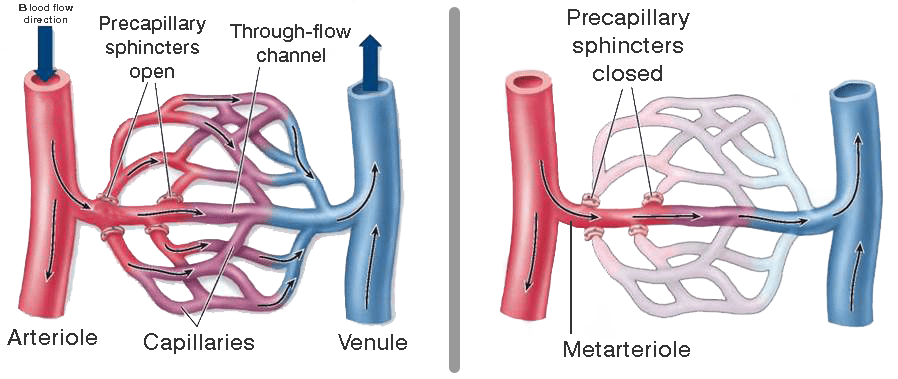 | |
throughfare channels allow direct flow from arteriole to venule bypassing capillary circulation. click on image to enlarge
Control of thermoregulation
Temperature regulation is monitored and co-ordinated by the hypothalamus.In response to low temperature the hypothalamus will co-ordinate the autonomic nervous system to trigger peripheral vasoconstriction reducing blood flow through AVA's. In simple terms* it could be said this vasoconstrictor response is via sympathetic stimulation of adrenergic nerves and that sympathetic stimulation also causes piloerection which traps air between skin hairs and provides insulation to prevent heat loss.
*Skin sympathetic nerve activity (SSNA) is a complex physiological subject that is often studied using microneurography and involves multiple overlapping vasodilator and constrictor pathways but this is well beyond the scope of the primary syllabus
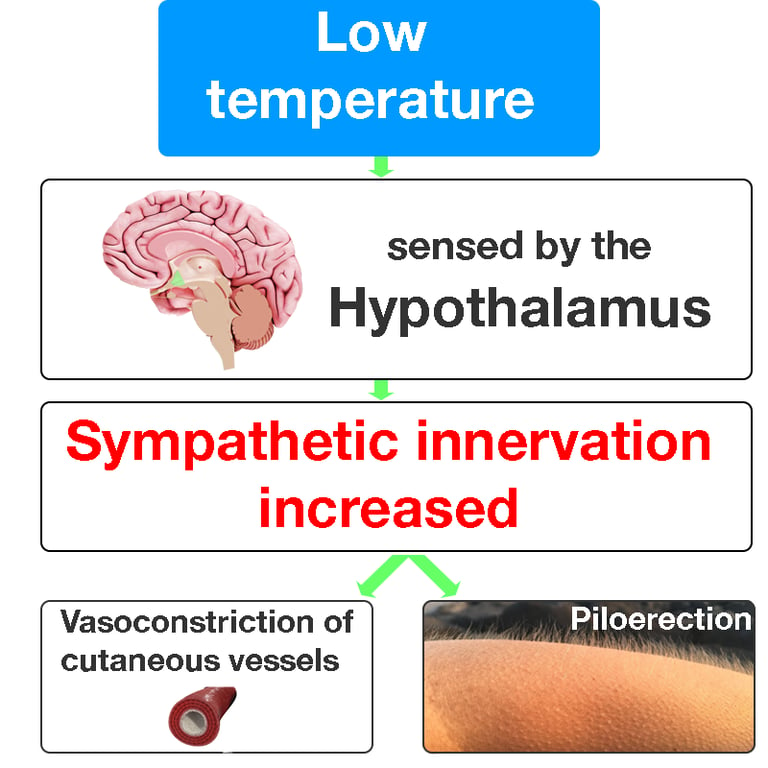 | |
Simple overview of sympathetic stimulation in response to low core body temperature. Click on image to enlarge
The bodies response to high temperatures is to increase heat dissipation through vasodilation and increase evaporative heat loss through sweating. Inhibition of sympathetic adrenergic stimulation allows smooth muscles in the cutaneous circulation to vasodilate.
When core temperature increases the hypothalamus sends sudomotor impulses to the sweat glands via sympathetic cholinergic ï¬bres which increases sweating and promotes heat loss. Impulses via these cholinergic fibres also release bradykinin which assists vasodilation.