Respiratory physiology: Lung compliance
On this page
Lung compliance
Lung compliance is a measure of the lung's ability to stretch and expand (distensibility of elastic tissue). It is the inverse of elasticity.Lung compliance is comprised of static and dynamic factors. Static lung compliance is the change in volume for any given applied pressure. Dynamic lung compliance is the compliance of the lung at any given time during movement of air.
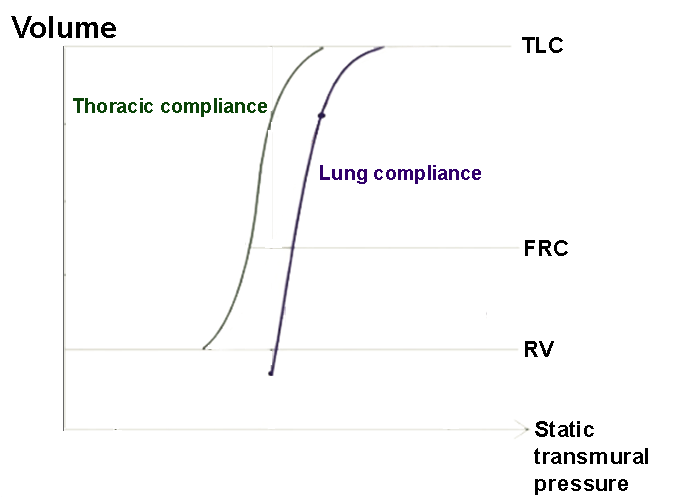 | |
Static pressure-volume loop. The gradient of the curve represents the compliance. Note maximal compliance occurs around the functional residual capacity (FRC)
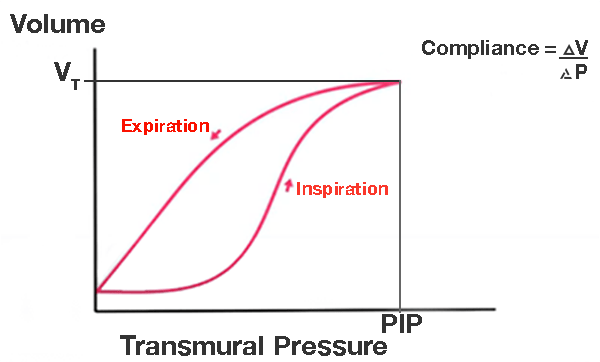 | |
Dynamic pressure-volume loop. The gradient of the curve represents the compliance. This shows that compliance is low near full inspiration and high near full expiration. It also shows compliance is different for the same lung volumes during inspiration and expiration, a phenomenon known as hystersis which is due to alterations in surface tension of the alveoli due to surfactant.
Note: these loops are not the same as flow volume loops used in spirometry
Note: these loops are not the same as flow volume loops used in spirometry
Lung compliance = –³V / –³P
V = lung volume
P = transpulmonary (transmural) pressure
Transpulmonary Pressure = Alveolar Pressure (Palv) - Pleural (intrapleural) Pressure (Ppl)
V = lung volume
P = transpulmonary (transmural) pressure
Transpulmonary Pressure = Alveolar Pressure (Palv) - Pleural (intrapleural) Pressure (Ppl)
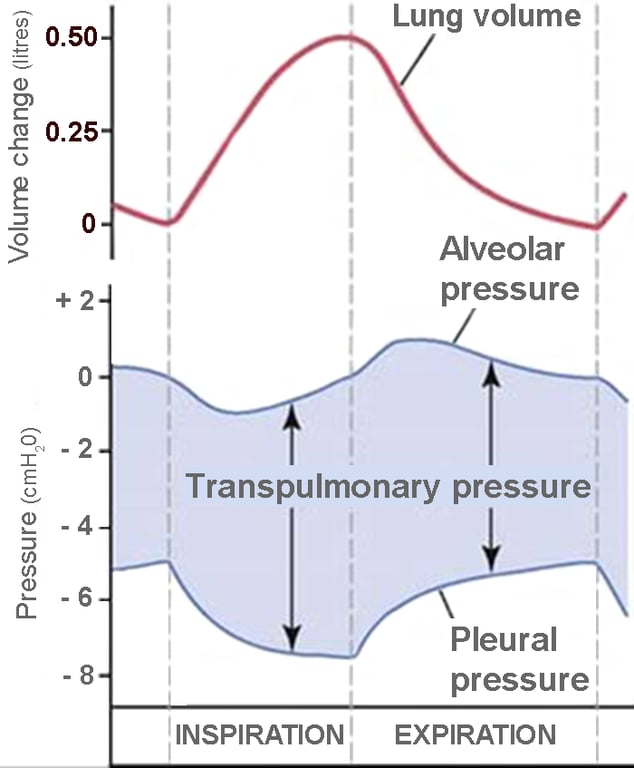 | |
Relationship between lung volume, alveolar pressure, pleural pressure and transpulmonary pressure during inspiration and expiration.
Static compliance (Cstat)
Static compliance represents pulmonary compliance during periods without air flow, such as during an inspiratory pause. There is no pressure component related to air flow and air resistance.Static compliance will vary with:
- Age
- Height
- Gender
- Lung conditions such as fibrosis
Oesophageal pressure (Pes) is used as a surrogate for Ppl and can be measured using balloon manometry. If no air is flowing then alveolar pressure is the same a mouth pressure i.e. zero. In this scenario transpulmonary pressure equals oesophageal pressure/pleural pressure.
Dynamic compliance (Cdyn)
Dynamic compliance represents pulmonary compliance during periods of air flow, such as during active inspiration. Air flow encounters air resistance which is accounted for with dynamic compliance measurement.Static v dynamic compliance
In ventilated patients static and dynamic compliance of the respiratory system may be represented by the equations below: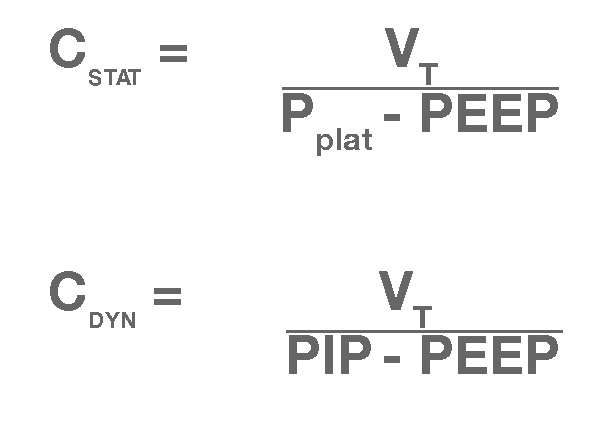 | |
VT = tidal volume;
Pplat = plateau pressure;
PEEP = positive end-expiratory pressure.
PIP = Peak inspiratory pressure (the maximum pressure during inspiration
Pplat = Plateau pressure. It is measured at the end of inhalation and prior to exhalation by using an inspiratory hold manoeuvre. During this manoeuvre, airflow is transiently (~0.5 sec) discontinued, which eliminates the effects of airway resistance. Pplat is never bigger than PIP and is typically <10 cm H2O lower than PIP when airway resistance is not elevated.
Note that dynamic compliance is always lower than or equal to static lung compliance because PIP is always greater than P plat.
Variations in compliance
As can be seen from the pressure volume loops compliance changes during inspiration and expiration depending on the lung volume. As the lungs near full capacity towards the end of inspiration compliance decreases preventing over distension whilst towards the end of expiration compliance is high to accommodate filling and prevent alveolar collapse.Factors increasing compliance
- Emphysema
- Administration of lung surfactant
- Advanced age
Factors decreasing compliance
Decreased static lung compliance:
- Loss of surfactant (eg. ARDS)
- Decreased lung elasticity
- Pulmonary fibrosis
- Pulmonary oedema
- Decreased functional lung volume
- Pneumonectomy or lobectomy
- Pneumonia
- Atelectasis
- Small stature
- Alveolar derecruitment
- Alveolar overdistension
- Increased airway resistance (eg. asthma)
- Increased air flow (increased respiratory rate)
Dynamic compression of the airways
Dynamic compression of the airways occurs when intrapleural pressure equals or exceeds airway pressure.
Intrapleural pressure ≥ airway pressure = dynamic compression of airways
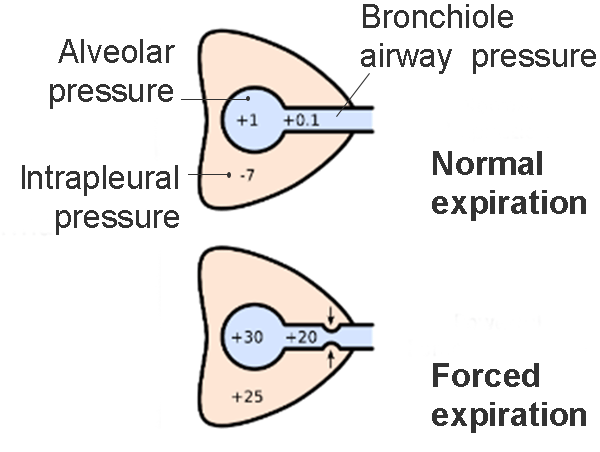 | |
Another way of saying this is that the airway collapse will occur when transpulmonary pressure becomes negative (as transpulmonary pressure = airway (alveolar or bronchiole) pressure ˆ’ intrapleural pressure).
Transpulmonary pressure is dependent on several factors including:
- Lung volumes
- Lung Compliance
- Airway resistance
- Lung pathologies
Dynamic compression of the airways occurs during forced expiration when intrapleural pressure is greater than atmospheric pressure but does not occur during passive expiration as intrapleural pressure remains at subatmospheric pressures.