Cervical sympathetic trunk
Cervical sympathetic trunk / Sympathetic chain / Paravertebral ganglia
The sympathetic trunk (or chain) are paired sympathetic nerve fibre bundles and ganglia that lie just lateral to the vertebral bodies for the entire length of the vertebral column.
In the cervical part of the chain (cervical sympathetic trunk) there are three ganglia connected by sympathetic nerve fibres. These ganglia are the superior, middle and inferior sympathetic ganglia.
Remember that the sympathetic nervous system is also termed the thoracolumbar outflow as sympathetic fibres exit the spinal cord in the thoracic and lumbar regions (T1 -L2/3). The sympathetic chain allows sympathetic fibres to ascend above T1 and below L2/3.
Overview
Sympathetic fibres that supply the head and neck originate from the spinal cord in the thoracic region (T1-6). These preganglionic fibres exit the spinal cord and enter the sympathetic chain. They ascend within the sympathetic chain until they reach their appropriate ganglion.
Each ganglion is a collection of neural cell bodies. In the ganglia the preganglionic sympathetic fibres synapse with these cell bodies which then give off post ganglionic branches which continue into the head and neck (and parts of the thorax).
Each of the three ganglia give off branches which 'hitch hike' to their destination alongside associated arteries. It should be noted that each ganglion gives off fibres to the spinal nerves via branches called grey-ramus communicans (pleural grey-rami communicantes).
The associated arteries of the ganglia are:
The sympathetic trunk (or chain) are paired sympathetic nerve fibre bundles and ganglia that lie just lateral to the vertebral bodies for the entire length of the vertebral column.
In the cervical part of the chain (cervical sympathetic trunk) there are three ganglia connected by sympathetic nerve fibres. These ganglia are the superior, middle and inferior sympathetic ganglia.
Remember that the sympathetic nervous system is also termed the thoracolumbar outflow as sympathetic fibres exit the spinal cord in the thoracic and lumbar regions (T1 -L2/3). The sympathetic chain allows sympathetic fibres to ascend above T1 and below L2/3.
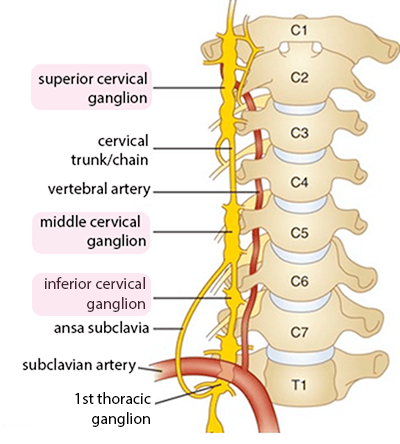 | |
Illustration of the cervical trunk and the three ganglia
Overview
Sympathetic fibres that supply the head and neck originate from the spinal cord in the thoracic region (T1-6). These preganglionic fibres exit the spinal cord and enter the sympathetic chain. They ascend within the sympathetic chain until they reach their appropriate ganglion.
Each ganglion is a collection of neural cell bodies. In the ganglia the preganglionic sympathetic fibres synapse with these cell bodies which then give off post ganglionic branches which continue into the head and neck (and parts of the thorax).
Each of the three ganglia give off branches which 'hitch hike' to their destination alongside associated arteries. It should be noted that each ganglion gives off fibres to the spinal nerves via branches called grey-ramus communicans (pleural grey-rami communicantes).
The associated arteries of the ganglia are:
- Superior ganglion: common, internal and external carotid arteries
- Middle ganglion: inferior thyroid artery
- Inferior ganglion: Vertebral and subclavian arteries
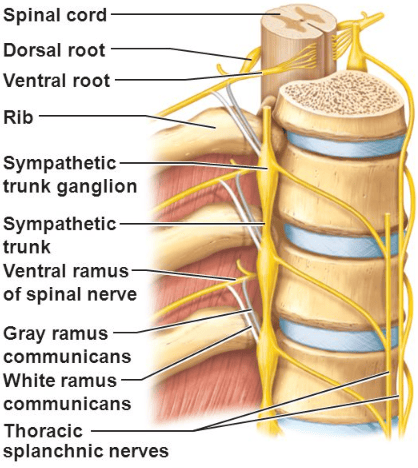 | |
Example of rami communicantes in sympathetic trunk. Note this is the thoracic sympathetic trunk pictured but the principal of the grey rami is the same as in the cervical sympathetic trunk. Note white rami are not present in the cervical spine
| Ganglia | Vertebral level | Branches | Spinal nerves supplied via grey rami |
|---|---|---|---|
| Superior | C1-C4 |
| C1-C4 |
| Middle | C6 |
| C5-C6 |
| Inferior | C7 |
| C7-T1 |