Conjunctiva
On this page
The conjunctiva
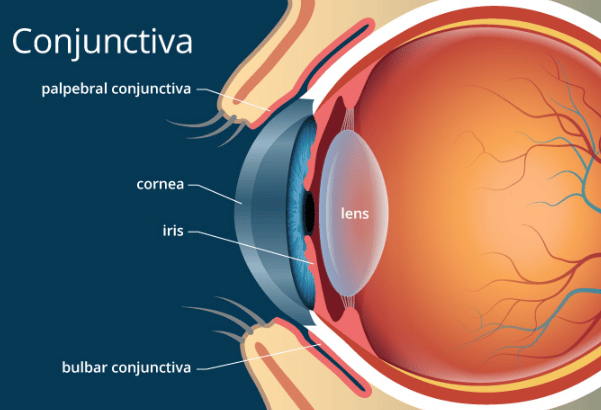
The conjunctiva lines the eyelids (palpebral conjunctiva) and the sclera (bulbar conjunctiva) of the eye.
The bulbar conjunctiva is the portion overlying the sclera. It is tightly adhered by Tenon's capsule and moves with the eyeball. Its borders are the limbus (the junction of iris and sclera) and the fornix conjunctiva at the eyelid.
Where the bulbar and palpebral conjunctiva meet is termed the fornix conjunctiva. Here the conjunctiva is loose to allow free movement.
 | |
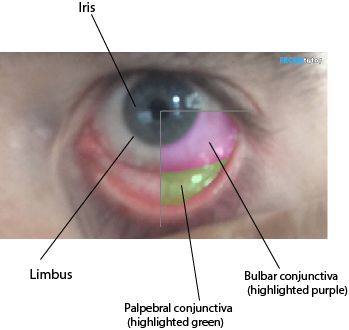 | |
The conjunctiva shown top in lateral view illustration and lower image anterior view photograph. Note where bulbar and palpebral conjunctiva meet (purple meets green in lower image) is the fornix conjunctiva
Function
- Eye lubrication by producing mucus and tears via goblet cells and accessory lacrimal glands.
- Immune function via physical barrier, tear production to wash away microbes and presence of T and B cell lymphocytes
Composition
- Primarily fibrous tissue and stratified squamous epithelium
Innervation
Sensory innervation of the conjunctiva is divided into four areas as summarised below:
| Part of conjunctiva | Innervation |
|---|---|
| Superior | Supraorbital nerve Supratrochlear nerve Infratrochlear nerve |
| Inferior | Infraorbital nerve |
| Lateral | Lacrimal nerve Zygomaticofacial nerve |
| Circumcorneal | Long ciliary nerves |