Upper limb injuries: Lunate and perilunate dislocation
Mechanism of injury
- High energy injury
- Forceful loading of dorsiflexed/extended wrist.
- Uncommon injury
- Potential poor outcomes
Lunate and perilunate dislocation
- In lunate dislocation the lunate displaces volarly into carpal tunnel
- In perilunate dislocation the lunate remains in position whilst the rest of the carpus dislocates around it (worse outcomes typically than lunate dislocation)
Lunate dislocation associated injuries
- Acute carpal tunnel syndrome (median nerve)
- Note that for the lunate to dislocate requires disruption to all of the perilunate ligaments/articulations i.e. scapholunate ligament, capitolunate articulation, lunotriquetral articulation and dorsal radiocarpal ligament
- Perilunate dislocation is the most severe form (grade IV) of perilunate instability
Management
- Surgical ORIF
- Very poor outcomes with non surgical management
Anatomy
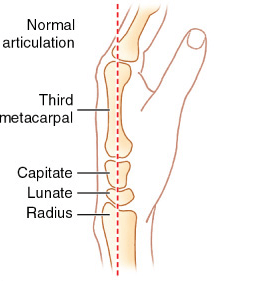 | |
Illustration of normal bony alignment at the wrist and carpus
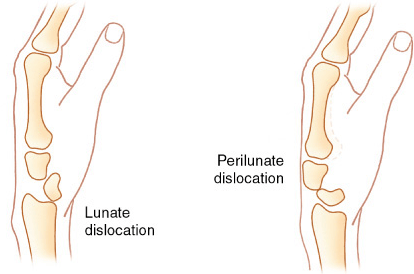 | |
Illustration of bony alignment at the wrist and carpus in lunate and perilunate dislocation
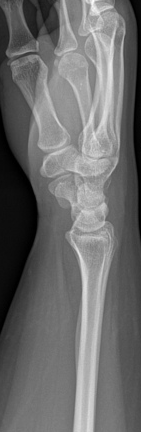 | |
Lateral XRAY showing normal bony alignment at the wrist and carpus
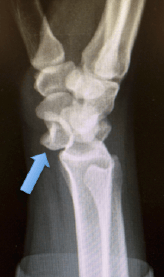 | |
Lateral XRAY showing lunate dislocation volarly
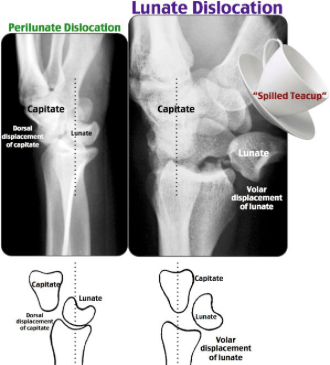 | |
The 'spilled teacup' sign seen on XRAY with lunate dislocation
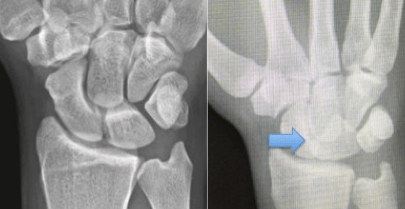 | |
Normal XRAY on the left side. On the right you can see the 'piece of pie' sign seen in lunate dislocation where the lunate and capitate overlap