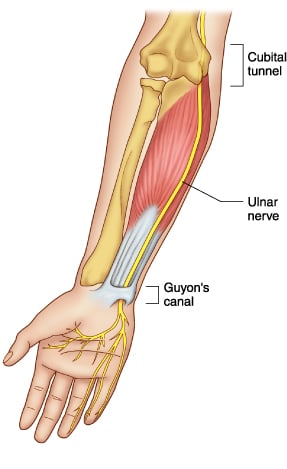
The ulnar nerve can be injured anywhere along its course. Most commonly it is injured at the elbow. There are a number of special tests that can be used to test for ulnar nerve lesions and these are outlined below.
View of ulnar nerve
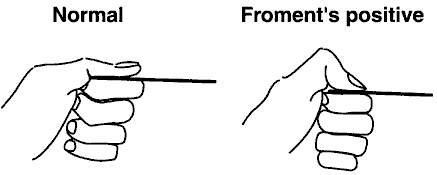
Froment's sign- Tests adductor pollicis which is supplied by the ulnar nerve
- Patient asked to grip paper between thumb and index finger
- Positive test i.e. demonstrating weakness of adductor pollicis is one where the patient flexes the IP joint of the thumb to compensate for lack of grip strength.
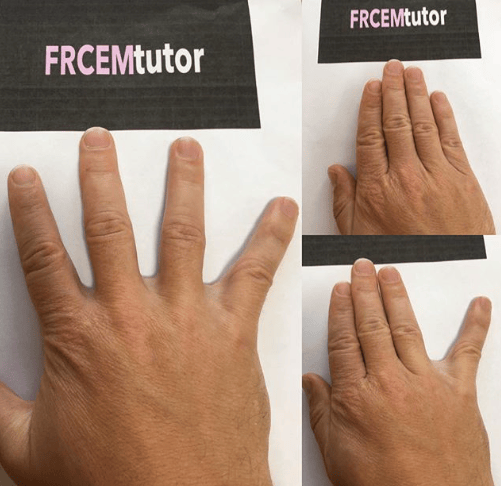
Wartenberg's sign- Tests ulnar nerve motor weakness
- Patient asked to place hand on table. Clinician passively abducts the fingers. Patient then asked to adduct the fingers back to the starting position
- Positive test if little finger remains abducted away from hand.
- This is due unopposed action of extensor digiti minimi (innervated by radial nerve)
Wartenberg's sign. Left side: patients fingers abducted into start position. Top right: normal response Bottom right: little finger remains abducted consistent with ulnar nerve injury
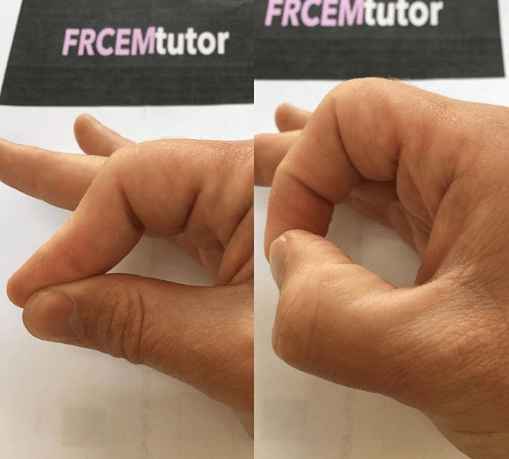
Jeanne's sign
- Similar to Froment's sign
- Patient asked to hold key/object between thumb and index
- Positive finding if patients first MCP joint is hyperextended with IP flexed
Jeanne's sign. Left side: Normal grip note no flexion of thumb IPJ or hyperextension at MCP. Right right: flexion of IPJ and hyperextension of thumb MCP constant with ulnar nerve injury