Tongue
Anatomy Overview
- The tongue is primarily muscle covered by a mucous membrane occupying the oral cavity and oropharynx.
- Its functions include taste, mastication, swallowing, speech and oral cleansing.
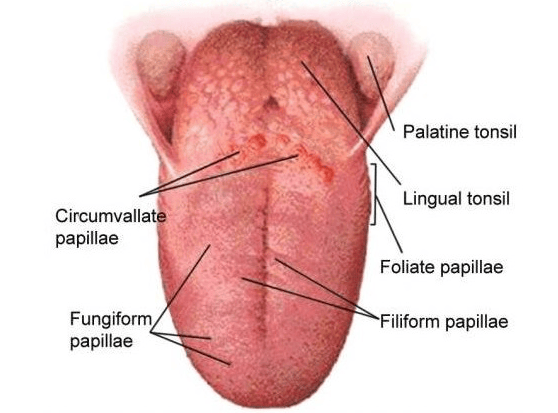
- Four types of lingual papillae cover the tongue: vallate, foliate, filiform, and fungiform (as shown in the image below)
- Divided into 2 parts (posterior 1/3 and anterior 2/3's) by the sulcus terminalis (or terminal sulcus). This is a muscular groove just behind the circumvallate papillae
 | |
Innervation
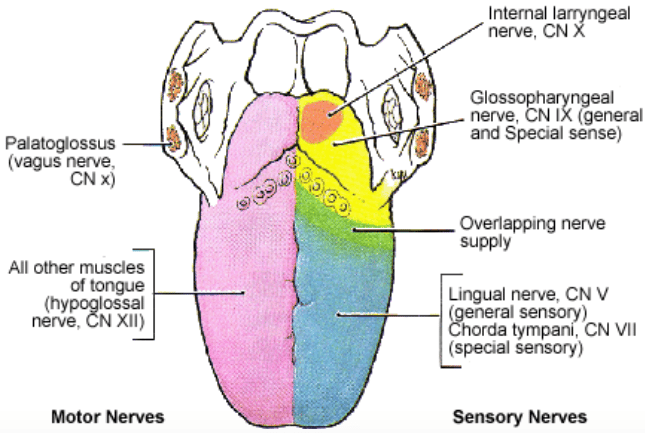
- Sensory innervation of the tongue is derived primarily from lingual & glossopharyngeal nerves
- The lingual nerve supplies sensory innervation to the anterior 2/3 of the tongue whilst the chorda tympani supply taste sensation to the anterior 2/3 of the tongue
- The glossopharyngeal nerve supplies general sensory and taste sensation to the posterior 1/3 of the tongue
- Motor supply is to all of the muscles of the tongue is via the hypoglossal nerve (except palatoglossus)
Image illustrating sensory and motor supply of the tongue
 | |
Lymph Drainage
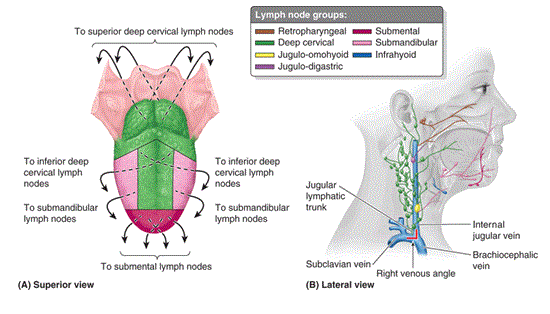
- The tongue has an unusual pattern of drainage. Note the crossover drainage pattern to the cervical nodes. It is also important to note that there is one deep cervical lymph node group called the jugulo-omohyoid lymph node that is strongly associated with lymph drainage of the tongue.
| Area of tongue | Drains to |
|---|---|
| Tip of tongue | Submental lymph nodes |
| Anterior 2/3 tongue laterally | Ipsilateral submandibular nodes |
| Anterior 2/3 tongue centrally | Bilaterally to inferior deep cervical lymph nodes |
| Posterior 1/3 | Superior deep cervical lymph nodes |
Image illustrating lymph drainage of the tongue
 | |