Nitrous oxide
On this page
Nitrous oxide is used for maintenance of anaesthesia and, in sub-anaesthetic concentrations, for analgesia. For anaesthesia, nitrous oxide is commonly used in a concentration of 50 to 66% in oxygen as part of a balanced technique in association with other inhalational or intravenous agents. Nitrous oxide is unsatisfactory as a sole anaesthetic owing to lack of potency, but is useful as part of a combination of drugs since it allows a significant reduction in dosage
For analgesia (without loss of consciousness), a mixture of nitrous oxide and oxygen containing 50% of each gas (Entonox®, Equanox®) is used. Self-administration using a demand valve is popular in obstetric practice, for changing painful dressings, as an aid to postoperative physiotherapy, and in emergency ambulances.
Nitrous oxide may have a deleterious effect if used in patients with an air-containing closed space since nitrous oxide diffuses into such a space with a resulting increase in pressure. This effect may be dangerous in conditions such as pneumothorax, which may enlarge to compromise respiration, or in the presence of intracranial air after head injury, entrapped air following recent underwater dive, or recent intra-ocular gas injection.
Diffusion hypoxia
Diffusion hypoxia is essentially the second gas effect in reverse. When nitrous oxide administration is discontinued nitrous oxide exits the blood and diffuses into the alveolus with nitrogen diffusing in the opposite direction. Nitrous oxide enters the alveoli far more rapidly than nitrogen leaves, causing dilution of the gaseous contents of the alveolus. This results in the dilution of oxygen within the alveoli of patients breathing air and may cause 'diffusion hypoxia'. The dilution of the alveolar contents by the egress of nitrous oxide form the blood may also dilute the concentration of volatile agents, enhancing their elimination, and speeding wakening
Side effects
For analgesia (without loss of consciousness), a mixture of nitrous oxide and oxygen containing 50% of each gas (Entonox®, Equanox®) is used. Self-administration using a demand valve is popular in obstetric practice, for changing painful dressings, as an aid to postoperative physiotherapy, and in emergency ambulances.
Nitrous oxide may have a deleterious effect if used in patients with an air-containing closed space since nitrous oxide diffuses into such a space with a resulting increase in pressure. This effect may be dangerous in conditions such as pneumothorax, which may enlarge to compromise respiration, or in the presence of intracranial air after head injury, entrapped air following recent underwater dive, or recent intra-ocular gas injection.
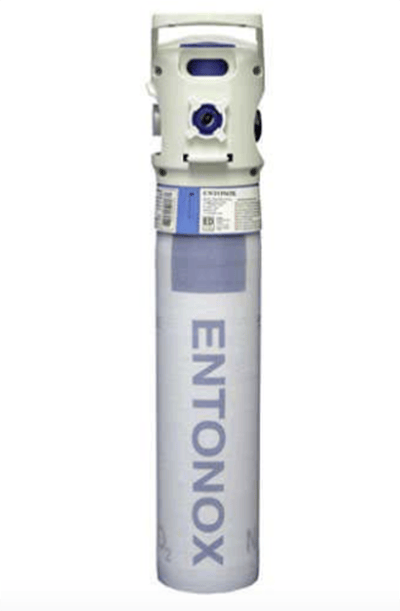 | |
Entonox bottle: note Entonox bottles should have blue and white colour coded collars as shown here. The bottles themselves are typically blue or white
Entonox alone cannot be used as a sole maintenance agent in anaesthesia
Second-gas effect
Nitrous oxide can speed the absorption of other inhaled anaesthetic agents via the 2nd gas effect. Nitrous oxide enters the alveoli then diffuses across the alveolar membrane into the blood. Nitrous oxide is 20 to 30 times more soluble than nitrogen which it displaces from the blood. The displaced Nitrogen diffuses in the opposite direction. Due to nitrous oxide diffusing much more rapidly across the alveolar basement membrane than nitrogen as it moves out of the alveoli there is a reduction in alveolar volume causing the remaining alveolar gases to become more concentrated. This increases the fractional content of inhaled anaesthetic gases and accelerates the uptake of volatile agents into the blood as bronchial and tracheal gas is drawn into the alveolus to make good the diminished alveolar volume.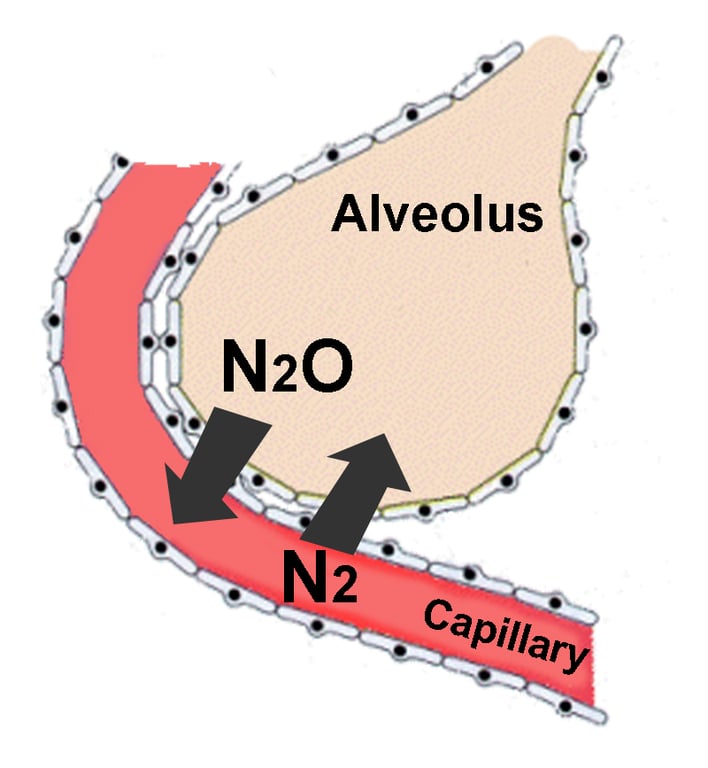 | |
Diffusion of nitrous oxide (N2O) and nitrogen (N2) gases across alveolar membrane during entonox administration
Diffusion hypoxia
Diffusion hypoxia is essentially the second gas effect in reverse. When nitrous oxide administration is discontinued nitrous oxide exits the blood and diffuses into the alveolus with nitrogen diffusing in the opposite direction. Nitrous oxide enters the alveoli far more rapidly than nitrogen leaves, causing dilution of the gaseous contents of the alveolus. This results in the dilution of oxygen within the alveoli of patients breathing air and may cause 'diffusion hypoxia'. The dilution of the alveolar contents by the egress of nitrous oxide form the blood may also dilute the concentration of volatile agents, enhancing their elimination, and speeding wakening
Contraindications
Nitrous oxide diffuses in to air filled spaces and expands therefore should be avoided in conditions where there is air-contained in a closed space such as:- Head injury resulting in presence of intracranial air
- Pneumothorax
- Recent intra-ocular gas injection
- Entrapped air following recent underwater dive
Side effects
- Megaloblastic anaemia (May occur with prolonged administration owing to interference with the action of vitamin B12. Neurological toxic effects can occur without preceding overt haematological changes)
- Agranulocytosis
- Peripheral neuropathy and subacute combined cord degeneration (with prolonged use)
- Abdominal distension
- Addiction
- Disorientation
- Dizziness
- Euphoric mood
- Middle ear damage
- Myeloneuropathy
- Nausea and vomiting
- Paraesthesia
- Sedation
- Tympanic membrane perforation