Neisseria meningitidis
On this page
Background
Neisseria meningitidis, also known as meningococcus, is a gram-negative bacteria of the diplococcus type. Neisseria meningitidis has the potential to cause serious infection with the two most common presentations being meningitis and septicaemia. Neisseria meningitidis colonises the nasopharynx of around 10% of the population as an asymptomatic commensal with carriage rates highest amongst adolescents and young adults. There are currently 12 identified capsular groups - A, B, C, E, H, I, K, L, W, X, Y, and Z.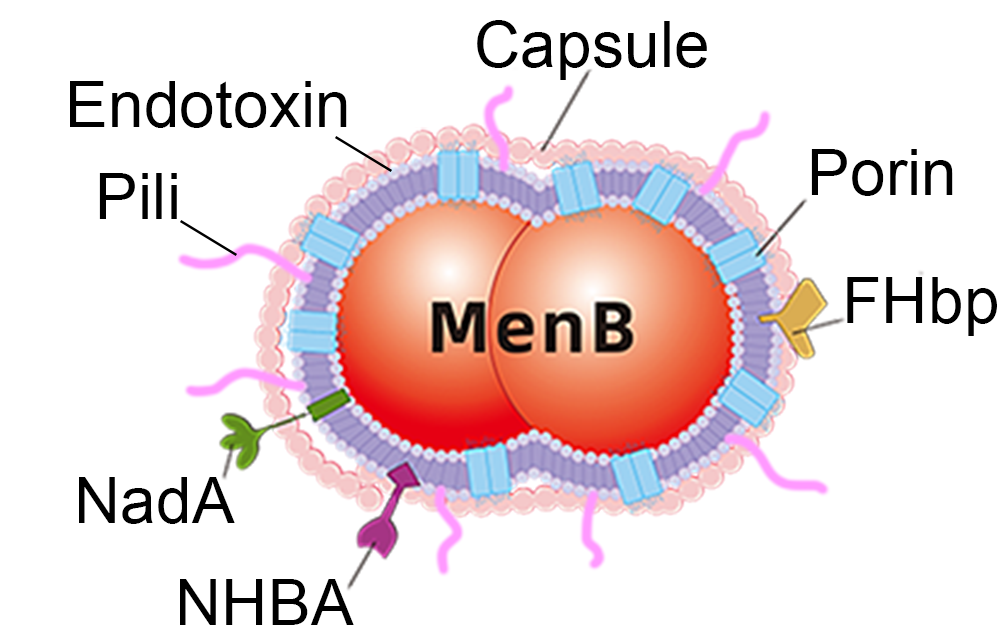 | |
Image showing illustration of Neisseria meningitidis strain B. Highlighting polysaccharide capsule, endotoxin and surface proteins. Click on image to enlarge
Peaks of infection
- Infants and young children (<5 years)
- Adolescents and young adults (16–25 years)
- Seasonal peaks in winter and early spring
Common serogroups causing disease:
- Globally: A, B, C, W, X, and Y
- In the UK B, C, W and Y are the most common causes of invasive disease
Transmission
Transmission is via inhalation of respiratory droplets, respiratory aerosol particles or direct contact with respiratory secretions e.g. kissing. The incubation period is usually 3–5 days
Pathogenesis
A number of factors contribute to the virulence of Neisseria meningitidis:- Capsule: Polysaccharide capsule protects against phagocytosis and is a key virulence factor.
- Lipooligosaccharide: component of outer membrane and acts as endotoxin
- Adhesion: Type IV pili and surface proteins (e.g. NadA, Opa and Opc) aid adhesion to cells.
- Enzyme production: various enzyme proteins are produced to aid survival. IgA protease cleaves host IgA class antibodies, catalase and superoxide dismutase help avoid host oxidative killing and Factor H binding protein binds complement proteins involved in complement-mediated death.
- Immune response: porins and other molecules trigger an excessive inflammatory response via production of cytokines (e.g., TNF-α, IL-6) that contributes to vascular damage and septic shock.
Risk factors
- Age (infants, adolescents and over 65)
- Season
- Smoking
- Preceding infection e.g. otitis media, sinusitis, pneumonia, mastoiditis
- Living in closed or semi-closed communities eg. university halls or military barracks
- Complement deficiency especially C5-C9 deficiency
- Splenectomy or hyposplenia
- Immunocompromised state e.g. HIV infection, active cancer or chemotherapy
- Organ dysfunction e.g renal failure
- Personal or family history of meningococcal disease
- Cranial anatomical defects (congenital or acquired)
- Cochlear implants
- Cerebrospinal leak
- Sickle cell disease
Clinical Features
Meningitis (most common):
- Fever
- Headache
- Neck stiffness
- Photophobia
- Altered mental status
- Seizures
- Non-blanching petechial or purpuric rash (typically rapidly evolving)
- Hypotension
- Multi-organ failure
- Disseminated intravascular coagulation (DIC)
- Pneumonia, arthritis, pericarditis
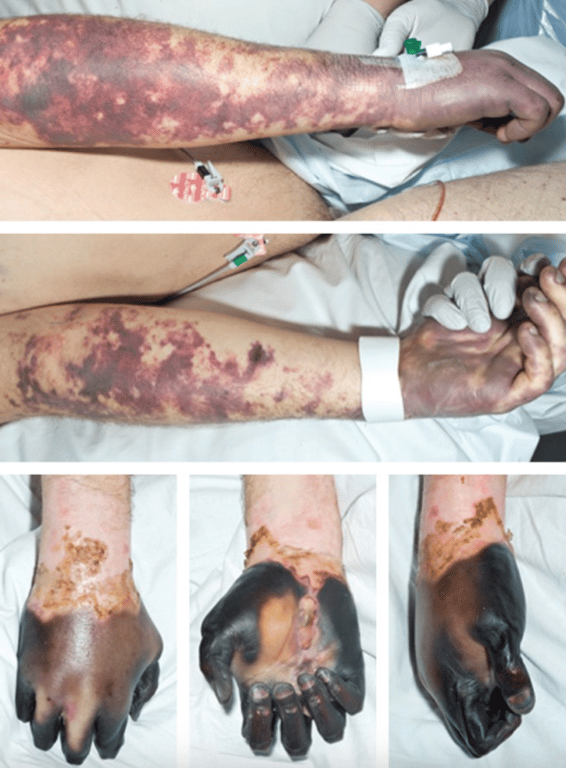 | |
Purpura fulminans. The purpuric rash is a result of disseminated intravascular coagulation (DIC) with haemorrhage and necrosis. Click on image to enlarge
Diagnosis
- Blood cultures
- Lumbar puncture & CSF analysis
- PCR testing may be performed on CSF or blood samples for rapid analysis
CSF results for patients with meningococcal meningitis typically show:
- Elevated WBCs (neutrophilic predominance)
- Low glucose
- high protein
- Gram-negative diplococci on Gram stain
Table: CSF values in normal individuals and those with meningitis of varying aetiology
| Parameter | Normal CSF | Bacterial Meningitis | Viral Meningitis | TB Meningitis | Fungal Meningitis |
|---|---|---|---|---|---|
| Appearance | Clear | Cloudy/purulent | Clear or slightly cloudy | Cloudy, fibrin web | Cloudy |
| WCC (×10⁶/L) | <5 | 1000-5000 | 50-1000 | 50-500 | 50-500 |
| White Cell Differential | None or few lymphocytes | Predominantly neutrophils | Predominantly lymphocytes | Predominantly lymphocytes | Predominantly lymphocytes |
| Red Cell Count (×10⁶/L) | None | None (unless traumatic tap) | None | May have RBCs (vascular invasion) | None |
| Glucose (% of blood glucose) | 50-80% | Low (<40%) (<1 mmol/L highly suggestive of bacterial meningitis) | Normal (>50%) | Low (<40%) | Low (<40%) |
| Protein (g/L) | 0.15-0.45 | High (>1.0) | Mildly high (<1.0) | High (1.0-5.0) | High (1.0-5.0) |
Medical Management
Empirical antibiotics (IV):
- Ceftriaxone or Cefotaxime or Benzylpenicillin
- IV fluids, vasopressors (if septic shock)
- Dexamethasone may be given to reduce inflammation
Meningitis and meningococcal sepsis are notifiable diseases in the UK
Prevention
Vaccination:
- Meningococcal vaccines are inactivated and are available as either conjugated vaccines or as a multicomponent protein vaccine
- MenB vaccine: Protects against serogroup B (common in infants & young adults)
- MenACWY vaccine: Covers serogroups A, C, W, Y (recommended for adolescents & high-risk individuals)
- Rifampicin, ciprofloxacin, or ceftriaxone may be given to eliminate nasal carriage. Rifampicin and ciprofloxacin considered first line. Rifampicin should not be used in pregnancy
Meningitis vaccine schedule UK
- MenB: recommended for babies aged 8 weeks, followed by a second dose at 16 weeks and a booster at 1 year.
- MenC: offered at 1 year of age as a combined Hib/MenC vaccine
- MenACWY: offered to teenagers aged 14 years old. It is also offered to people up to the age of 25 who have never had a vaccine containing MenC.
Key Points
- Gram negative diplococcus
- Sometimes referred to as Meningococcus
- Incubation is 3-5 days
- Present in non-pathogenic nasopharynx flora in around 10% of adults
- Infection is traditionally seen in the Winter
- Epidemics occur approximately every 10 years.
- Close contacts should be treated with Rifampicin (or other effective agent). Close contacts usually means household members, or intimate contacts within the previous seven days.
- Those diagnosed with the disease should be treated with IV Benzyl Penicillin or Cefotaxime/Ceftriaxone. IM Benzyl penicillin can be given in the community.