Needlestick Injury
Following a needlestick injury the main risks are of Hepatitis B/C and HIV transmission. The quoted ranges of risk of transmission from a positive donor are:
- 0.3% for percutaneous exposure to HIV-infected blood.
- 0.1% for mucocutaneous exposure to HIV-infected blood.
- 0.5-1.8% for percutaneous exposure to HCV-infected blood with detectable RNA.
- 30% for percutaneous exposure of a non-immune individual to an HBeAg positive source.
A needlestick injury occurs when a contaminated sharp object, such as a hypodermic needle, pierces the skin. These injuries pose a risk of transmitting blood-borne viruses (BBV), the main viruses of concern being:
- Human Immunodeficiency Virus (HIV)
- Hepatitis B (HBV)
- Hepatitis C (HCV)
These types of injuries are common in healthcare workers but also occur in other occupational groups such as refuse collectors and tattoo artists.
Seroconversion risk
The average estimated seroconversion risks from published studies and reports are:
- 0.3% for percutaneous exposure to HIV-infected blood.
- 0.1% for mucocutaneous exposure to HIV-infected blood.
- 0.5-1.8% for percutaneous exposure to HCV-infected blood with detectable RNA.
- 30% for percutaneous exposure of a non-immune individual to an HBeAg positive source.
High risk features of a percutaneous needlestick injury :
- Deep needlestick injury.
- Terminal HIV-related illness in the source patient.
- Visible blood on the device which caused the needlestick injury.
- Injury with a needle which had been placed in a source patient's artery or vein.
Management
There following steps should be considered when managing needlestick injuries:
- First aid measures
- Risk assessment
- Investigations
- Consider need for Reporting
- Consider need for prophylaxis
First aid measures
These should occur as soon as possible after the needlestick. Encourage bleeding at the injury site but advise patients that wounds should not be sucked. Wash the area with soap and water. Do not scrub or use disinfectants like bleach.
Risk assessment
- Source info: is the source known to have a blood borne virus (BBV) or at high risk (see high risk features in box below). If possible the source patient should be consented to have blood taken and tested for Hepatitis B surface antigen, Hepatitis C antibody and HIV antibody.. The consent and blood taking should not be performed by the injured party.
- Check vaccination status of injured party
- Type of fluid involved: see table below
- Pattern of injury: are there any high risk features of a percutaneous needlestick injury (see box above)
| High risk source | High risk fluids |
|---|---|
| Intravenous drug user Sex industry worker Originates from sub-Saharan Africa. Regularly has unprotected sex with any of the above Child whose mother has HIV. Under investigation for an AIDS defining illness. If the source patient is unknown assume a low risk exposure | Blood Internal body fluids Semen Vaginal secretions Saliva (from dental procedures) Urine and faeces considered low risk |
Investigations
Blood should typically be taken from the injured party for storage at the time of first presentation and sent as virology for storage. These samples are typically kept for 2 years, and in the event of a subsequent positive result for BBV the stored sample helps determine BBV serostatus at time of injury.
Pregnancy testing is advised in females, though a positive test does not preclude the use of PEP. Some sources advocate LFTs be performed and repeated at three and six months.
BASHH advises the following baseline tests in patients being considered for PEP:
- Creatinine (and eGFR)
- Alanine transaminase
- HIV-1 Ag/Ab
- If not known to be vaccinated with documented HepBsAb >10 IU: Hepatitis B serology (HepBsAg, HepBsAb, HepBcAb)
Testing of the source is considered above in the risk assessment section.
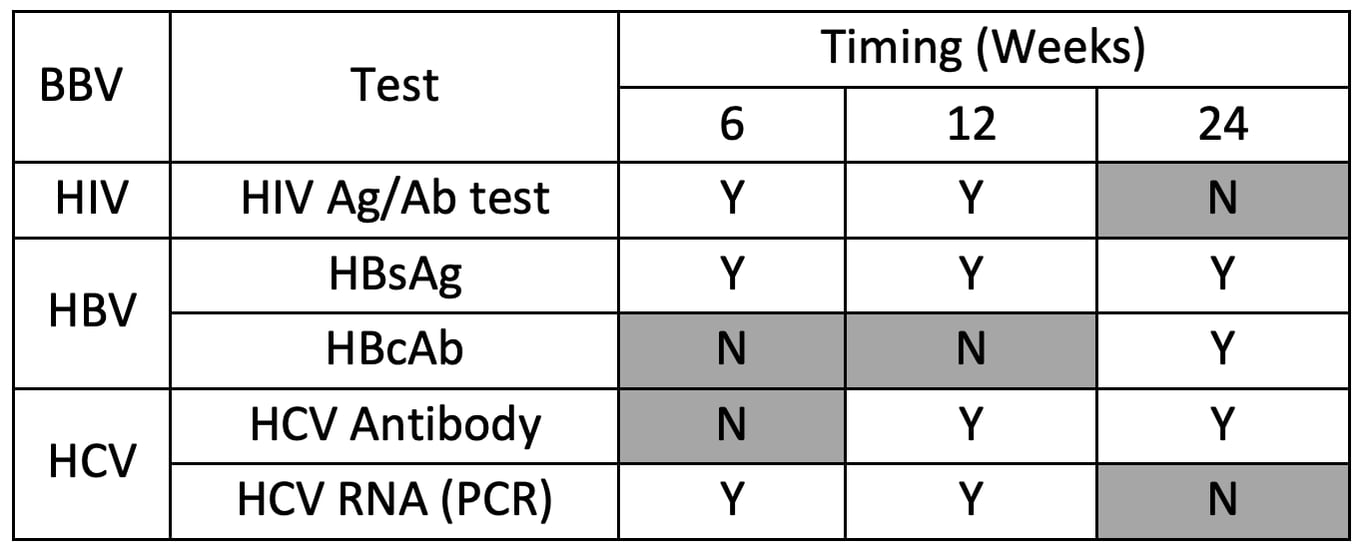 | |
Recommended testing schedule for BBVs after significant exposure event. Note: If giving HIV PEP, testing occurs 6 and 12 weeks from the end of treatment. Click on image to enlarge
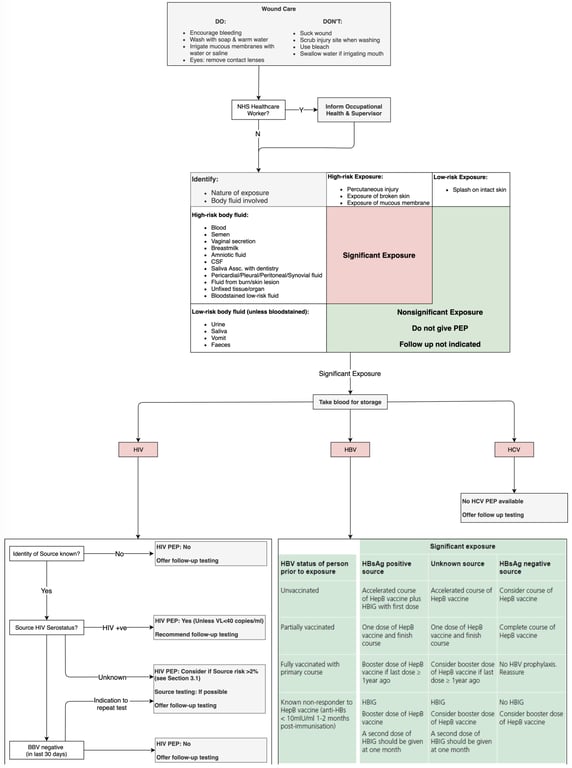 | |
Needlestick injury assessment for blood borne viruses (BBV) flowchart courtesy of NHS lothian Click on image to enlarge
Consider need for Reporting
A needlestick injury occurring in a healthcare worker should be reported to occupational health and the injured workers line manager.Post exposure prophylaxis (PEP)
Consideration should be given regarding prophylactic treatment to prevent HIV and HBV transmission. Note that there is no prophylactic treatment for hepatitis C (HCV)HIV post exposure prophylaxis:
The decision on whether to offer HIV PEP should take into account the risk associated with the source and the anxiety/wishes of the injured party. BASHH 2021 guidelines (amended 2023) advise the following for needlestick exposures injuries:
| Index case | When to prescribe PEP |
|---|---|
| HIV-positive | PEP is recommended following a high-risk injury (includes needlestick) if the index case is known to be HIV-positive and is not on ART for >6 months with a suppressed viral load within the last 6 months. PEP is generally not indicated following a sharps injury if the index case has been on ART for at least 6 months with an undetectable HIV viral load (at the time of last measurement and within the previous 6 months) and reported good adherence, however due to lack of direct evidence, a case by case decision can be made depending on the nature of the injury |
Unknown HIV status | PEP is not recommended following a sharps or mucosal splash injury if the index case is untested but from a low risk group. PEP is generally not recommended following a sharps or mucosal splash injury if the index case is untested and from a high-risk group, e.g. MSM or PWID (person who injects drugs, also known as IDU), unless there were other factors that increased likelihood of transmission (e.g. a deep injury or blood bolus injected or a sharps injury from an PWID in the context of a local outbreak) |
| Community needlestick exposure | PEP is not recommended following a community needlestick exposure. However PEP may be considered following a community needlestick injury, if the recipient is confident that it was a freshly discarded needle |
It is worth emphasising that where PEP is 'generally not recommended' it may still be appropriate to give HIV PEP depending on individual circumstances and local population risk. HIV prevalence amongst IDUs varies considerably depending on whether there is a local outbreak and country of origin and is particularly high in IDUs from Eastern Europe and central Asia. A careful assessment of risk is required. If in doubt consultation with an appropriate specialist (public health consultant, infectious disease consultant or microbiolgy consultant) is advised.
When HIV PEP is required, start as soon as possible, ideally within 1h of a significant exposure, but no later than 72 hours post exposure.
HIV PEP is ineffective if started after 72h
HIV PEP is ineffective if started after 72h
If it is decided to give HIV PEP the treatment below is typically given for 28 days.
The first-line regimen for HIV PEP (for occupational and non-occupational use) is Raltegravir/Truvada for 28 days. The BASHH dose regimen is:
- 1 x Tenofovir disoproxil 245mg/emtricitabine 200mg once daily plus
- 1 x Raltegravir 1200mg once daily
HBV post exposure prophylaxis:
Needstick injuries are classified as a significant or high risk exposure for hepatitis B virus (HBV). HBV PEP comes in the form of an accelerated hepatitis B vaccine course (Doses at 0, 1 and 2 months or alternatively 0, 7 & 21 days if more pragmatic), or booster dose of the hepatitis B vaccine plus in some cases Hepatitis B Immunoglobulin as shown by the table below:
| HBV status of person prior to exposure | HBsAg positive source | Unknown source | HBsAg negative source |
|---|---|---|---|
| Unvaccinated | Accelerated course of HepB vaccine plus HBIG with first dose | Accelerated course of HepB vaccine | Consider course of HepB vaccine |
| Partially vaccinated | One dose of HepB vaccine and finish course | One dose of HepB vaccine and finish course | Complete course of HepB vaccine |
| Fully vaccinated with primary course | Booster dose of HepB vaccine if last dose ≥ 1 year ago | Consider booster dose of HepB vaccine if last dose ≥ 1 year ago | No HBV prophylaxis. Reassure |
| Known non-responder to HepB vaccine (anti-HBs <10mIU/ml 1-2 months post-immunization) | HBIG Booster dose of HepB vaccine. A second dose of HBIG should be given at one month | HBIG Booster dose of HepB vaccine. A second dose of HBIG should be given at one month | No HBIG Consider booster dose of HepB vaccine |
Patient advice
The injured party should be advised:
- If they choose to have sex, to practise safe sex and to ensure that they follow such advice until follow up testing is complete
- Not to donate blood until all necessary screening tests are clear.
- To see their GP if they develop a fever.
- Healthcare workers can coninue to carry out procedures as long as they adhere to standard PPE requirements