Abdominal oesophagus
The oesophagus has a short abdominal section. The abdominal oesophagus blends smoothly with the gastric mucosa. The abdominal oesophagus commences at the diaphragmatic opening and terminates at the gastro-oesophogeal junction (GOJ). For the exam you need to know the anatomical level these relate to and important anatomical relations:
Anatomical relations
Factors guarding against reflux
The GOJ acts like a sphincter and is sometimes referred to as the lower oesophageal sphincter. It is a physiological sphincter rather than an anatomical one. It is classified like this as it does not have sphincteric muscle. The physiological sphincter is formed from:
Abdominal oesophagus anatomical levels
- Diaphragm opening at T10 vertebral level OR 7th costal cartilage level
- Gastric cardia/GOJ at T11 vetebral level
Anatomical relations
| Structure | Position in relation to oesophagus |
|---|---|
| Peritoneum Left vagus nerve Posterior surface of heart Left lobe of liver | Anterior |
| Right vagus nerve Left crus of diaphragm | Posterior |
Factors guarding against reflux
The GOJ acts like a sphincter and is sometimes referred to as the lower oesophageal sphincter. It is a physiological sphincter rather than an anatomical one. It is classified like this as it does not have sphincteric muscle. The physiological sphincter is formed from:
- Fibres of right crus of diaphragm 'pinch' or have a noose like effect on the oesophagus.
- The folds of muscularis mucosa form flaps which help occlude the oesophageal lumen and prevent reflux
- Angulation of the oesophagus as the oesophagus enters the stomach at an acute angle.
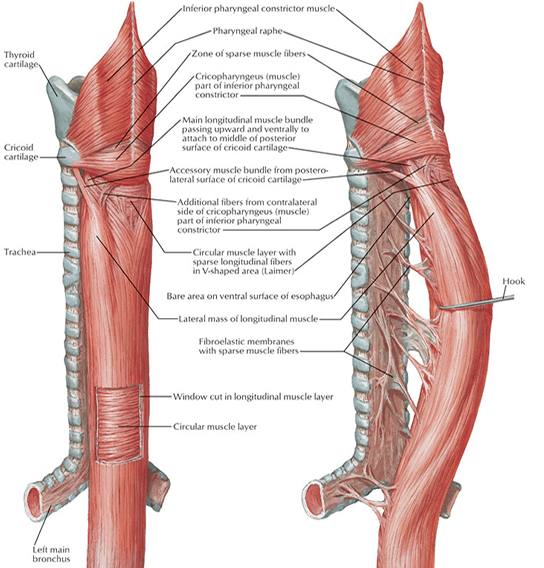 | |
Diagram illustrating the upper and thoracic sections of the oesophagus
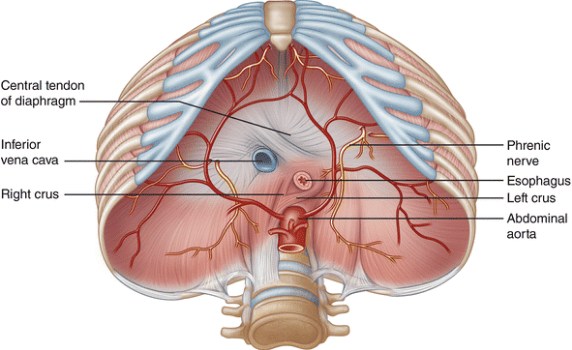 | |
Inferior view of oesophagus passing through the diagram. Note how the left crus passes posterior to the oesophagus