Measures of central tendency: Mean, median and mode
On this page
Mean:
The mean, or average, is the sum of all the values in a dataset divided by the number of values.Mode:
The mode is the value that appears most frequently in a set of data. A dataset can have one mode, more than one mode (bimodal or multimodal), or no mode at all.Median:
The median is the middle value that separates the higher half from the lower half of a dataset. To find it, arrange all values in ascending order and pick the middle one.- If the dataset has an odd number of values, the median is the single middle number.
- If it has an even number of values, the median is the average of the two middle numbers.
Implications
The mean is sensitive to outliers and skew.
The median is more robust and often preferred in skewed distributions.
The mode reflects the most frequent value, but may not be helpful if the data has no clear peak or is continuous.
The mean is sensitive to outliers and skew.
The median is more robust and often preferred in skewed distributions.
The mode reflects the most frequent value, but may not be helpful if the data has no clear peak or is continuous.
Example
For example a study looks at the number of attendances brittle asthmatics have at A&E's across the north of England each quarter. Each A&E submits the number of attendances as below:1,3,4,5,5,5,6,7,7,9,12,14,17
Mean = 7.3
Mode = 5
Median = 6
Skewed distributions
In medicine, many types of data are not normally distributed and instead show skewed distributions. This means the data are asymmetrical, which when represented graphically, show one tail longer than the other.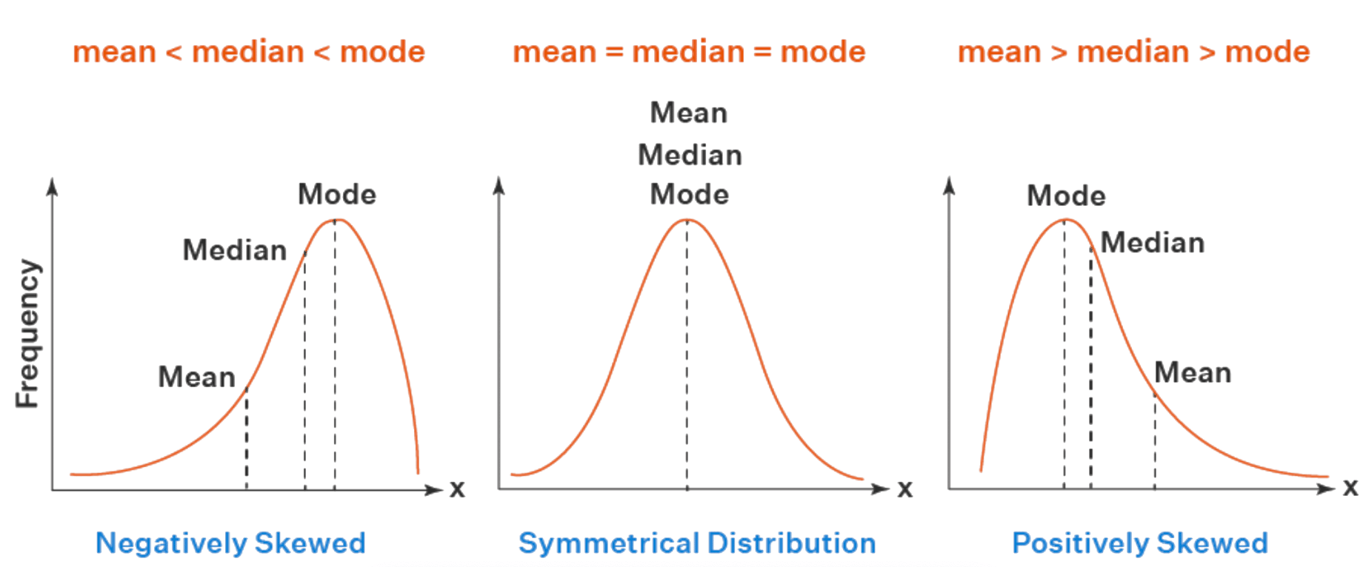 | |
Click on image to enlarge
Right-skewed (positive skew):
- Tail extends toward higher values.
- Common in: income, hospital stay length, blood loss, waiting times
- In right skew: mean > median > mode
- The median is often used instead of the mean because it’s less affected by outliers.
Left-skewed (negative skew):
- Tail extends toward lower values.
- Less common but may occur in survival times for low-risk conditions.
- In left skew: Mean < Median < Mode
- As for right-skew, the median is often used instead of the mean because it’s less affected by outliers.
Understanding skew is important because:
- It affects which measures of central tendency (mean, median, mode) are appropriate
- It can impact clinical interpretation, such as typical vs. extreme patient outcomes
- It informs decisions in data analysis (e.g., whether transformation or non-parametric tests are needed)