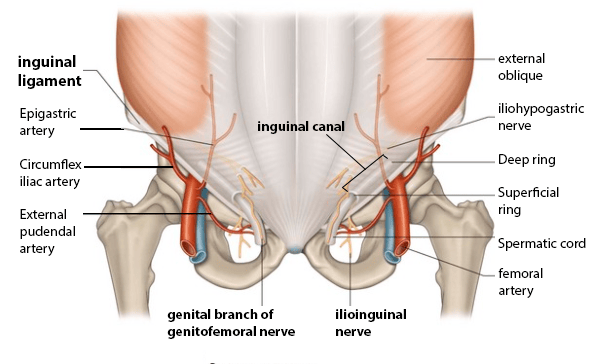
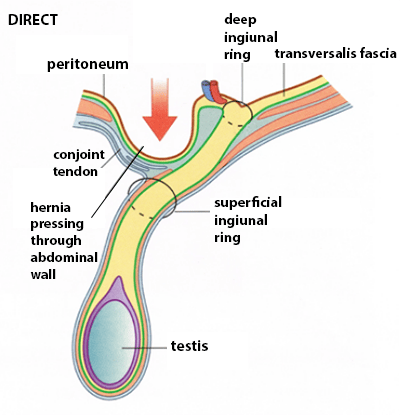
The inguinal canal is a common source of questions and there are certain things candidates are expected to know:
- Position of the canal
- Composition of the roof, floor and walls
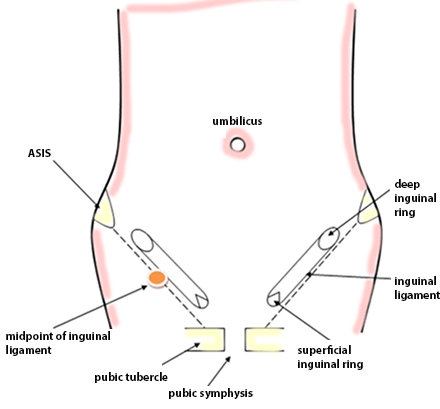
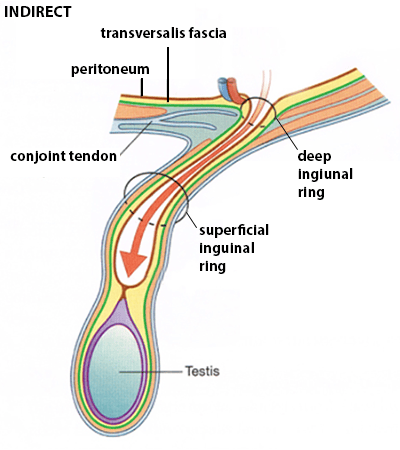
- Position/planes of the deep (internal) and superficial inguinal rings
- Contents
| Structure | Contents of the inguinal canal |
|---|
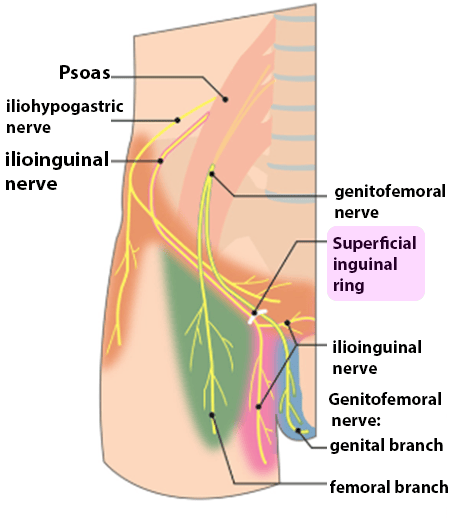
| Nerves | - 3 Nerves (Note ilioinguinal passes through superficial ring rather than truly through canal)
- Genital branch of genitofemoral, ilioinguinal, autonomic fibres
|
| Arteries | - 3 Arteries
- Artery to Vas Deferens, Cremasteric artery, testicular artery
|
| Fascia | - 3 Fascial Layers
- external spermatic, cremasteric, internal spermatic
|
| Other Things | - 3 Other things
- Pampiniform plexus, lymphatics, vas deferens (males)
|
| Male/Female | - Male: spermatic cord
- Female: Round ligament of Uterus
|
| Boundary of inguinal canal | Structures composing boundary |
|---|
| Anterior wall | Aponeurosis of external oblique reinforced by internal oblique |
| Posterior wall | Transversalis fascia
Conjoint tendon
Deep inguinal ring |
| Floor | Inguinal ligament
Lacunar ligament |
| Roof | Transversalis fascia
Internal oblique
Transversus abdominis |
- The entrance to the inguinal canal, the deep inguinal ring is located halfway between pubic tubercle and the anterior superior iliac spine
Superficial inguinal ring- The exit to the inguinal canal is located 1cm above and medial to the pubic tubercle
Diagram illustrating nerves of the inguinal canalDiagrams illustrating direct vs indirect hernias and relationship to inguinal canal