Carpal tunnel
Definition
Carpal Tunnel Syndrome (CTS) is the most common entrapment neuropathy, caused by compression of the median nerve as it passes through the carpal tunnel at the wrist, a fibro-osseous canal formed by the carpal bones on the floor and sides and the transverse carpal ligament (flexor retinaculum) on the roof. This fibro-osseous canal contains the median nerve and flexor tendons. Compression leads to sensory and motor deficits in the median nerve distribution.Contents of the carpal tunnel:
- Median Nerve
- Flexor Digitorum Superficialis (4 tendons)
- Flexor Digitorum Profundus (4 tendons)
- Flexor Pollicis Longus
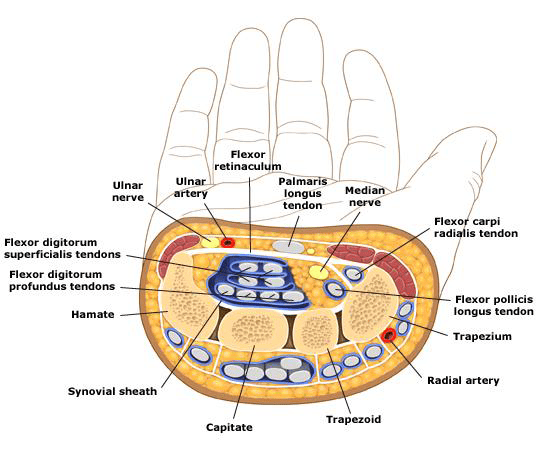 | |
Illustration of carpal tunnel. Click on image to enlarge
Pathophysiology
- Increased pressure in the carpal tunnel (normal ~2–10 mmHg) leads to median nerve ischaemia and demyelination.
- Chronic compression can cause axonal loss and muscle wasting.
- Risk factors increase intracarpal pressure or reduce canal size, including repetitive wrist flexion/extension, fluid retention, or structural anomalies.
Risk Factors
- Female sex (middle age)
- Repetitive hand/wrist activity (typing, manual labor)
- Pregnancy (fluid retention)
- Obesity
- Diabetes mellitus, hypothyroidism, rheumatoid arthritis
- Trauma or prior wrist fracture
Clinical Features
- Sensory: Numbness, tingling, pins-and-needles in the thumb, index, middle, and radial half of ring finger. Symptoms often worse at night or with wrist flexion.
- Motor: Weakness of thumb abduction/opposition; in chronic cases, thenar muscle wasting.
- Tinel’s sign: Percussion over median nerve produces tingling in fingers.
- Phalen’s test: Wrist flexion reproduces symptoms.
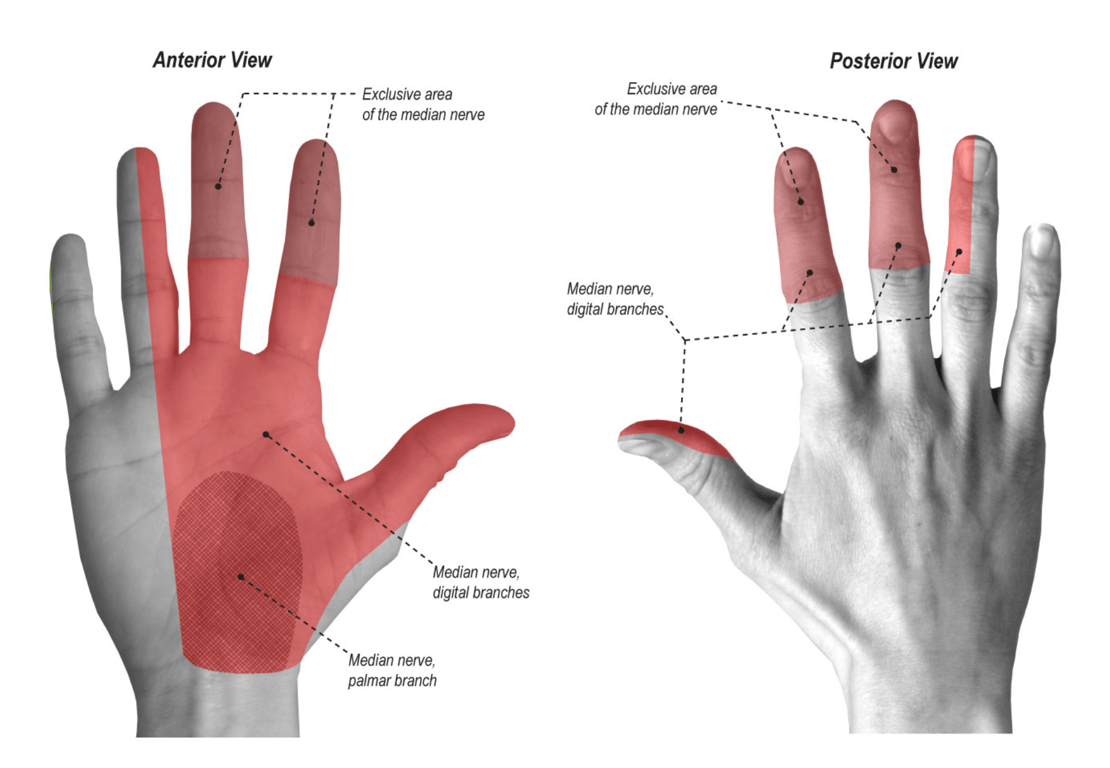 | |
Sensory distribution of median nerve. Click on image to enlarge
Diagnosis
Clinical diagnosis is usually sufficient. Nerve conduction studies (NCS)/electromyography (EMG) may be used if diagnosis is uncertain or surgery is considered. Imaging is rarely required.
Management
Conservative measures for mild to moderate CTS include:- Wrist splinting (futuro) especially at night
- Activity modification
- Analgesia / NSAIDs
- Corticosteroid injection into carpal tunnel
- Carpal tunnel release: Division of the transverse carpal ligament (flexor retinaculum) is indicated for persistent or severe symptoms, muscle wasting, or failed conservative therapy.
Prognosis
- Early conservative management often successful.
- Untreated CTS may progress to permanent sensory loss and thenar atrophy.
- Surgical release generally has a high success rate, especially if performed before significant axonal loss.