Helicobacter pylori
Background
Helicobacter pylori is a Gram-negative, microaerophilic, spiral-shaped (or helical) bacterium with multiple flagella. It is uniquely adapted to survive in the highly acidic environment of the human stomach.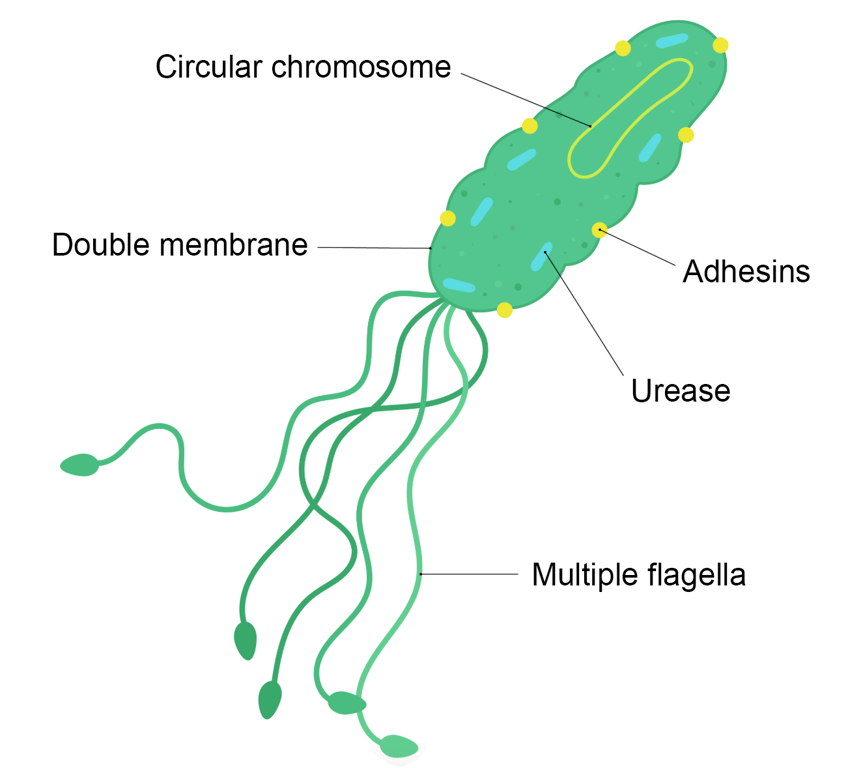 | |
Helicobacter pylori: multi-flagellated urease producing bacteria. Click on image to enlarge
Epidemiology
Prevalence varies considerably worldwide with over 80% of Japanese and South American people infected, compared with a rate of 20% in Scandinavia.
In the United Kingdom, an estimated 30–40% of the population carries H. pylori although only around 15% of these will develop symptoms.
Pathogenesis
H. pylori has multiple mechanisms that optimise its virulence:- Motility: Its flagella enable it to penetrate the gastric mucus layer.
- Urease production: Urease hydrolyses urea into ammonia and carbon dioxide, the ammonia locally locally neutralises stomach acid protects the bacterium from the highly acidic environment.
- Adhesion: Adhesins enable tight binding to gastric epithelial cells.
- Toxins: Virulence factors like CagA and VacA interfere with host cell function and provoke inflammation.
Once established H pylori is thought to cause its effects by increasing gastrin release which results in hypersecretion of gastric acid, stimulate release of multiple proinflammatory cytokines leading to chronic inflammation and reduce bicarbonate secretion.
These factors allow the bacterium to establish chronic infection, resulting in gastritis, peptic ulceration, and in some cases, increasing the risk of gastric cancer or mucosa-associated lymphoid tissue (MALT) lymphoma.
Helicobacter Pylori Key Points
H pylori produces urease to protect itself from the effects of gastric acid.It is commonly asymptomatic but is associated with chronic gastritis, gastric and duodenal ulceration, gastric cancer and MALT lymphoma.
Transmission
Transmission occurs through multiple routes including:- Person-person
- Faecal-oral
- Ingestion of contaminated food or water
Clinical features
Many infected individuals remain asymptomatic, but H. pylori infection can lead to:
- Dyspepsia
- Gastritis
- Peptic ulcer disease (gastric or duodenal ulcers)
- Complications such as gastric adenocarcinoma and MALT lymphoma
Helicobacter pylori (H. pylori) infection is one of the most common causes of peptic ulcer disease, with 95% of duodenal and 70–80% of gastric ulcers associated with it.
Diagnosis
As per NICE guidance, initial testing should be non-invasive:- Urea breath test
- Stool antigen test
Before testing, patients should avoid:
- Proton pump inhibitors (PPIs) for at least 2 weeks
- Antibiotics for at least 4 weeks
Treatment
First-line eradication therapy for H. pylori involves a 7-day course of triple therapy, taken twice daily:
- A proton pump inhibitor (PPI) e.g., omeprazole
- Amoxicillin
- Either clarithromycin or metronidazole, depending on prior antibiotic exposure and local resistance patterns
If eradication fails, second-line therapy should be guided by previous regimens used and, if necessary, culture and sensitivity testing.