Gastrointestinal physiology: Saliva
On this page
Sites of saliva production
Saliva is produced by the salivary glands. Humans have 3 pairs of major salivary glands and hundreds of minute minor salivary glands. The paired major salivary glands are:- Parotid glands
- Submandibular glands
- Sublingual glands
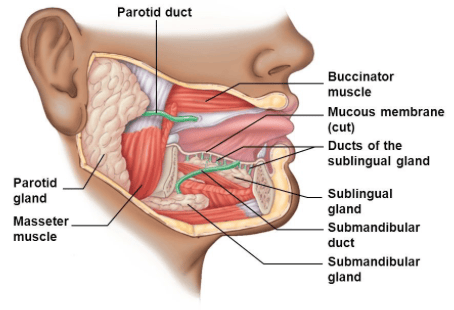 | |
Distribution of the major salivary glands. Click to enlarge
Functions
Saliva has a number of functions:
- Moisten and lubricate mouth
- Dissolve food so it can react with gustatory receptors
- Buffering of acids
- Aid swallowing
- Enzymatic digestion of polysaccharides (amylase)
- Physical barrier (coating) to protect the mucosal lining
- Antimicrobial action via constituents such as histatins and lysozyme
- Contains immunoglobulins (primarily IgA)
Amylase is present in saliva and pancreatic secretions. It breaks starch down into sugars
Composition
Adults produce approximately 1L-1.5L of saliva per day. Saliva is hypotonic and contains >99% water by composition but Its exact composition varies depending on which gland is secreting and if that gland is at rest or being stimulated. The normal pH of saliva is 6.7 to 7.4.Salivary glands may be broadly classified as serous, mucous or seromucous (mixed). Serous secretions primarily contain alpha-amylase proteins (enzyme) whereas mucous secretions primarily contain the protein mucin.
The tables below provide a summary:
| Glands | Composition | Contribution (rest) | Contribution (stimulated) |
|---|---|---|---|
| Parotid | Serous Rich in electrolytes (K+, Na+, Cl- & HCO3-) and amylase | 20% | 50% |
| Sublingual | Mucous Rich in mucins, antibodies, protein and carbohydrates | 7.5% | 10% |
| Submandibular | Seromucous Mix of above two types | 65% | 30% |
| Minor glands | Mucous | 7.5% | 10% |
Saliva plays an important role in digestion and contains the following three major digestive enzymes:
- α-amylase: starts the digestion of starch in the mouth
- Lingual lipase: digest fats but not activated until entering the acidic environment of the stomach
- Kallikrein: proteolytically cleaves high-molecular-weight kininogen to produce bradykinin
Saliva contains several minor digestive enzymes (not listed) and a number of antimicrobial enzymes that kill bacteria:
- Lysozyme
- Salivary lactoperoxidase
- Lactoferrin
- Immunoglobulin A
Control of salivary secretion
Saliva secretion is controlled via reflex responses. Taste (gustatory) receptors and mechanoreceptors in the mouth are stimulated by the presence of food and trigger an increase in saliva production via autonomic nerve fibres. The smell and anticipation of food may also stimulate saliva production from the submandibular and sublingual glands (but not the parotid).
Nerve supply
Parasympathetic innervation to the salivary glands is via cranial nerves:- Parotid gland receives input from the glossopharyngeal nerve (CN IX) via the otic ganglion
- Submandibular and sublingual glands receive their parasympathetic input from the facial nerve (CN VII) via the submandibular ganglion.
Sympathetic innervation of the salivary glands takes place via preganglionic nerves in the thoracic segments T1-T3 which synapse in the superior cervical ganglion.
Parasympathetic innervation increases volume of saliva produced.
Sympathetic stimulus increases amylase secretion but also causes vasoconstriction which reduces saliva's water content.