Tapeworm
On this page
Epidemiology and food hygiene
Human tapeworm infections are most commonly caused by Taenia saginata (beef tapeworm) and Taenia solium (pork tapeworm). Poor food hygiene, particularly the consumption of raw or undercooked beef or pork, is a significant risk factor. Areas with inadequate meat inspection, poor sanitation, and free-range pigs are most affected. Proper cooking of meat and good hygiene practices are essential to prevent infection.Basis of Infection
Humans may become infected by ingesting taenia eggs or larvae cysts:- Eating undercooked meat containing larval cysts leads to intestinal infection (taeniasis).
- With T. solium ingesting eggs (from contaminated food, water, or poor hygiene) causes the eggs to hatch in the intestine. The released larvae invade the bloodstream, spreading to muscles, skin, eyes, and the brain, leading to cysticercosis.
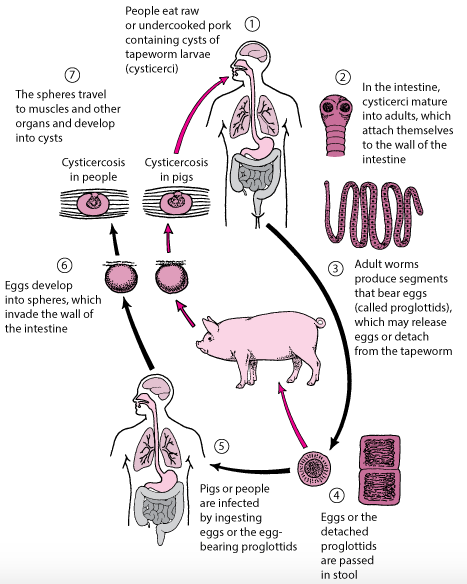 | |
Diagram illustrating the lifecycle of the tapeworm
Clinical Features
- Taeniasis refer to intestinal infection by adult tapeworms. Taeniasis is often asymptomatic but may cause nonspecific symptoms such as abdominal discomfort, nausea, diarrhoea, weight loss, and occasionally passage of proglottids (worm segments) in the stool. Taeniasis may be the result of infection with Taenia saginata (beef tapeworm) or Taenia solium (pork tapeworm)
- Cysticercosis refer to tissue infection caused by the young (larval) form of the Taenia solium (pork tapeworm). T. solium larvae migrating to tissues. When the brain is involved (neurocysticercosis), it can cause seizures, headaches, visual disturbances, and hydrocephalus due to inflammatory responses.
Diagnosis
- Taeniasis: Diagnosis is made by detecting characteristic eggs or proglottids in stool samples. Microscopy is the standard methodology but multiple samples may be required.
- Cysticercosis: Diagnosis requires serological tests (e.g., ELISA) and confirmation through imaging (CT or MRI), which reveals characteristic cysts, especially in neurocysticercosis.
Principles of Management:
- Taeniasis is typically treated with niclosamide or praziquantel (both available from specialist sources). Treatment is generally well tolerated.
- Cysticercosis/Neurocysticercosis management is more complex and requires specialist input. Treatment may include antiparasitic drugs (albendazole or praziquantel), corticosteroids to control inflammation, anticonvulsants for seizures, and sometimes surgical intervention for cyst removal and treatment of hydrocephalus.
Echinococcosis
Human echinococcosis is a zoonotic disease (a disease that is transmitted to humans from animals) that is caused by parasites, namely tapeworms of the genus Echinococcus.
Cystic echinococcosis, also known as hydatid disease or hydatidosis is caused by infection with the dog tapeworm
Echinococcus granulosus
Humans are intermediate hosts. Dogs are the definitive host and typically get infected from being fed the meat of infected animals and ingesting cysts. Humans are infected through ingestion of parasite eggs in contaminated food, water or soil, or through direct contact with animal hosts.
Most often seen in farmers. Treatment is typically with surgery plus albendazole or mebendazole which may be required for long durations.
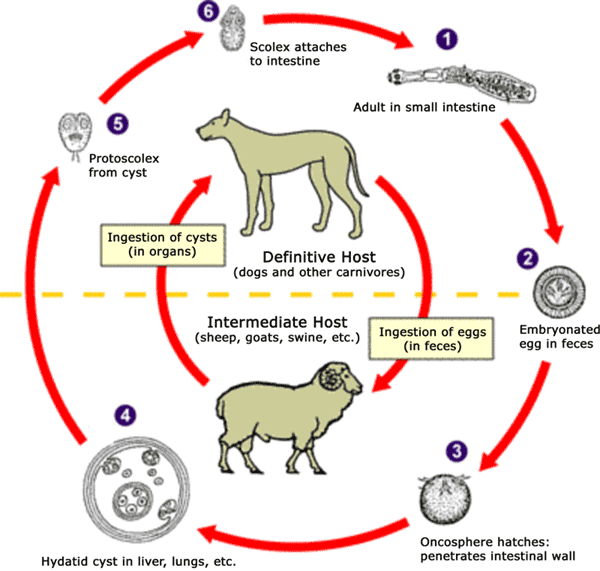 | |
Diagram illustrating the lifecycle of Echinococcus