Normal (Gaussian) distribution
The normal distribution is also known as the Gaussian distribution or 'bell-shaped' distribution. It describes the spread of many biological and clinical measurements
In a normal (Gaussian) distribution the median equals the mode and mean value. 68.2% of values are within 1 standard deviation of the mean, 95.4% are within 2 standard deviations of the mean and 99.7% are within 3 standard deviations of the mean. This is known as the three-sigma rule or empirical rule.
Properties of the Normal distribution:
In a normal (Gaussian) distribution the median equals the mode and mean value. 68.2% of values are within 1 standard deviation of the mean, 95.4% are within 2 standard deviations of the mean and 99.7% are within 3 standard deviations of the mean. This is known as the three-sigma rule or empirical rule.
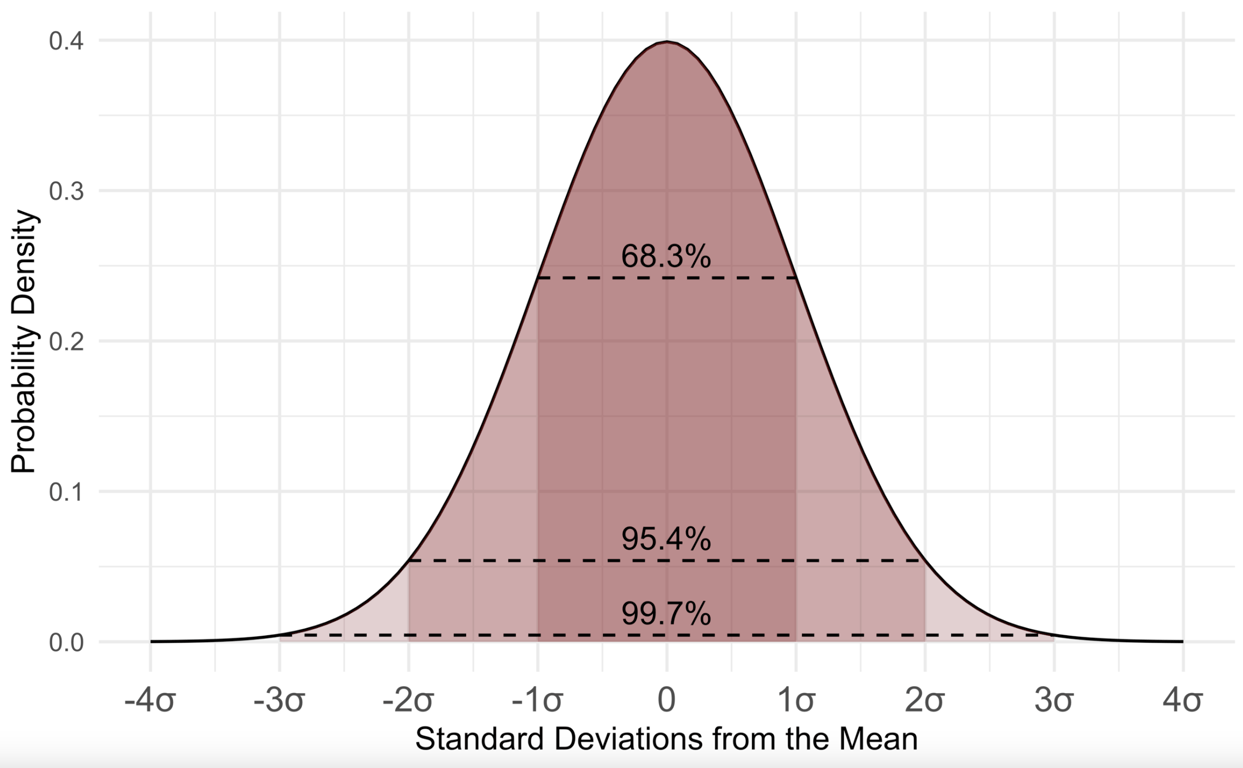 | |
Gaussian distribution. Click on image to enalrge
Properties of the Normal distribution:
- Symmetrical i.e. Mean = mode = median
- 68.2% of values lie within 1 SD of the mean
- 95.4% of values lie within 2 SD of the mean
- 99.7% of values lie within 3 SD of the mean
- This is often reversed, so that within 1.96 SD of the mean lie 95% of the sample values
- The range of the mean - (1.96 *SD) to the mean + (1.96 * SD) is called the 95% confidence interval, i.e. If a repeat sample of 100 observations are taken from the same group 95 of them would be expected to lie in that range
Standard deviation:
- the standard deviation (SD) is a measure of how much dispersion exists from the mean
- SD = √ variance (square root of variance)