Haemophilia A and Haemophilia B
On this page
Haemophilia is a X-linked recessive disorder of coagulation. Up to 30% of patients have no family history of the condition. Haemophilia A is due to a deficiency of factor VIII whilst in haemophilia B (Christmas disease) there is a lack of factor IX.
Blood tests
Inherited coagulation disorders are genetic conditions characterised by deficiencies or dysfunctions of clotting factors, leading to an increased risk of bleeding. The most clinically important are Haemophilia A, Haemophilia B, and von Willebrand disease (vWD).
Features
- Haemoarthroses
- Haematomas
- Prolonged bleeding after surgery or trauma
Blood tests
- Prolonged APTT
- Bleeding time, thrombin time, prothrombin time normal
- Low clotting factor levels (factor VIII in Haemophilia A and factor IX in haemophilia B)
Up to 10-15% of patients with haemophilia A develop antibodies to factor VIII treatment
Inheritance
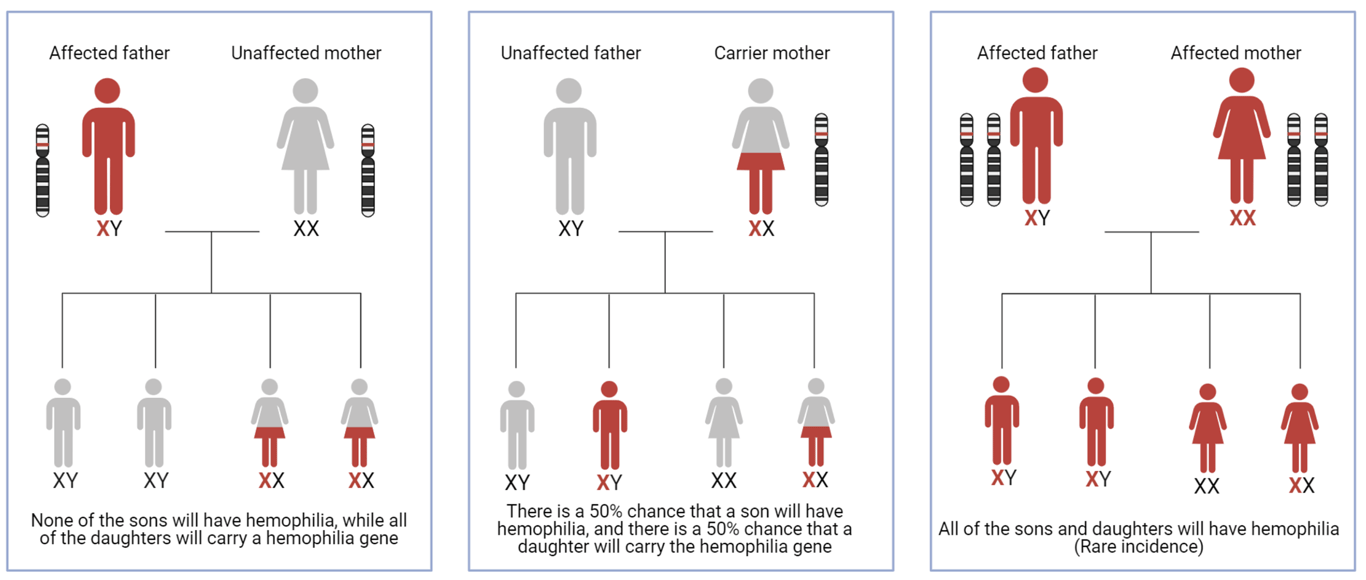 | |
X-linked recessive inheritance pattern. Click on image to enlarge
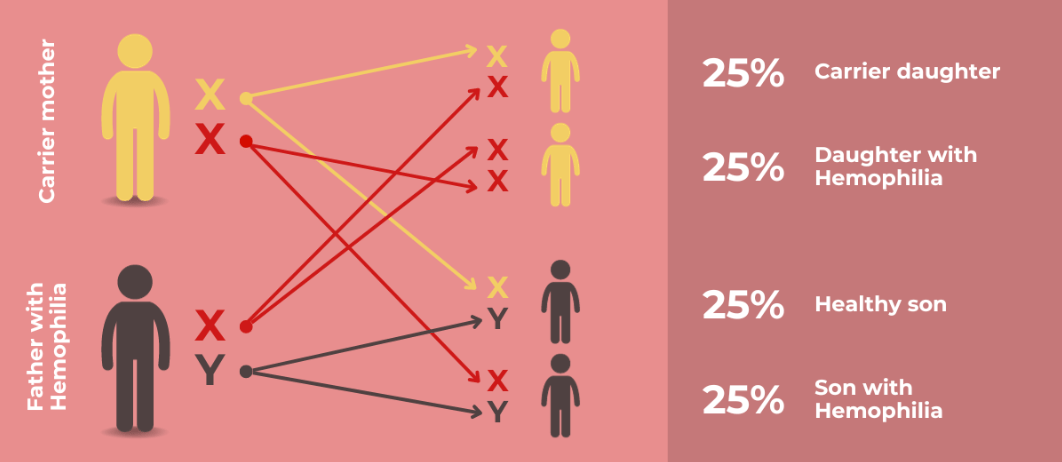 | |
The other scenario is an affected father and carrier mother having offspring. In this case 50% of males will have haemophilia with 50% unaffected, 50% of females will have haemophilia and the other 50% of females will be carriers.
Comparison of Haemophilia A and Haemophilia BClick on image to enlarge
| Feature | Haemophilia A (Factor VIII deficiency) | Haemophilia B (Factor IX deficiency) |
|---|---|---|
| Genetics | X-linked recessive | X-linked recessive |
| Incidence | 1 in 5,000 male births | 1 in 30,000 male births |
| Factor deficiency | Factor VIII | Factor IX |
| Clinical features | Haemarthroses, deep muscle bleeds, prolonged bleeding after trauma/surgery | Similar to Haemophilia A (joint and muscle bleeds, prolonged bleeding) |
| Investigations | Prolonged APTT, normal PT, reduced FVIII activity | Prolonged APTT, normal PT, reduced FIX activity |
| Management | Recombinant factor VIII replacement; Desmopressin (DDAVP) useful in mild disease | Recombinant factor IX replacement (DDAVP not effective) |