Escherichia coli
On this page
Background
Escherichia coli (E. coli) is a Gram-negative, rod-shaped, facultative anaerobic bacterium. It is a member of the Enterobacteriaceae family and a component of the normal gut flora in humans and animals. It is oxidase-negative, lactose-fermenting, and some strains produce toxins, including exotoxins and endotoxins. Many strains are harmless, but pathogenic variants are significant causes of both community-acquired and healthcare-associated infections.E. coli infections lead to a variety of diseases in humans including:
- Diarrhoeal illnesses
- UTIs
- Neonatal meningitis
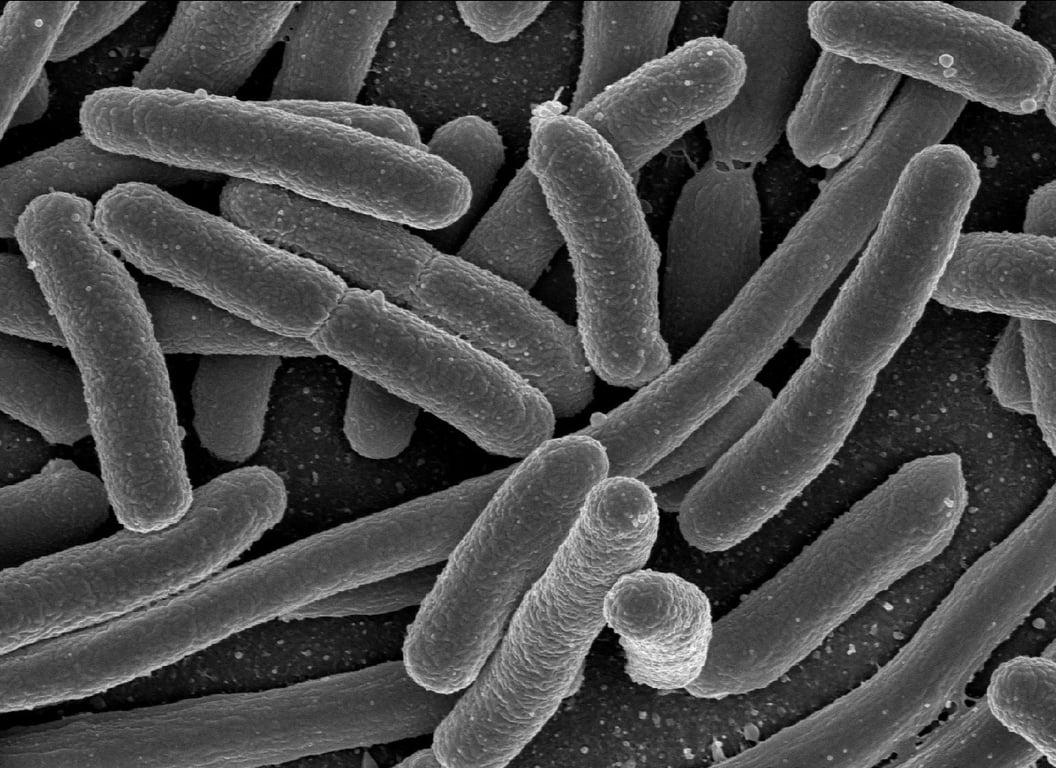 | |
Scanning electron micrograph of Escherichia coli, grown in culture and adhered to a cover slip. Credit: NIAID
Transmission
E. coli is transmitted through various routes depending on the clinical syndrome:
- Faecal-oral transmission is common for enteric disease, typically through ingestion of contaminated food or water.
- Peripartum exposure during childbirth is the main transmission route for neonatal infections.
- Endogenous spread from gut flora to the urinary tract or surgical sites is typical for UTIs, wound infections, and intra-abdominal sepsis.
- Nosocomial transmission is particularly relevant in intensive care units and catheterised patients.
Serotypes
E. coli may be classified according to the expressed antigens which may trigger an immune response:
| Antigen | Origin | Notes |
|---|---|---|
| O | Lipopolysaccharide layer | |
| K | Capsule | Neonatal meningitis secondary to E. coli is usually caused by a serotype that contains the capsular antigen K-1 |
| H | Flagellin |
E. coli O157:H7 is a particular strain associated with severe, haemorrhagic, watery diarrhoea. It has a high mortality rate and can be complicated by haemolytic uraemic syndrome. It is often spread by contaminated ground beef.
Pathogenesis
E. coli has a variety of virulence factors that contribute to its pathogenicity across different systems:- Pili (fimbriae): Adhesion to mucosal surfaces, particularly uropathogenic strains that target urinary tract epithelium (e.g. P fimbriae).
- Capsule (K antigen): Protects against phagocytosis, particularly important in neonatal meningitis strains.
- Endotoxins (lipopolysaccharide): Induce systemic inflammatory responses and septic shock.
- Exotoxins: Various toxins including heat-stable and heat-labile enterotoxins (ETEC), Shiga toxin (STEC/EHEC), and cytotoxins (EIEC).
- Flagella: Confer motility, aiding ascent through the urinary tract.
E Coli virulence in UTIs
Uropathogenic E. coli (UPEC) strains possess adaptations that enhance their ability to cause infection:
Uropathogenic E. coli (UPEC) strains possess adaptations that enhance their ability to cause infection:
- Adhesins: Pili or fimbriae (especially P fimbriae) enable attachment to uroepithelial cells, avoiding urinary flushing.
- Motility: Flagella assist in ascending infection from urethra to bladder and kidneys.
- Siderophores: Sequester iron to support bacterial growth in the host environment.
- Toxins: May damage uroepithelial cells and contribute to inflammation and symptoms.
Sites of infection and clinical syndromes
E. coli causes a wide range of infections, which can be broadly categorised into enteric, urinary, CNS, and systemic infections:
| Site | Details |
|---|---|
| Urinary Tract Infections (UTIs) |
|
| Central Nervous System Infections |
|
| Gastrointestinal Disease | Several pathotypes cause diarrhoea:
|
| Other Infections |
|
Treatment
Treatment depends on the site and severity of infection and local antimicrobial resistance patterns.
| Site | Treatment |
|---|---|
| Uncomplicated UTIs | First-line therapy includes:
|
| Pyelonephritis or complicated infections | First-line therapy includes:
|
| Neonatal meningitis | Empirical treatment options include:
|
| Diarrhoeal illness | Usually supportive; antibiotics are generally not indicated except in invasive disease. Antibiotics avoided in EHEC infections due to risk of precipitating HUS |