Cushing's syndrome
On this page
Background
Cushing's syndrome refers to the clinical syndrome caused by prolonged exposure to elevated levels of either endogenous or exogenous glucocorticoids.The severity of symptoms can vary significantly depending on the level of steroid exposure.
Classification
Causes of Cushing's syndrome can be divided into two groups:- Adrenocorticotropic hormone (ACTH)-dependent disease: excessive ACTH from the pituitary gland or ACTH secreting tumours stimulate excessive cortisol production
- Non-ACTH-dependent disease: excess glucocorticoid independent of ACTH stimulation.
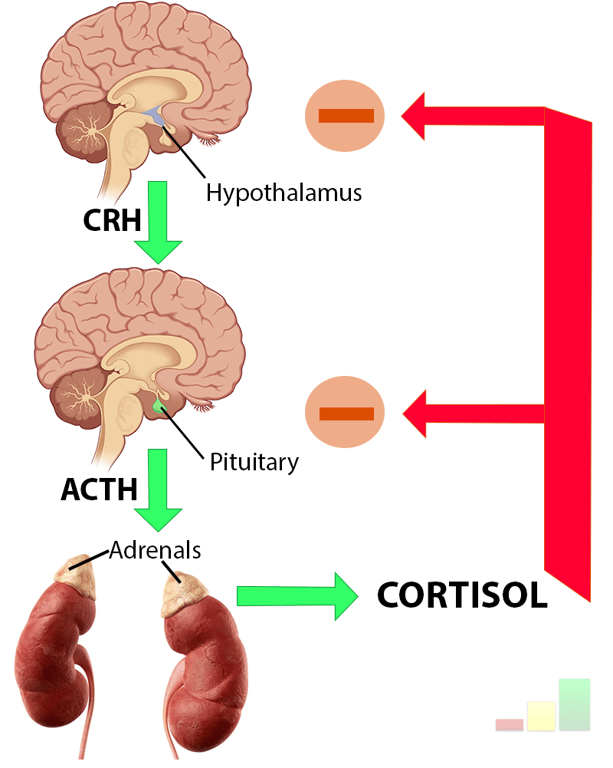 | |
Illustration of Hypothalamic-pituitary-adrenal axis and feedback between CRH, ACTH and cortisol. Click on image to enlarge
Causes
| ACTH dependent | ACTH independent |
|---|---|
| ACTH from the pituitary gland (Cushing's disease) ACTH secreting tumours Excess exogenous ATCH administration | Adrenal adenomas Adrenal carcinomas Excess glucocorticoid administration |
Cushing syndrome causes
Exogenous steroid use is the most common cause of Cushing syndrome
Pituitary adenoma is the second most common cause of Cushing syndrome & the most common endogenous cause.
Exogenous steroid use is the most common cause of Cushing syndrome
Pituitary adenoma is the second most common cause of Cushing syndrome & the most common endogenous cause.
Cushing disease versus Cushing syndrome
Cushing disease refers to Cushing syndrome that is caused by an ACTH-producing pituitary tumourClinical features
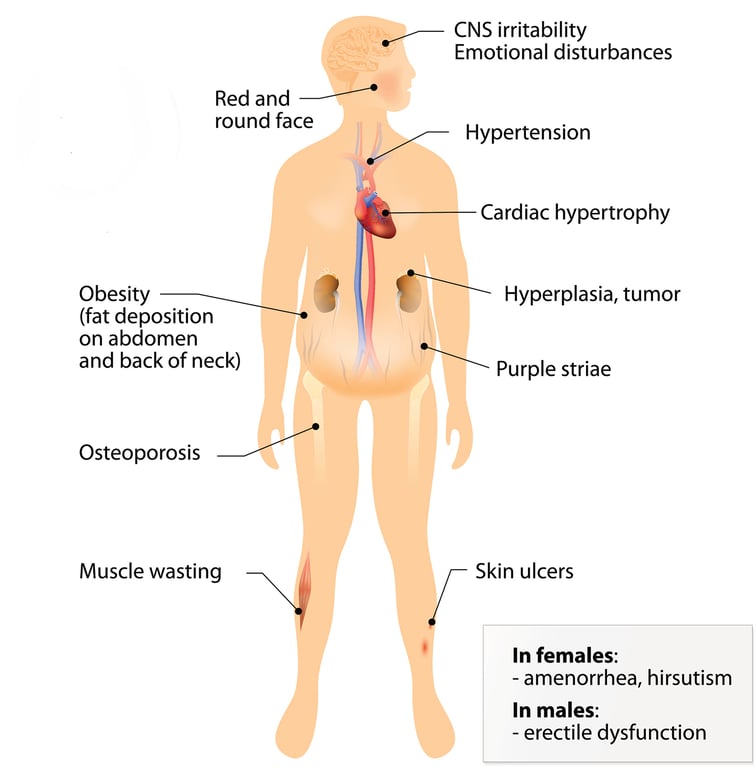 | |
Illustration of Cushing syndrome symptoms. Click on image to enlarge
- Truncal obesity
- Supraclavicular fat pads, buffalo hump
- Weight gain.
- Moon facies
- Proximal muscle wasting and weakness.
- Diabetes or impaired glucose tolerance.
- Gonadal dysfunction, reduced libido.
- Hypertension.
- Nephrolithiasis.
- Skin changes (skin atrophy, striae, easy bruising, hirsutism, acne & hyper-pigmentation in ACTH-dependent causes).
- Depression & emotional lability.
- Osteopenia or osteoporosis.
- Oedema.
- Iirregular menses or amenorrhoea
- Polydipsia & polyuria.
- Poor wound healing.
- Signs related to tumour if that is underlying cause e.g. headaches & visual problems
Investigations
The recommended diagnostic tests for Cushing's syndrome are:
- 24-hour urinary free cortisol
- 1 mg overnight dexamethasone suppression test
- Late-night salivary cortisol
Other investigations are aimed at assessing metabolic disturbance and identifying underlying cause. They include:
- Plasma ACTH
- FBC: raised white cell count
- U&E's and VBG: hypokalaemia & metabolic alkalosis can occur
- CT or MRI of abdomen, chest and/or pituitary may be required to assess suspected adrenal tumours, ectopic ACTH secreting tumours and pituitary tumours
Imaging may be guided by the ACTH result:
- Undetectable ACTH with elevated serum cortisol level is diagnostic of ACTH-independent Cushing's syndrome. Imaging of adrenals is indicated.
- Raised ACTH suggests an ACTH secreting tumour and imaging of the pituitary +/- chest/abdo (to detect ectopic ACTH secreting tumours).
Summary of causes
ACTH dependent causes
ACTH independent causes
Pseudo-Cushing's
ACTH dependent causes
- Cushing's disease (80%): pituitary tumour secreting ACTH producing adrenal hyperplasia
- ectopic ACTH production (5-10%): e.g. small cell lung cancer
ACTH independent causes
- iatrogenic: steroids
- adrenal adenoma (5-10%)
- adrenal carcinoma (rare)
- Carney complex: syndrome including cardiac myxoma
- micronodular adrenal dysplasia (very rare)
Pseudo-Cushing's
- mimics Cushing's
- often due to alcohol excess or severe depression
- causes false positive dexamethasone suppression test or 24 hr urinary free cortisol
- insulin stress test may be used to differentiate