Asthma: management in adults
On this page
The British Thoracic Society (BTS) updated their asthma guidelines in 2016 resulting in some significant changes in how asthma is diagnosed and managed. In terms of management, some of the key changes include:
In terms of management, the BTS suggest the following approach:
The previous steps 1-5 of asthma management have been abandoned. Previously 'Step 1' of asthma management was the use of a short-acting beta agonist (SABA) as required. This is no longer suggested as the initial first step. Instead, all patients from the 'diagnosis and assessment' onwards should use a SABA as required. Having to use a SABA more than 3 times per week is considered a sign that further add-on therapy is needed.
It is now recommended that a low-dose inhaled corticosteroid (ICS) is started in all patients with a diagnosis, or suspected diagnosis, of asthma, right from the 'diagnosis and assessment' period prior to a formal diagnosis being made. The first step of asthma management is now a low-dose inhaled corticosteroid in combination with a short-acting beta agonist.
The a long-acting beta agonist (LABA). This should ideally be in the form of a combination inhaler.
If poor control remains the next step depends on the response to the LABA:
Consider trials of either:
Next step....
The consideration of regular oral steroids at the lowest dose providing adequate daily control.
Table showing examples of inhaled corticosteroid doses
- the previous numbered steps have been abandoned
- all patients should receive an inhaled corticosteroid, right from the point of assessment in patients with suspected asthma
- a combined inhaled corticosteroid/long-acting beta agonist (ICS/LABA) is recommended instead of separate inhalers to increase compliance
- a long-acting muscarinic antagonist (LAMA) is an options for patient who haven't responded to a combined ICS/LABA inhaler
In terms of management, the BTS suggest the following approach:
- 1. Start treatment at the level most appropriate to initial severity
- 2. Achieve early control
- 3. Maintain control by increasing treatment as necessary and decreasing treatment when control is good
The previous steps 1-5 of asthma management have been abandoned. Previously 'Step 1' of asthma management was the use of a short-acting beta agonist (SABA) as required. This is no longer suggested as the initial first step. Instead, all patients from the 'diagnosis and assessment' onwards should use a SABA as required. Having to use a SABA more than 3 times per week is considered a sign that further add-on therapy is needed.
Initial step
It is now recommended that a low-dose inhaled corticosteroid (ICS) is started in all patients with a diagnosis, or suspected diagnosis, of asthma, right from the 'diagnosis and assessment' period prior to a formal diagnosis being made. The first step of asthma management is now a low-dose inhaled corticosteroid in combination with a short-acting beta agonist.
Next step.
The a long-acting beta agonist (LABA). This should ideally be in the form of a combination inhaler.
Next step..
If poor control remains the next step depends on the response to the LABA:
- no response to LABA - stop LABA and increase dose of ICS to medium-dose
- response to LABA - continue LABA and increase ICS to medium-dose. An alternative to this is to continue on the current treatment but consider a trial of a leukotriene receptor antagonist, SR theophylline or a long-acting muscarinic antagonist (LAMA)
Next step...
Consider trials of either:
- increasing the ICS to high-dose, OR
- the addition of a fourth drug (e.g. a leukotriene receptor antagonist, SR theophylline, a LAMA or an oral beta-agonist tablet)
- patient should be referred to specialist care at this point
Next step....
The consideration of regular oral steroids at the lowest dose providing adequate daily control.
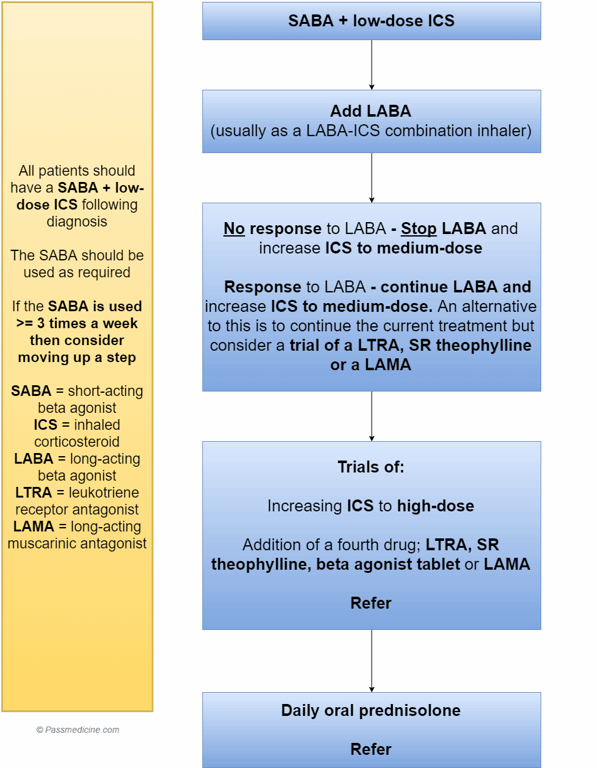 | |
2016 British Thoracic Society asthma algorithm for adults
Table showing examples of inhaled corticosteroid doses
| Low | Medium | High |
|---|---|---|
Beclometasone dipropionate
Fluticasone propionate
| Beclometasone dipropionate
Fluticasone propionate
| Beclometasone dipropionate
Fluticasone propionate
|