Psoriasis
Psoriasis is a common (prevalence around 2%) and chronic skin disorder. It generally presents with red, scaly patches on the skin although it is now recognised that patients with psoriasis are at increased risk of arthritis and cardiovascular disease.
Pathophysiology
Recognised subtypes of psoriasis
Other features
Complications
Pathophysiology
- multifactorial and not yet fully understood
- genetic: associated HLA-B13, -B17, and -Cw6. Strong concordance (70%) in identical twins
- immunological: abnormal T cell activity stimulates keratinocyte proliferation. There is increasing evidence this may be mediated by a novel group of T helper cells producing IL-17, designated Th17. These cells seem to be a third T-effector cell subset in addition to Th1 and Th2
- environmental: it is recognised that psoriasis may be worsened (e.g. Skin trauma, stress), triggered (e.g. Streptococcal infection) or improved (e.g. Sunlight) by environmental factors
Recognised subtypes of psoriasis
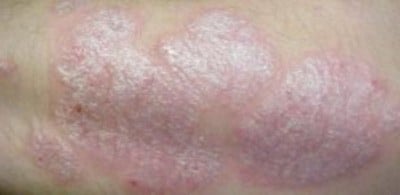
- plaque psoriasis: the most common sub-type resulting in the typical well demarcated red, scaly patches affecting the extensor surfaces, sacrum and scalp
- flexural psoriasis: in contrast to plaque psoriasis the skin is smooth
- guttate psoriasis: transient psoriatic rash frequently triggered by a streptococcal infection. Multiple red, teardrop lesions appear on the body
- pustular psoriasis: commonly occurs on the palms and soles
 | |
Other features
- nail signs: pitting, onycholysis
- arthritis
Complications
- psoriatic arthropathy (around 10%)
- increased incidence of metabolic syndrome
- increased incidence of cardiovascular disease
- increased incidence of venous thromboembolism
- psychological distress
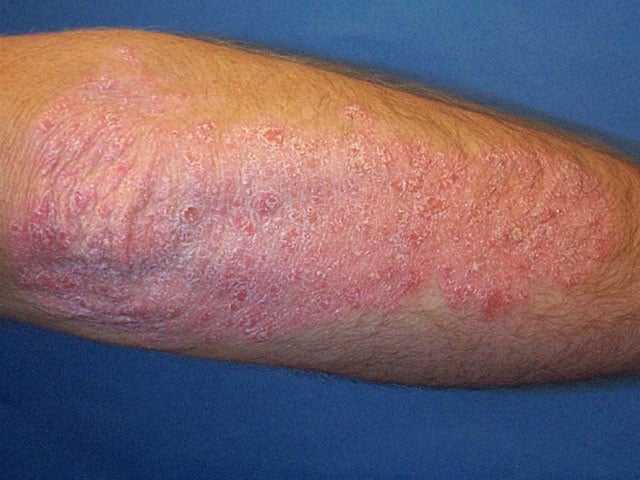 | |
| © Image used on license from DermNet NZ | |