Membrane receptors
There are four main types of membrane receptor: ligand-gated ion channels, tyrosine kinase receptors, guanylate cyclase receptors and G protein-coupled receptors
Ligand-gated ion channel receptors
Tyrosine kinase receptors
Guanylate cyclase receptors
G protein-coupled receptors
Ligand-gated ion channel receptors
- generally mediate fast responses
- e.g. nicotinic acetylcholine, GABA-A & GABA-C, glutamate receptors
Tyrosine kinase receptors
- intrinsic tyrosine kinase: insulin, insulin-like growth factor (IGF), epidermal growth factor (EGF)
- receptor-associated tyrosine kinase: growth hormone, prolactin, interferon, interleukin
Guanylate cyclase receptors
- contain intrinsic enzyme activity
- e.g. atrial natriuretic factor, brain natriuretic peptide
G protein-coupled receptors
- generally mediate slow transmission and affect metabolic processes
- activated by a wide variety of extracellular signals e.g. Peptide hormones, biogenic amines, lipophilic hormones, light
- 7-helix membrane-spanning domains
- consist of 3 main subunits: alpha, beta and gamma
- the alpha subunit is linked to GDP.Ligand binding causes conformational changes to receptor, GDP is phosphorylated to GTP,and the alpha subunit is activated
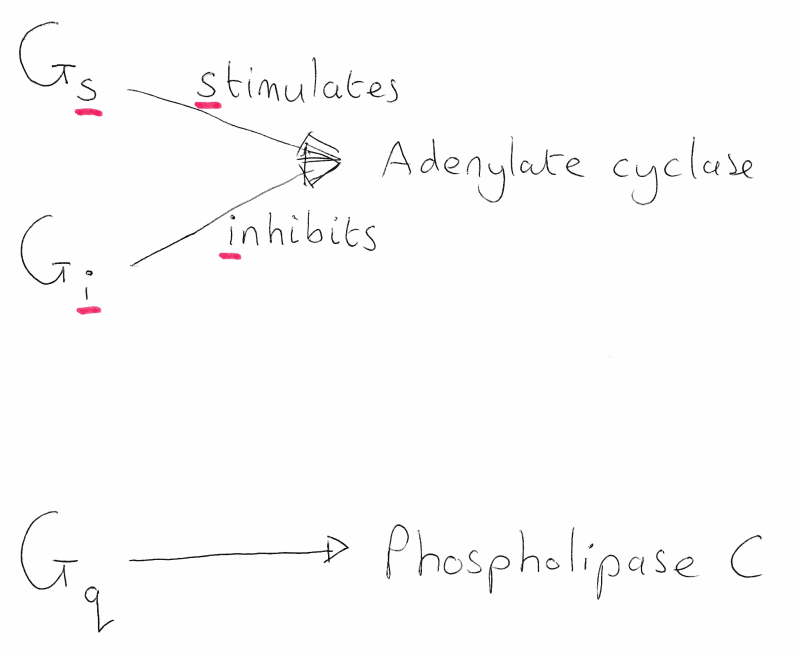
- G proteins are named according to the alpha subunit (Gs, Gi, Gq)
 | |
| Gs | Gi | Gq | |
|---|---|---|---|
| Mechanism | Stimulates adenylate cyclase → increases cAMP → activates protein kinase A | Inhibits adenylate cyclase → decreases cAMP → inhibits protein kinase A | Activates phospholipase C → splits PIP2 to IP3 & DAG → activates protein kinase C |
| Examples | • Beta-1 receptors (epinephrine, norepinephrine, dobutamine) • Beta-2 receptors (epinephrine, salbuterol) • H2 receptors (histamine) • D1 receptors (dopamine) • V2 receptors (vasopressin) • Receptors for ACTH, LH, FSH, glucagon, PTH, calcitonin, prostaglandins | • M2 receptors (acetylcholine) • Alpha-2 receptors (epinephrine, norephinephrine) • D2 receptors (dopamine) • GABA-B receptor | • Alpha-1 receptors (epinephrine, norepinephrine) • H1 receptors (histamine) • V1 receptors (vasopressin) • M1, M3 receptors (acetylcholine) |