Glucagon
On this page
Glucagon, the hormonal antagonist to insulin, is released from the alpha cells of the Islets of Langerhans in the pancreas. It results in increased plasma glucose levels hence its primary use to treat hypoglycaemia. Glucagon may also be used to treat beta-blocker overdose.
Contra-indications
Cautions
Diagram illustrating arrangement of cells in the pancreas
Side-effects
| Common | Uncommon | Rare or very rare |
|---|---|---|
| Nausea | Vomiting | Abdominal pain Hypertension Hypotension Tachycardia |
Contra-indications
- Phaeochromocytoma
Cautions
- Glucagonoma
- Ineffective in chronic hypoglycaemia, starvation, and adrenal insufficiency
- Insulinoma
- When used in the diagnosis of growth hormone secretion, delayed hypoglycaemia may result (deaths have been reported)
Glucagon Key Facts
- Produced by the alpha cells in the islets of Langerhans in the pancreas.
- Glucagon should be used with caution in patients with insulinoma as it may cause rebound hypoglycaemia.
- Glucagon is contraindicated in patients with phaeochromocytoma
- Glucagon is ineffective in patients with chronic hypoglycaemia (e.g. due to chronic alcoholism) due to depleted glycogen stores.
| Notes | Further detail | |
|---|---|---|
| Source | Alpha cells of the pancreas | |
| Function | Glycogenolysis Gluconeogenesis Lipolysis | In simple terms glucagon has the opposite metabolic effects to insulin |
| Regulation | Factors that increase secretion
Factors that decrease secretion
| Glucagon is used to rapidly reverse the effects of hypoglycaemia in diabetics |
Diagram illustrating arrangement of cells in the pancreas
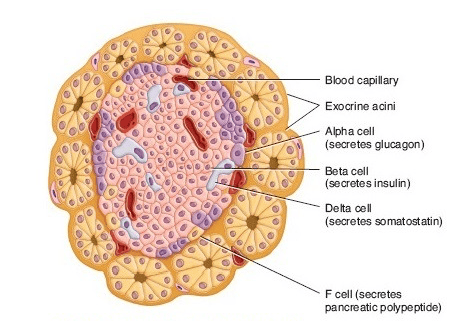 | |
Note the central collection of cells or islet consisting mostly of beta cells surrounded by the ductal or acinar (exocrine) cells
Hypoglycaemia management
Treatment options in adults
If able to take oral medication:- Oral carbohydrate: 15-20g of a quick acting carbohydrate should be followed by a long acting carbohydrate. Soft drinks such as Lucozade may be used but the carbohydrate content should be checked carefully.
- Buccal Glucose Gel: Absorbed more quickly than complex carbohydrates and is easily administered. The patient should be able to swallow in order for it to be fully effective.
- Glucagon: Glucagon 1 mg IV, IM or SC. Useful in situations where behaviour, co-operation or other neuroglycopenic symptoms make oral or IV routes difficult. Repeated doses are not advised. Glucagon will be less effective in those with depleted glycogen reserves e.g. sulphonylurea treatment, malnourished, or excessive alcohol consumption.
- Dextrose: 10-20% IV dextrose (glucose) may be used. Typical doses are 75-80 ml 20% glucose or 150-160 ml of 10% glucose. 50% dextrose is highly irritant and risks extravasation injury.
Treatment options in children
If able to take oral medication:- Glucose 5-20 g in liquid form (Glucogelµ, Dextrogelµ, or Rapiloseµ) or granulated sugar or sugar lumps. May be repeated after 10-15 minutes if required. Patient should be fed to prevent recurrence of hypoglycaemia.
- Glucagon (if child aged < 8, body weight < 25 kg dose is 500 microgram)
- If not effective in 10 minutes give IV glucose
- 2 mL/kg of 10% glucose IV as bolus followed by 10% glucose IV infusion at a rate of 5 mL/kg/hour
- Carbohydrates should be given as soon as possible after treatment