Digoxin and digoxin toxicity
On this page
Digoxin is a cardiac glycoside now mainly used for rate control in the management of atrial fibrillation. As it has positive inotropic properties it is sometimes used for improving symptoms (but not mortality) in patients with heart failure.
Side effects
Common:
Contraindications
Do not prescribe digoxin to people with:
Cautions
Prescribe digoxin with caution to people with:
Mechanism of action
- Stimulates the parasympathetic nervous system via the vagus nerve which slows conduction through the atrioventricular node which in turn slows the ventricular rate in atrial fibrillation and flutter. Digoxin is therefore a negative chronotrope
- Increases the force of cardiac muscle contraction due to inhibition of the Na+/K+ ATPase pump which raises intracellular sodium which indirectly raises intracellular calcium levels. Digoxin is therefore a positive inotrope
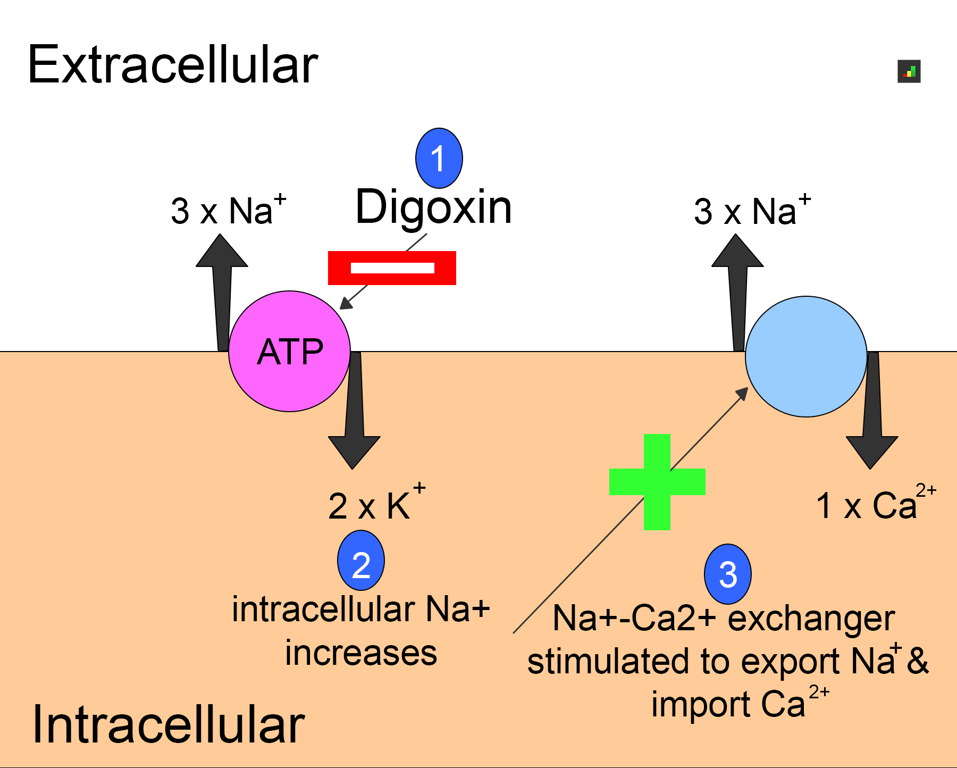 | |
1. Digoxin inhibits the Na+/K+ ATPase. 2. Intracellular sodium levels rise. 3. The Na+/Ca2+ exchanger is stimulated to export sodium from the cell in exchange for calcium. Note the Na+/Ca2+ exchanger can exchange 3 Na+ ions for 1 Ca2+ ion in either direction so some may refer to this pump being inhibited whereas some may describe it being activated. Click on image to enlarge
Key Points
- Digoxin inhibits the Na+/K+-ATPase pump increasing intracellular sodium, this in turn increases intracellular calcium increasing the force of myocardial contraction.
- Digoxin has a slow onset of action, even when given intravenously. Its half life is around 40 hours.
Side effects
Common:
- Arrythmias
- Cardiac conduction disorder
- Cerebral impairment
- Diarrhoea
- Dizziness
- Eosinophilia
- Nausea, skin reactions, vision disorders, vomiting
- Depression
- Reduced appetite
- Asthenia
- Confusion
- Gastrointestinal disorders
- Gynaecomastia
- Headache
- Malaise
- Psychosis
- Thrombocytopenia (rare).
Contraindications
Do not prescribe digoxin to people with:
- Supraventricular arrhythmias associated with accessory pathways (such as Wolff-Parkinson-White syndrome).
- Intermittent complete heart block; second-degree atrioventricular (AV) block.
- Myocarditis.
- Ventricular tachycardia or ventricular fibrillation.
Cautions
Prescribe digoxin with caution to people with:
- Constrictive pericarditis.
- Hypertrophic cardiomyopathy.
- Recent myocardial infarction.
- Sick sinus syndrome.
- Thyroid disease.
- Severe respiratory disease.
- Hypokalaemia, hypomagnesaemia, hypercalcaemia, and hypoxia (increased risk of digitalis toxicity)
- Renal impairment (consider reducing initial and maintenance doses and monitor plasma digoxin concentration. Risk of toxicity increased)
- Elderly (consider reduced dose as increased susceptibility to digitalis toxicity)
Digoxin toxicity
Plasma concentration alone does not determine whether a patient has developed digoxin toxicity. The BNF advises that the likelihood of toxicity increases progressively from 1.5 to 3 mcg/L. Digoxin has a narrow therapeutic index & toxicity may occur even when levels are within the normal therapeutic range (0.7 - 2.0 mcg/L).
Features:
Precipitating factors:
Management
*Digoxin toxicity may be precipitated by hypokalaemia. Toxicity can then lead to hyperkalaemia
Plasma concentration alone does not determine whether a patient has developed digoxin toxicity. The BNF advises that the likelihood of toxicity increases progressively from 1.5 to 3 mcg/L. Digoxin has a narrow therapeutic index & toxicity may occur even when levels are within the normal therapeutic range (0.7 - 2.0 mcg/L).
Features:
- Generally unwell
- GI: nausea & vomiting, diarrhoea and anorexia
- CNS: confusion, lethargy, weakness, dizziness, delirium
- CVS: palpitations, syncope, arrhythmias, and dyspnoea.
- Visual disturbance (rare): yellow-green vision, blurred vision, haloes
- ECG changes: downsloping ST depression (often referred to as a reverse tick), T wave flattening or inversion or biphasic T waves, QT shortening, premature beats (atrial, junctional or ventricular), tachyarrhythmias or bradyarrhythmias, prolonged PR interval.
Precipitating factors:
- classically: hypokalaemia*
- increasing age
- renal failure
- myocardial ischaemia
- hypomagnesaemia, hypercalcaemia, acidosis
- hypoalbuminaemia
- hypothermia
- hypothyroidism
- drugs: amiodarone, quinidine, verapamil, diltiazem, spironolactone (competes for secretion in distal convoluted tubule therefore reduce excretion), ciclosporin. Also drugs which cause hypokalaemia e.g. thiazides and loop diuretics
Management
- Digibind
- correct arrhythmias
- monitor potassium
*Digoxin toxicity may be precipitated by hypokalaemia. Toxicity can then lead to hyperkalaemia