Bacterial vaginosis
Bacterial vaginosis (BV) describes an overgrowth of predominately anaerobic organisms such as Gardnerella vaginalis. This leads to a consequent fall in lactic acid producing aerobic lactobacilli resulting in a raised vaginal pH.
Whilst BV is not a sexually transmitted infection it is seen almost exclusively in sexually active women.
Features
Amsel's criteria for diagnosis of BV - 3 of the following 4 points should be present
Management
Bacterial vaginosis in pregnancy
Whilst BV is not a sexually transmitted infection it is seen almost exclusively in sexually active women.
Features
- vaginal discharge: 'fishy', offensive
- asymptomatic in 50%
Amsel's criteria for diagnosis of BV - 3 of the following 4 points should be present
- thin, white homogenous discharge
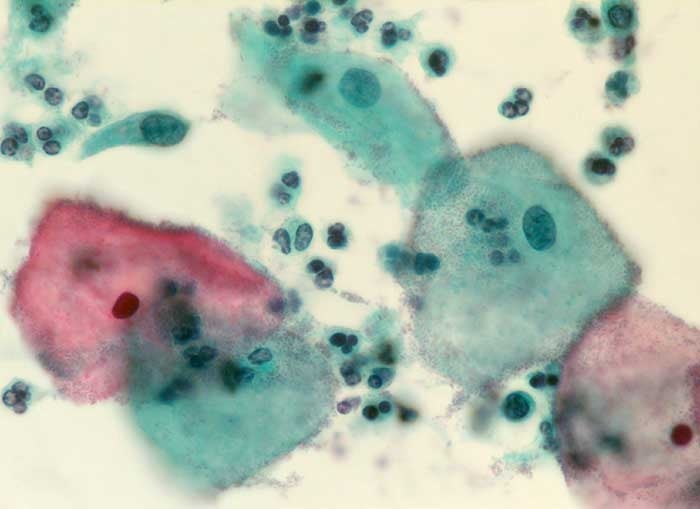
- clue cells on microscopy: stippled vaginal epithelial cells
- vaginal pH > 4.5
- positive whiff test (addition of potassium hydroxide results in fishy odour)
Management
- oral metronidazole for 5-7 days
- 70-80% initial cure rate
- relapse rate > 50% within 3 months
- the BNF suggests topical metronidazole or topical clindamycin as alternatives
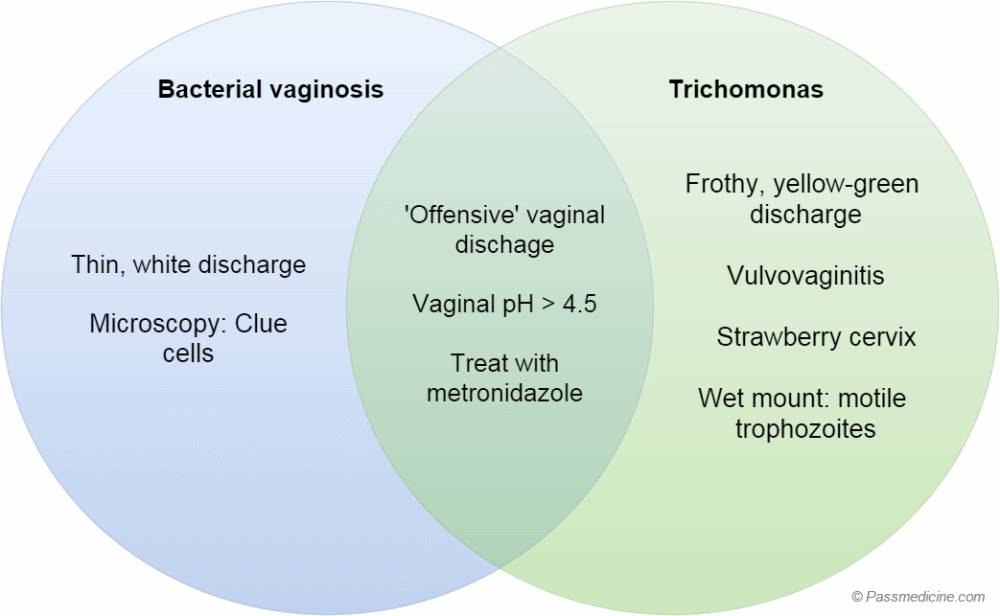 | |
Comparison of bacterial vaginosis and Trichomonas vaginalis
Bacterial vaginosis in pregnancy
- results in an increased risk of preterm labour, low birth weight and chorioamnionitis, late miscarriage
- it was previously taught that oral metronidazole should be avoided in the first trimester and topical clindamycin used instead. Recent guidelines however recommend that oral metronidazole is used throughout pregnancy. The BNF still advises against the use of high dose metronidazole regimes
 | |
| © Image used on license from PathoPic | |
Clue cells - epithelial cells develop a stippled appearance due to being covered with bacteria