Molluscum contagiosum
Molluscum contagiosum is a common skin infection caused by molluscum contagiosum virus (MCV), a member of the Poxviridae family. Transmission occurs directly by close personal contact, or indirectly via fomites (contaminated surfaces) such as shared towels and flannels. The majority of cases occur in children (often in children with atopic eczema), with the maximum incidence in preschool children aged 1-4 years.
Typically, molluscum contagiosum presents with characteristic pinkish or pearly white papules with a central umbilication, which are up to 5 mm in diameter. Lesions appear in clusters in areas anywhere on the body (except the palms of the hands and the soles of the feet). In children, lesions are commonly seen on the trunk and in flexures, but anogenital lesions may also occur. In adults, sexual contact may lead to lesions developing on the genitalia, pubis, thighs, and lower abdomen. Rarely, lesions can occur on the oral mucosa and on the eyelids.
Self care advice:
Treatment is not usually recommended. If lesions are troublesome or considered unsightly, use simple trauma or cryotherapy, depending on the parents' wishes and the child's age:
Referral may be necessary in some circumstances:
Typically, molluscum contagiosum presents with characteristic pinkish or pearly white papules with a central umbilication, which are up to 5 mm in diameter. Lesions appear in clusters in areas anywhere on the body (except the palms of the hands and the soles of the feet). In children, lesions are commonly seen on the trunk and in flexures, but anogenital lesions may also occur. In adults, sexual contact may lead to lesions developing on the genitalia, pubis, thighs, and lower abdomen. Rarely, lesions can occur on the oral mucosa and on the eyelids.
Self care advice:
- Reassure people that molluscum contagiosum is a self-limiting condition.
- Spontaneous resolution usually occurs within 18 months
- Explain that lesions are contagious, and it is sensible to avoid sharing towels, clothing, and baths with uninfected people (e.g. siblings)
- Encourage people not to scratch the lesions. If it is problematic, consider treatment to alleviate the itch
- Exclusion from school, gym, or swimming is not necessary
Treatment is not usually recommended. If lesions are troublesome or considered unsightly, use simple trauma or cryotherapy, depending on the parents' wishes and the child's age:
- Squeezing (with fingernails) or piercing (orange stick) lesions may be tried, following a bath. Treatment should be limited to a few lesions at one time
- Cryotherapy may be used in older children or adults, if the healthcare professional is experienced in the procedure
- Eczema or inflammation can develop around lesions prior to resolution. Treatment may be required if:
- → Itching is problematic; prescribe an emollient and a mild topical corticosteroid (e.g. hydrocortisone 1%)
- → The skin looks infected (e.g. oedema, crusting); prescribe a topical antibiotic (e.g. fusidic acid 2%)
Referral may be necessary in some circumstances:
- For people who are HIV-positive with extensive lesions urgent referral to a HIV specialist
- For people with eyelid-margin or ocular lesions and associated red eye urgent referral to an ophthalmologist
- Adults with anogenital lesions should be referred to genito-urinary medicine, for screening for other sexually transmitted infections
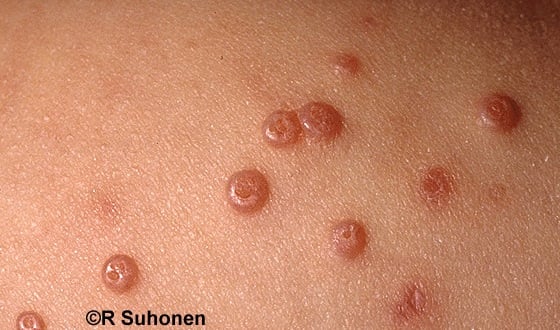 | |
| © Image used on license from DermNet NZ and with the kind permission of Prof Raimo Suhonen | |
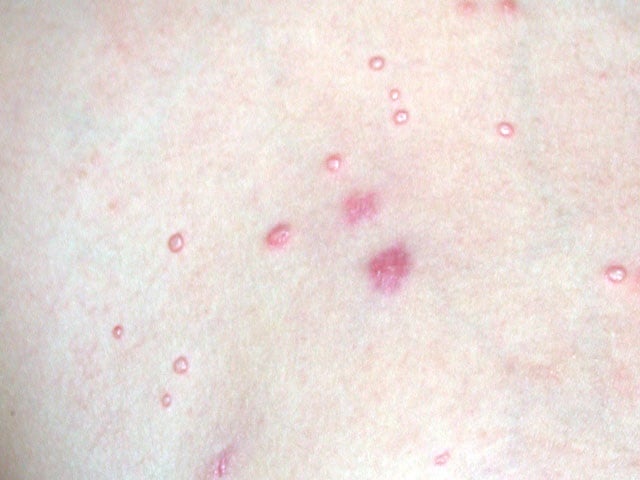 | |
| © Image used on license from DermNet NZ | |