Heparin
There are two main types of heparin - unfractionated, 'standard' heparin or low molecular weight heparin (LMWH). Heparins generally act by activating antithrombin (also known as antithrombin III). Activated antithrombin accelerates the inactivation of coagulation enzymes.
Unfractionated heparin forms a complex with antithrombin III which inhibits thrombin, factor Xa, and to some extent factors IXa, XIa and XIIa. LMWH forms a complex with antithrombin III which only increases the action of antithrombin III on factor Xa (see image below).
The table below shows the differences between standard heparin and LMWH:
Side effects
Common or very common:
Contraindications
Unfractionated heparin forms a complex with antithrombin III which inhibits thrombin, factor Xa, and to some extent factors IXa, XIa and XIIa. LMWH forms a complex with antithrombin III which only increases the action of antithrombin III on factor Xa (see image below).
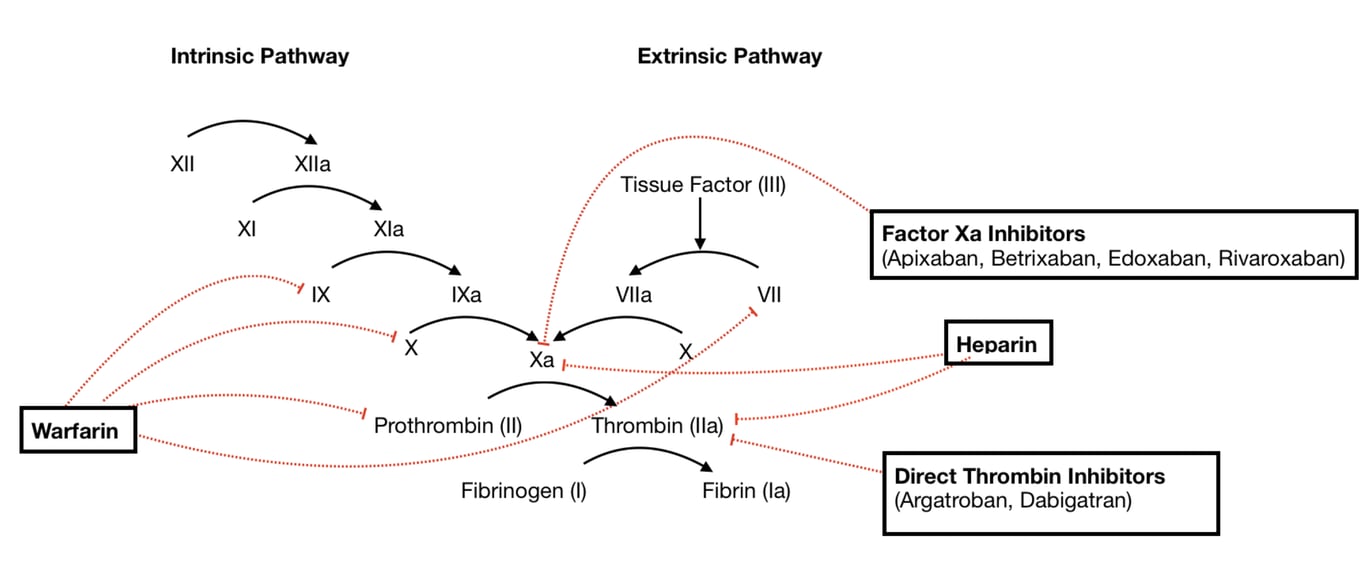 | |
The coagulation cascade and where anticoagulants act. Click on image to enlarge
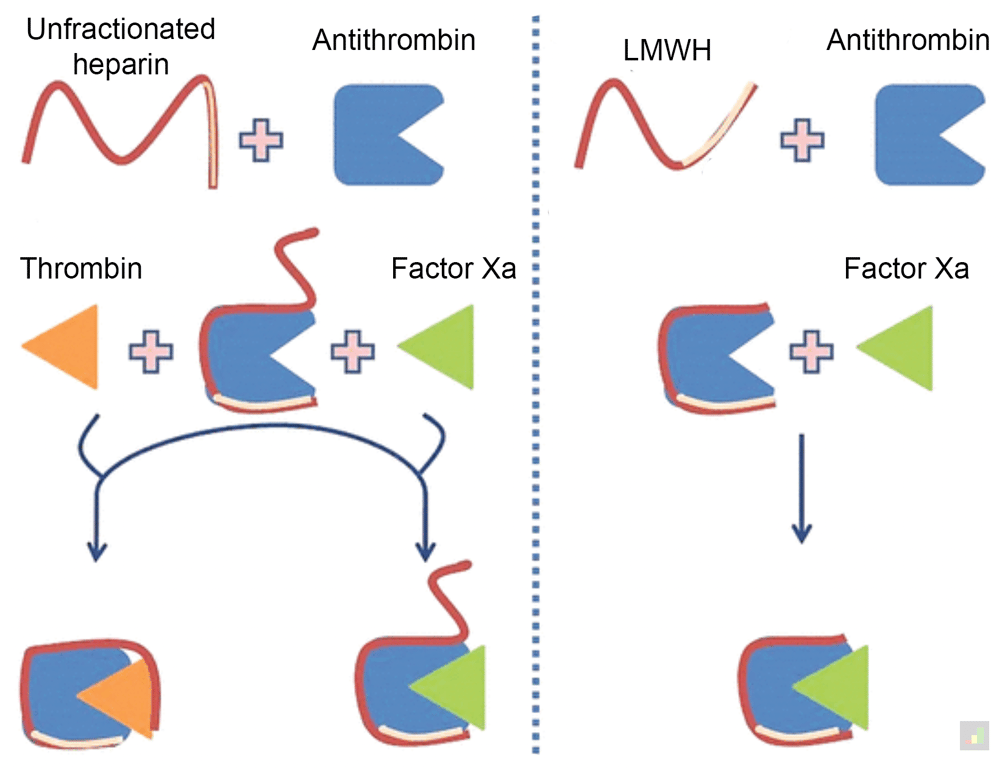 | |
Simplified illustration of unfractionated heparin versus LMWH. Click on image to enlarge
The table below shows the differences between standard heparin and LMWH:
| Standard heparin | Low molecular weight heparin (LMWH) | |
|---|---|---|
| Administration | Intravenous | Subcutaneous |
| Duration of action | Short | Long |
| Mechanism of action | Activates antithrombin III. Forms a complex that inhibits thrombin, factors Xa, IXa, Xia and XIIa | Activates antithrombin III. Forms a complex that inhibits factor Xa |
| Advantages | Short half life Faster reversal Renal excretion minimal | Monitoring not routinely required Easier to administer Lower risk of HIT and osteoporosis with LMWH |
| Monitoring | Activated partial thromboplastin time (APTT) | Anti-Factor Xa (although routine monitoring is not required) |
| Notes | Useful in situations where there is a high risk of bleeding as anticoagulation can be terminated rapidly | Now standard in the management of venous thromboembolism treatment and prophylaxis and acute coronary syndromes |
Side effects
Common or very common:
- Haemorrhage
- Heparin-induced thrombocytopenia
- Skin reactions e.g. urticaria
- Alopecia
- Hyperkalaemia (via inhibition of aldosterone)
- Osteoporosis (following long term use)
- Spinal haematoma
Heparin-induced thrombocytopaenia (HIT)
- immune mediated: typically IgG antibodies form against complexes of platelet factor 4 (PF4) and heparin
- these antibodies bind to the PF4-heparin complexes on the platelet surface and induce platelet activation by cross-linking FcγIIA receptors
- usually does not develop until after 5-10 days of treatment
- despite being associated with low platelets HIT is actually a prothrombotic condition
- features include a greater than 50% reduction in platelets, thrombosis and skin allergy
- treatment options include alternative anticoagulants such as lepirudin, danaparoid, fondaparinux, bivalirudin, and argatroban.
Contraindications
- Acute bacterial endocarditis
- After major trauma
- Avoid injections containing benzyl alcohol in neonates
- Epidural anaesthesia with treatment doses
- Haemophilia or other haemorrhagic disorders
- Peptic ulcer
- Recent cerebral haemorrhage
- Recent surgery to eye or nervous system
- Spinal anaesthesia with treatment doses
- Thrombocytopenia (including history of heparin-induced thrombocytopenia
Reversal of heparin
Heparin overdose may be reversed by protamine sulphate (sulfate), although this only partially reverses the effect of LMWH.
Heparin overdose may be reversed by protamine sulphate (sulfate), although this only partially reverses the effect of LMWH.