Complement system & complement deficiencies
On this page
Complement is a group of around 20 liver synthesised proteins. They are a vital component of the immune system. There are three types of triggers, or activation pathways, which can initiate the complement cascade where complement proteins sequentially activate other complement proteins.
Complement triggers the following immune functions:
C3b
As can be seen all activation pathways eventually lead to the splitting of C3 into C3a and C3b. C3b is an important complement protein that plays a role in:
Anaphylatoxins
Anaphylatoxins (C3a, C4a, C5a) are complement fragments that cause anaphylaxis-like reactions by:
C3b and C5-C9 are involved in opsonisation and destruction of bacteria so deficiencies here lead to severe bacterial infection especially with encapsulated bacterial.
Complement decay-accelerating factor (DAF/CD55) is a membrane-bound regulatory protein that protects host cells from their own complement system by accelerating the breakdown of C3 and C5 convertases. Its deficiency, as seen in paroxysmal nocturnal haemoglobinuria (PNH), leads to complement-mediated destruction of the body's own cells, particularly red blood cells.
The table below summarises the deficiencies and associated diseases:
Complement triggers the following immune functions:
- Membrane attack complex: causes pathogen cell death via rupturing the cell wall.
- Enhances phagocytosis via opsonization: C3b being the most important opsonin.
- Inflammation: attracting macrophages and neutrophils.
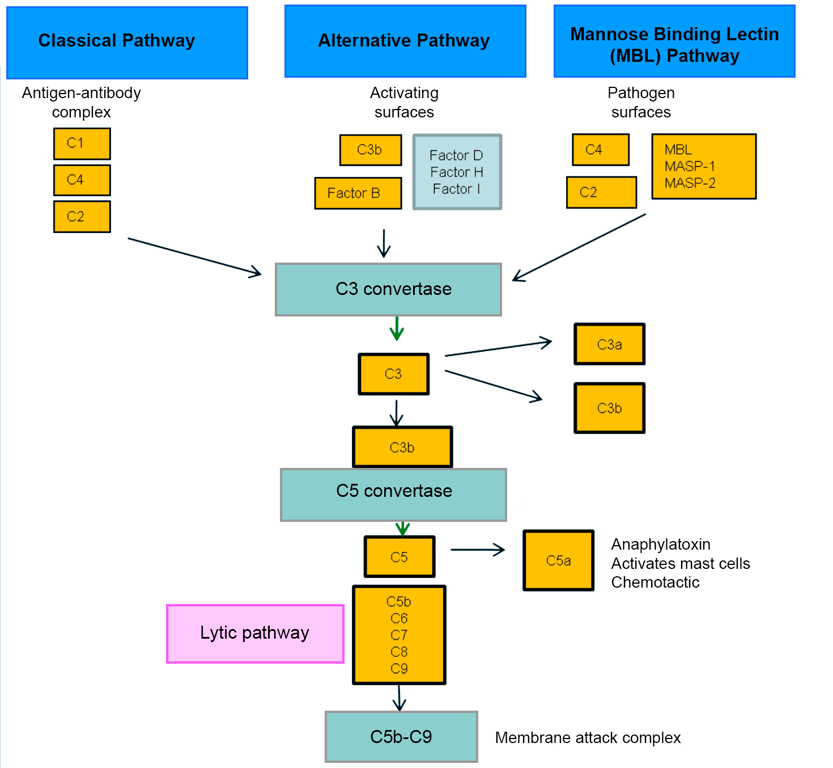 | |
Diagram illustrating the complement system. Note the final step of the compliment cascade is sometimes referred to as the lytic pathway. This is the part of the complement system that causes the death of bacterial cells. It's triggered by the splitting of C5 and the attachment of C5b to a target. Click on image to enlarge
Membrane attack complex (MAC)
Membrane attack complex (MAC) is formed by the sequential assembly of complement proteins C5b, C6, C7, C8, and multiple C9 molecules, which create a pore-like structure in the membrane of a target cell, leading to cell lysis and death.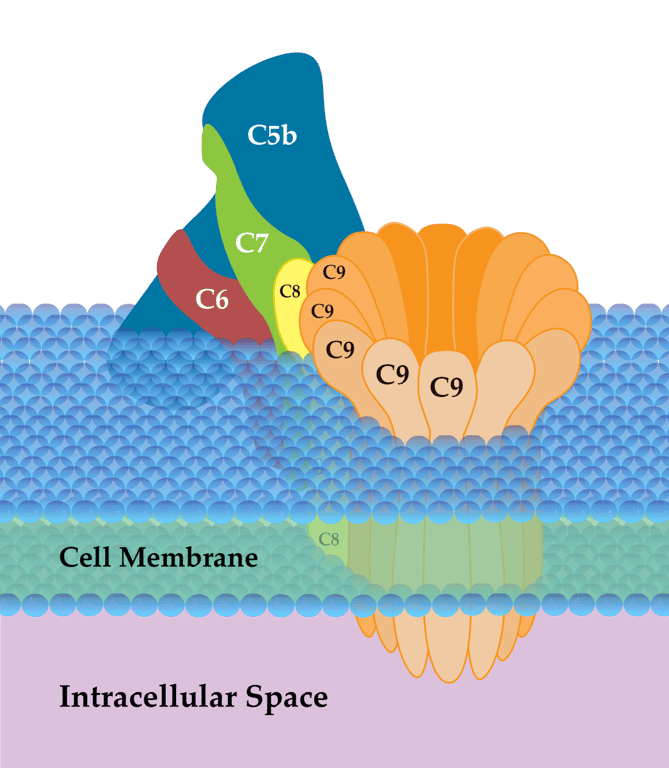 | |
Membrane attack complex (MAC) forming pore on pathogen cell membrane. Click on image to enlarge
C3b
As can be seen all activation pathways eventually lead to the splitting of C3 into C3a and C3b. C3b is an important complement protein that plays a role in:
- Opsonisation
- C3b may combine with other complement proteins to form C5 convertase and convert C5 to C5a and C5b. C5b recruits C6, C7, C8 and C9 to form membrane attack complex
Anaphylatoxins
Anaphylatoxins (C3a, C4a, C5a) are complement fragments that cause anaphylaxis-like reactions by:
- Stimulating mast cell and basophil degranulation
- Causing smooth muscle contraction
- Increasing vascular permeability
- Acting as chemoattractants (especially C5a)
Chemoattractants
C5a is the most potent chemoattractant among complement proteins.
C3a also has chemotactic properties but is much weaker than C5a.
C5a is the most potent chemoattractant among complement proteins.
C3a also has chemotactic properties but is much weaker than C5a.
Complement deficiency
Complement deficiencies may be congenital or acquired. Different complement deficiencies can have different outcomes. For example C1 deficiency can result in SLE as the body's ability to effectively clear away immune complexes and cellular debris is impaired, leading to an accumulation of autoantigens that can trigger an autoimmune response characteristic of SLE.C3b and C5-C9 are involved in opsonisation and destruction of bacteria so deficiencies here lead to severe bacterial infection especially with encapsulated bacterial.
Complement control protein deficiencies
Conversely a deficiency in the enzymes that regulate complement can lead to various problems. For example deficiency of the enzyme that inhibit C1 acitivity (C1 esterase inhibitor) can result in hereditary angioedema (HAE) as the response to antigens is unregulated.Complement decay-accelerating factor (DAF/CD55) is a membrane-bound regulatory protein that protects host cells from their own complement system by accelerating the breakdown of C3 and C5 convertases. Its deficiency, as seen in paroxysmal nocturnal haemoglobinuria (PNH), leads to complement-mediated destruction of the body's own cells, particularly red blood cells.
The table below summarises the deficiencies and associated diseases:
| Complement Deficiency | Inheritance Pattern | Associated Clinical Features | Increased Susceptibility to Infections | |||
|---|---|---|---|---|---|---|
| C1 | Autosomal recessive | Systemic lupus erythematosus (SLE) | Not specifically noted | |||
| C2 | Autosomal recessive | SLE, recurrent pyogenic infections with encapsulated bacteria (especially pneumococcal), other autoimmune disorders (e.g., glomerulonephritis, vasculitis) | Streptococcus pneumoniae | |||
| C3 | Autosomal recessive | Recurrent pyogenic infections with encapsulated bacteria from birth, glomerulonephritis, other immune complex disorders | Streptococcus pneumoniae, Neisseria meningitidis | |||
| C4 | Autosomal recessive | SLE, other autoimmune disorders (e.g., IgA nephropathy, systemic sclerosis, type 1 diabetes mellitus) | Not specifically noted | |||
| C5-C9 (Terminal Pathway Components) | Autosomal recessive | Recurrent Neisseria meningitidis and disseminated Neisseria gonorrhoeae infections | Neisseria meningitidis | |||
| Mannose-Binding Lectin (MBL) | Autosomal recessive | Recurrent pyogenic infections with encapsulated bacteria from birth; unexplained sepsis; increased infection severity in secondary immunodeficiencies | Streptococcus pneumoniae, Neisseria meningitidis | |||
| MASP-2 | Unknown | Autoimmune disorders (e.g., inflammatory bowel disease, erythema multiforme), recurrent pyogenic infections with encapsulated bacteria | Streptococcus pneumoniae | |||
| Factor B | Autosomal recessive | Pyogenic infections | Not specifically noted | |||
| Factor D | Autosomal | Pyogenic infections | Not specifically noted | |||
| Properdin | X-linked | Increased risk of fulminant | Neisseria infection | |||
| C1 Inhibitor | Autosomal dominant | Angioedema | Not specifically noted DAF | Acquired | Paroxysmal nocturnal haemoglobinuria | Not specifically noted |
| Factor I | Autosomal codominant | Similar to C3 deficiency | Streptococcus pneumoniae, Neisseria meningitidis | |||
| Factor H | Autosomal codominant | Similar to C3 deficiency; hemolytic-uremic syndrome | Streptococcus pneumoniae, Neisseria meningitidis |
Deficiencies in components like C3, properdin, and terminal pathway components (C5-C9) are associated with increased susceptibility to infections by Neisseria meningitidis and Streptococcus pneumoniae.