Bile ducts
Common bile duct (CBD)
The common bile duct (CBD) is formed by the merging of the common hepatic duct and the cystic duct. The common hepatic duct is formed from the left and right hepatic ducts which arise from the left and right lobes of the liver respectively.
The RCEM expect candidates to be aware of the 3 parts of the CBD.
The CBD can actually be divided into 4 parts and many resources will quote 4 parts of the CBD. This may be down to one of two reasons. Firstly because only some people have a supraduodenal CBD section. Cadaver studies suggest around 1 in 3 have this section. If present it measures 5-20mm and lies in the free edge of the lesser omentum. We have included detail on the supraduodenal secton as it has come up in past exams. Secondly some sources consider the retro-pancreatic and intraduodenal sections together as one
| Part | Description | Relations |
|---|---|---|
| 1 | Supraduodenal | CBD anterior to portal vein CBD to left of hepatic artery |
| 2 | Retro-duodenal | CBD posterior to duodenum CBD anterior to IVC Gastroduodenal artery on the left |
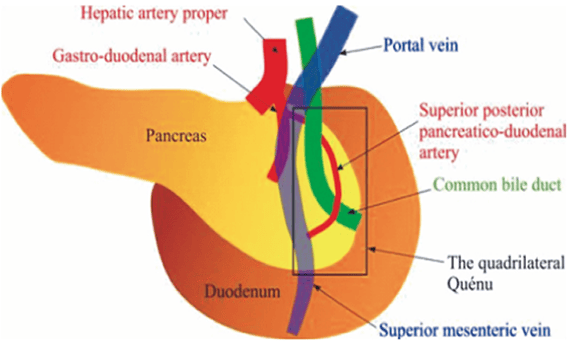
| 3 | Retro-pancreatic or infraduodenal | Runs in groove on posterior part of the head of the pancreas. May be totally embedded in pancreatic tissue. CBD anterior to IVC Gastroduodenal artery on the left Pancreaticoduodenal artery crosses the bile duct anteriorly and posteriorly |
| 4 | Intra-parietal or intraduodenal | Enters the 2nd part of duodenum |
The common bile duct terminates at the ampulla of Vater into the second part of the duodenum.
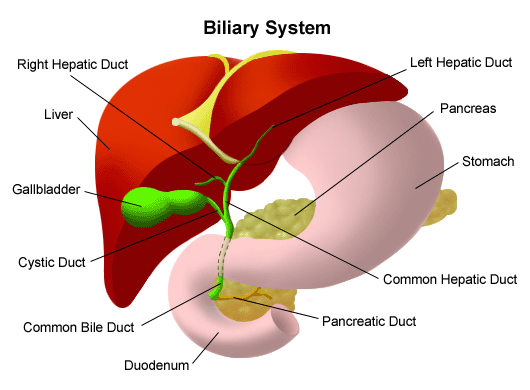 | |
Diagram illustrating the biliary tree
 | |
| Wikipedia | |
Posterior view of the retro-duodenal and retro-pancreatic common bile duct
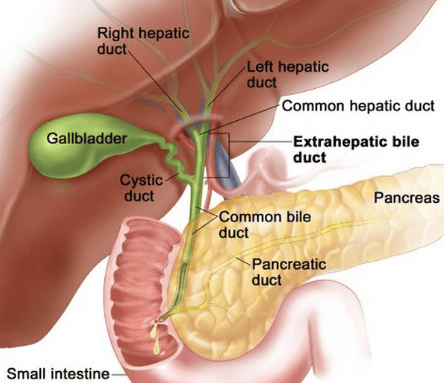 | |
Close up of the gallbladder and close anatomical relations
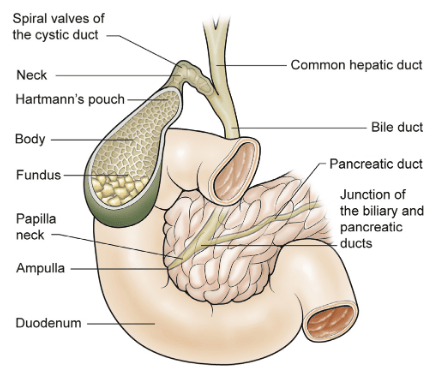 | |
Fundus, body and neck of gallbladder and relation to 1st and 2nd parts of duodenum. See how the gallbladder lies anterior to the 1st part of the duodenum and part of the 2nd part (descending part)of the duodenum