Temporomandibular joint (TMJ)
TMJ Key Points
- The joint between the mandibular head (condyle) and the squamous temporal bone is synovial
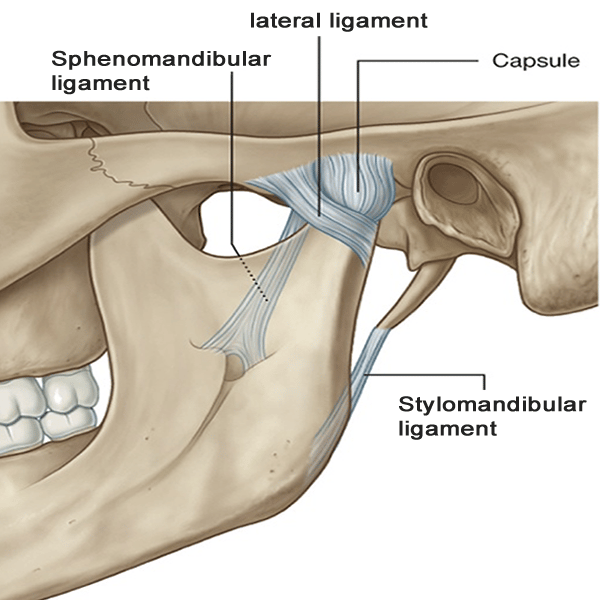
- The lateral temporomandibular ligament limits movement of the mandible posteriorly
- The sphenomandibular ligament limits movement of the mandible inferiorly
- The joint is least stable when the mandible is in the open position
- The TMJ allows multidirectional movement of the mandible under the actions of several muscles which are summarised in the table below.
 | |
| Wikipedia | |
The tables below show mandibular movements broken down by movement and by muscles moving the mandible
| Movement | Muscles responsible |
|---|---|
| Elevation of mandible |
|
| Depression of mandible |
|
| Retraction of mandible |
|
| Protrusion |
|
| Muscle | Movement of mandible |
|---|---|
| Medial pterygoid | Elevation of the mandible Minimal assistance to lateral pterygoid with protrusion |
| Lateral pterygoid | Depression and protrusion |
| Masseter | Elevation and protusion |
| Temporalis | Elevation and retraction |
| Digastric | Complex jaw movements Elevates hyoid, if hyoid stabilised depresses mandible |