Trigeminal nerve
The trigeminal nerve is the fifth cranial nerve and is often referred to as CN V. CN V is responsible for sensation to the face and also contributes to motor functions such as biting and chewing.
The trigeminal nerve has 3 major branches:
The ophthalmic (V1) and maxillary nerves (V2) are purely sensory, whereas the mandibular nerve supplies motor as well as sensory functions. The mandibular nerve carries touch-position and pain-temperature sensations from the mouth with its lingual nerve branch conveying sensation from the tongue.
In a patient with facial shingles the cutaneous involvement of the tip of the nose indicates nasociliary nerve involvement and is known as Hutchinson's sign. A positive Hutchinson's sign increases the likelihood of ocular complications associated with shingles.
The trigeminal nerve has 3 major branches:
- Ophthalmic nerve (V1)
- Maxillary nerve (V2)
- Mandibular nerve (V3)
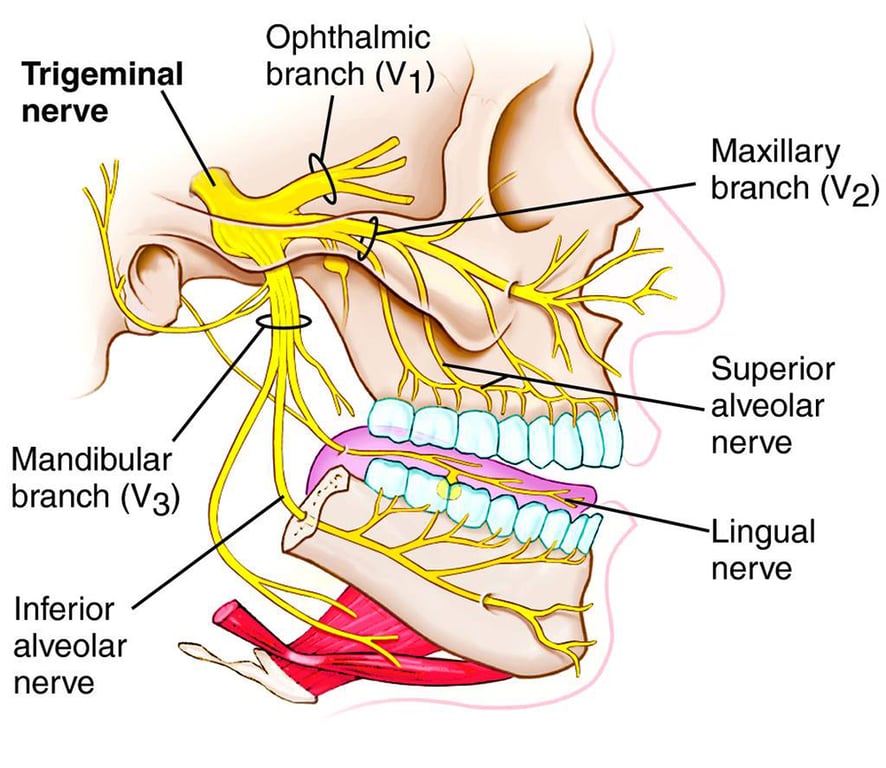 | |
Trigeminal nerve. Click on image to enlarge
The ophthalmic (V1) and maxillary nerves (V2) are purely sensory, whereas the mandibular nerve supplies motor as well as sensory functions. The mandibular nerve carries touch-position and pain-temperature sensations from the mouth with its lingual nerve branch conveying sensation from the tongue.
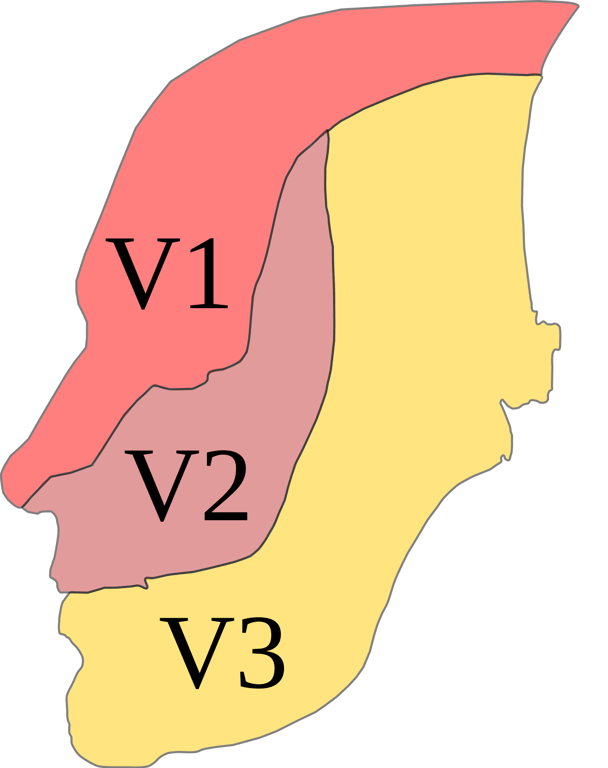 | |
Sensory distribution of major trigeminal nerve branches. Click on image to enlarge
Hutchinson's sign
The nasociliary nerve is a branch of the ophthalmic nerve (CN V1).In a patient with facial shingles the cutaneous involvement of the tip of the nose indicates nasociliary nerve involvement and is known as Hutchinson's sign. A positive Hutchinson's sign increases the likelihood of ocular complications associated with shingles.