Renal regulation of acid base balance
On this page
Bicarbonate
Proximal renal tubule
Bicarbonate (HCO3-) is freely filtered at the glomerulus. Filtrate HCO3- concentration is therefore roughly the same as plasma.Filtrate [HCO3-] = plasma [HCO3-] = ~ 24 mmol/L
<0.1% of filtered HCO3- is normally excreted in the urine. Approximately 80% of filtered bicarbonate is reabsorbed in the proximal tubule.
Bicarbonate (HCO3-) is not transported directly, It associates with hydrogen (H+) ions to form carbonic acid (H2CO3) which rapidly dissociates into carbon dioxide and water in the presence of carbonic anhydrase as shown in the equation below.
H+ + HCO3- ‡Œ H2CO3 ‡Œ CO2 + H2O
CO2 + H2O diffuse into the tubular cells where they recombine into H2CO3 which then dissociates into H+ + HCO3- i.e. the equation above happens in reverse.
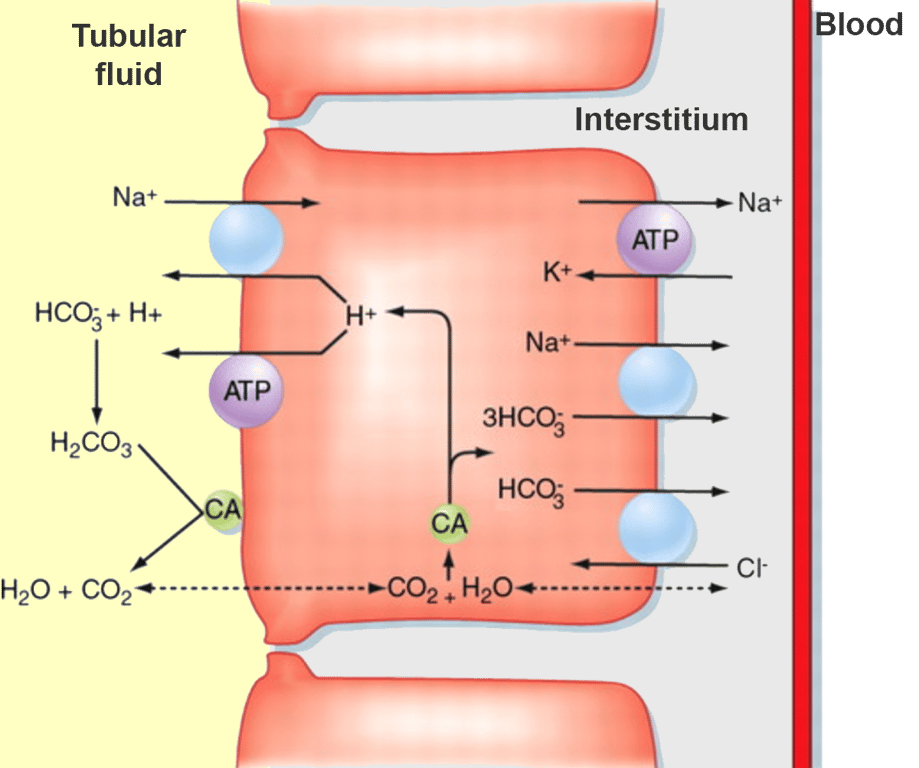 | |
Bicarbonate reabsorption and H+ secretion in the proximal tubule
Bicarbonate (HCO3-) is transported into the interstitial fluid primarily via Na+-HCO3- symporters.
For every 1 hydrogen ion (H+) secreted into the lumen 1 bicarbonate (HCO3-) and 1 sodium (Na+) ion enter the plasma. This mechanism does not lead to the net excretion of any H+ from the body as the H+ is consumed in the reaction with the filtered bicarbonate in the tubular lumen
Thick ascending loop
A further 10-15% of bicarbonate is reabsorbed in the thick ascending loop via similar mechanisms.Distal renal tubule
The secretion of H+ into the distal tubule promotes reabsorption of any remaining HCO3-. In total 4000-5000 mmol of bicarbonate is reabsorbed each day.H+ secretion in the early distal tubule is primarily via Na+-H+ exchange. More distally H+ secretion is from H+-ATPase and H+-K+ATPase pumps in intercalated cells.
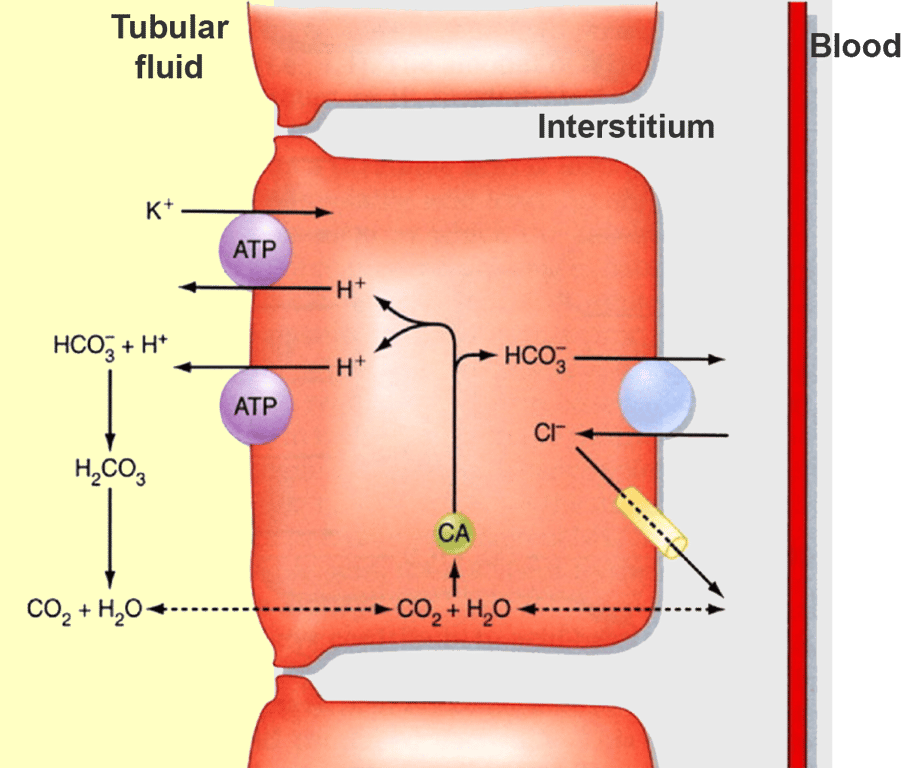 | |
H+ ion secretion in the distal tubule. Note the image shows the active transporters in the late distal tubule. In the early distal tubule H+ ion secretion is primarily via Na+-H+ exchange. click on image to enlarge
Note that the H+ formed is derived from the breakdown of carbonic acid which is itself formed by combining carbon dioxide and water. Intercalated cells contain plentiful carbonic anhydrase to drive the initial formation of carbonic acid from CO2 and H2O.
H+ secretion is proportional to intracellular [H+]. Tubular fluid becomes more acidic as it moves through the nephron due to this.
Ammonia
Proximal renal tubule
Glutamate metabolism in tubular cells generates ammonia (NH3). NH3 may diffuse out of cells into the tubular fluid as NH3 or be transported by the Na+-H+ antiporter as ammonium (NH4+) which substitutes for H+ .In the tubular fluid NH3 will combine with H+ to form ammonium (NH4+). Ammonium cannot diffuse freely through membranes and requires transporters.
Thick ascending loop to distal tubule
Approximately 50% of secreted NH4+ is reabsorbed in the thick ascending limb of the loop of Henle by the Na+-K+-2Cl- symporter where is substitutes for K+. This NH4+ enters the medullary interstitium and dissociates into NH3 and H+. NH3 re-enters the tubular fluid in the collecting duct by diffusion and recombines with H+ reforming NH4+ which is then trapped in the lumen and excreted in the urine.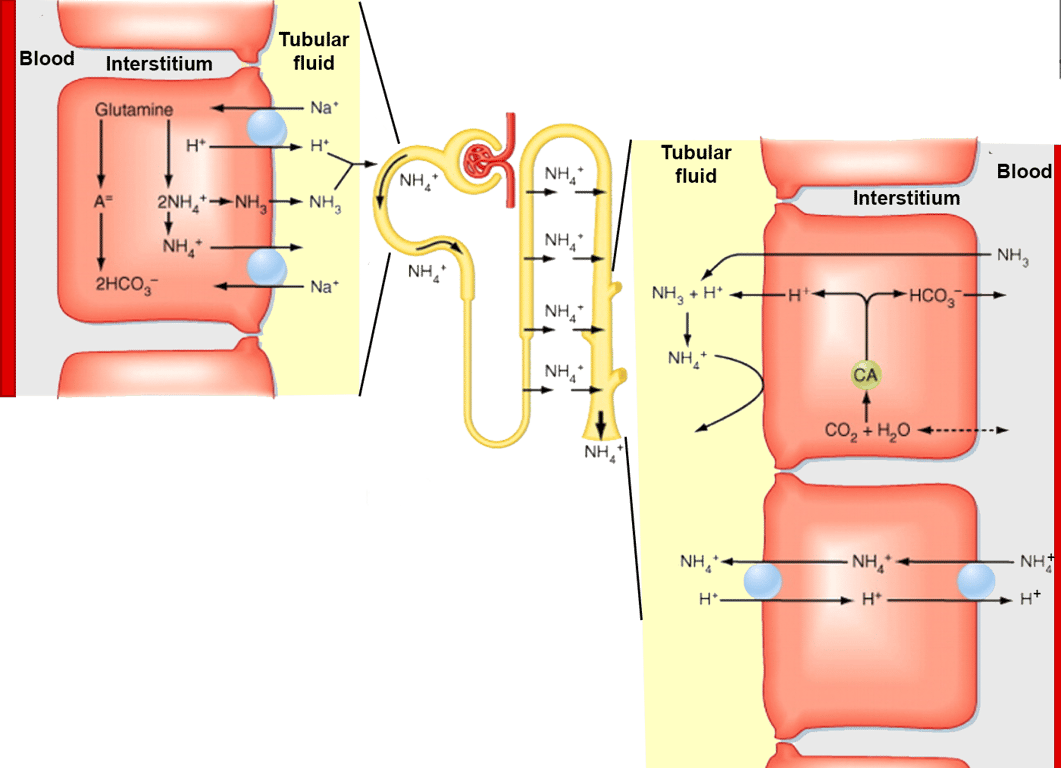 | |
Renal handling of ammonia. click on image to enlarge
Distal renal tubule, urinary buffers & acid excretion
The combination of H+ with NH3 and phosphate (PO43-) prevents H+ recycling and allows acid excretion.
In the proximal tubule H+ secretion promotes HCO3- reabsorption.
In the distal tubule H+ generation results in bicarbonate production & H+ secretion is met by urinary buffers which leads to acid excretion in the urine.
In the distal tubule H+ generation results in bicarbonate production & H+ secretion is met by urinary buffers which leads to acid excretion in the urine.