Cell membrane transport: protein transport and ion channels
Specialised protein channels
Specialised protein channels made of multiple protein sub units. Two important examples are aquaporins and gap junctions. Aquaporins are membrane proteins that serve as channels in the transfer of water, and in some cases, small solutes across the membrane. Gap junctions are clusters of intercellular channels that allow direct diffusion of ions and small molecules between adjacent cells. The intercellular channels are formed by head-to-head docking of hexameric assemblies (connexons).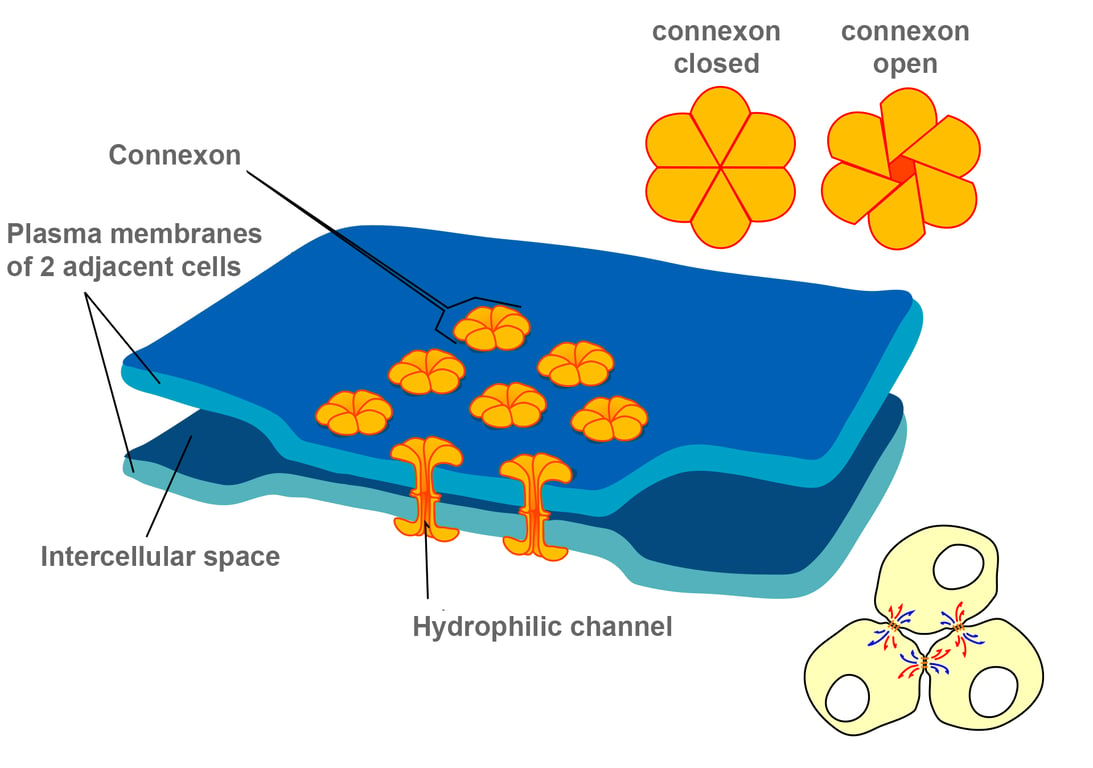 | |
Gap junctions between cells. Click on image to enlarge
Protein carrier mediated transport
Proteins in the cell membrane may function as transporters. Transporters may be classed as uniporters, symporters or antiporters depending on the number of molecules transported and the direction of travel (see image below).
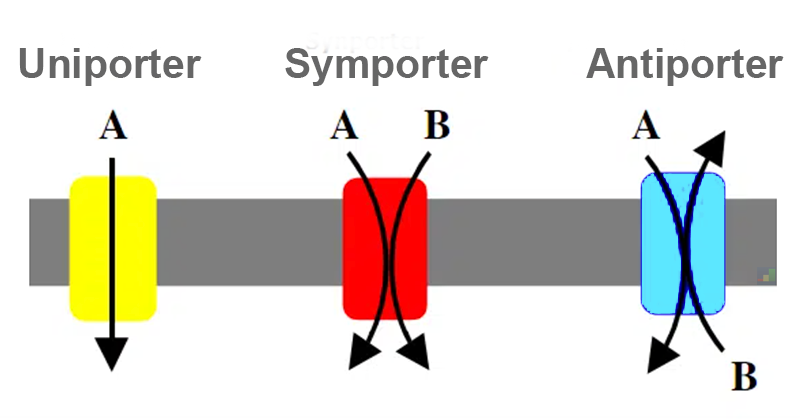 | |
Types of transport channel. Click on image to enlarge
Transporters that allow a molecule to move along its concentration gradient are said to allow facilitated diffusion. The energy required for the conformational change in the protein is provided by the concentration gradient rather than cell generated ATP.
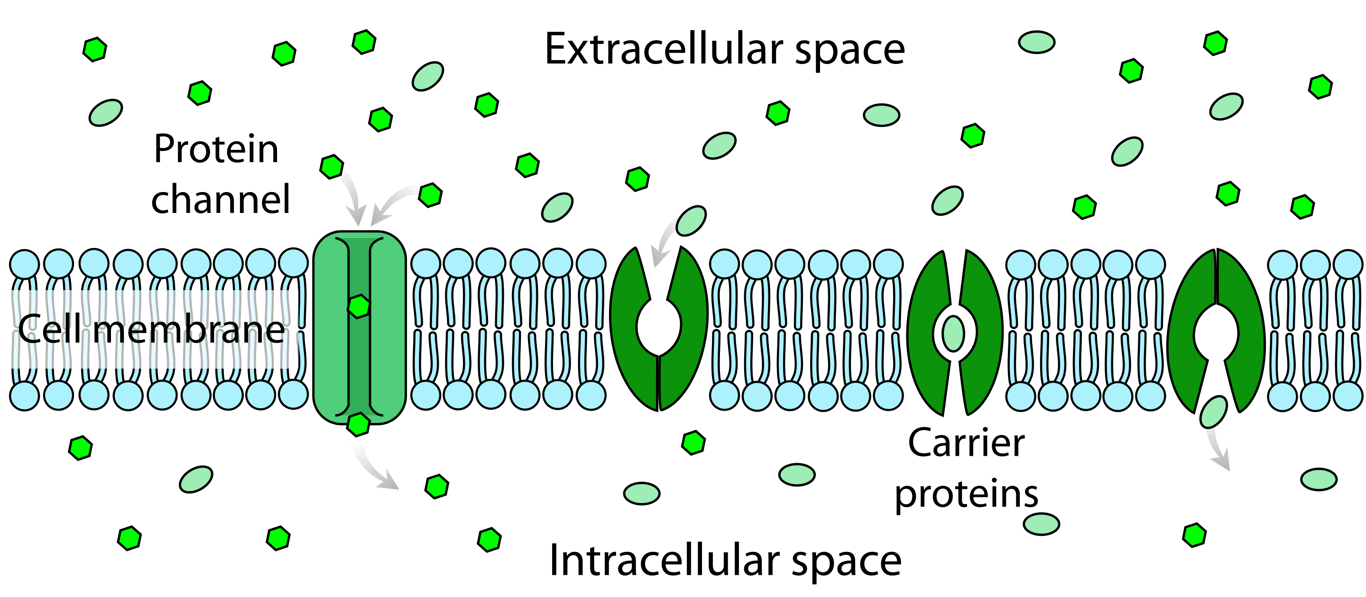 | |
Diffusion versus facilitated diffusion. Click on image to enlarge
A number of symporters and antiporters may use the energy generated by molecules moving along their concentration gradient to move another molecule against its concentration gradient, when this occurs it is termed secondary active transport.
Examples of secondary active transport are:
- The Na+-Ca2+ antiporter which moves one 1 x Ca2+ out of the cell in exchange for 3 x Na+ moved into the cell.
- The Na+-Glucose symporter which moves 2x Na+ into the cell and one glucose into the cell.
Primary active transport describes an energy consuming process that moves ions or molecules against their concentration gradients. The Na+-K+-ATPase is the most famous example of this.
Ion channels are transmembrane proteins which provide an aqueous, typically hydrophilic, pore through which ions can move across the lipid bilayer. Ions pass through channels down their electrochemical gradient.
The aqueous pore becomes accessible (opens) to ions after a conformational change in the transmembrane protein structure. Ion channels are therefore in an open or closed state. Transition between open and closed states is termed gating. Ion channels are gated with varying types of gating mechanism as shown below:
Ion pumps can be distinguished from ion channels on the basis that ion pumps actively transport ions against a concentration gradient.
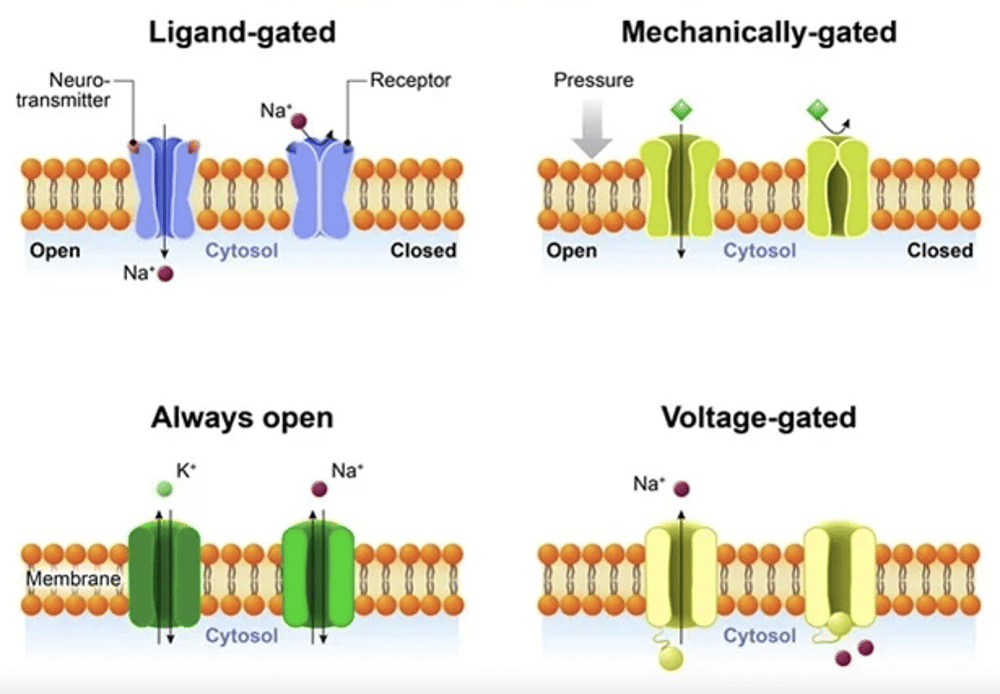 | |
Types of ion channel. Voltage-gated ion channels open according to the potential difference across the cell membrane. Ligand gated channels open in response to a signal molecule binding to them. Click on image to enlarge
Ion channels give the cell the ability to control the movement of ions across the cell membrane and have a number of features that allow them to do so. Ion channels are typically selective for particular ions and the pore is charged to either allow cations or anions. In addition to charge, ion size and water of hydration determine which channels particular ions are able to pass down. Multiple channels often exist for the same ion but differing channel types will allow ionic movement at different rates depending on the channel conductance.
Ion movement generates electrical current.
Conductance is the degree to which an object conducts electricity, calculated as the ratio of the current which flows to the potential difference present. This is the reciprocal of the resistance, and is measured in siemens or mhos.
Conductance is the degree to which an object conducts electricity, calculated as the ratio of the current which flows to the potential difference present. This is the reciprocal of the resistance, and is measured in siemens or mhos.
Channel function may be modified via phosphorylation by enzymes e.g. protein kinase. This results in a change in their gating and/or conductive properties. An example of this is renal Na+ channels are not gated by voltage in their unphosphorylated state. However, upon phosphorylation these channels become voltage-dependent.
Ligand gated channels may be gated in a number of ways including:
- Gated by intracellular molecules such as cAMP
- Gated by extracellular molecules such as hormones or neurotransmitters.
- Gated by special receptors in response to a change in variable e.g. pH