Roundworm
On this page
Symptoms depend on the parasite load with more severe symptoms occurring in those with high parasite loads. Malnutrition is possible with lethargy and poor growth in children. Diarrhoea can also be a feature. The majority however are asymptomatic.
Roundworm infection is most prevalent in tropical and subtropical areas of Asia, Africa, and Latin America, especially in regions with poor sanitation. It is transmitted via ingestion of eggs that are passed in human faeces and mature in the soil.
The severity of symptoms typically correlates with parasite load:
Clinical Features
Early phase (larval migration):
Diagnosis
Microscopic examination of stool samples to detect characteristic Ascaris eggs. Note in cases of high parasite burden actual worms may be passed in stool or vomit. Due to the large number of eggs produced by each adult female worm (female worms can produce 200,000 eggs a day), examination of a single stool sample is usually diagnostic.
Imaging, such as ultrasound or CT, may be used for suspected intestinal or hepatobiliary complications.
In cases of intestinal obstruction, supportive care and sometimes surgical intervention may be required
Background
Ascaris lumbricoides (human roundworm) is a parasitic nematode. it is the largenst nematode to colonise the human gut. | |
Human roundworm. Females can reach up to 40cm in length. Click on image to enlarge
Roundworm infection is most prevalent in tropical and subtropical areas of Asia, Africa, and Latin America, especially in regions with poor sanitation. It is transmitted via ingestion of eggs that are passed in human faeces and mature in the soil.
Poor hygiene and inadequate waste disposal contribute significantly to its spread.
Migratory cycle
After ingestion, Ascaris eggs hatch in the intestine, releasing larvae that penetrate the intestinal wall. These larvae travel via the bloodstream to the liver and then to the lungs, where they mature for 10–14 days. They then ascend the trachea, where they are either coughed up or swallowed. Swallowed parasites return to the small intestine, where they develop into adult worms capable of producing eggs.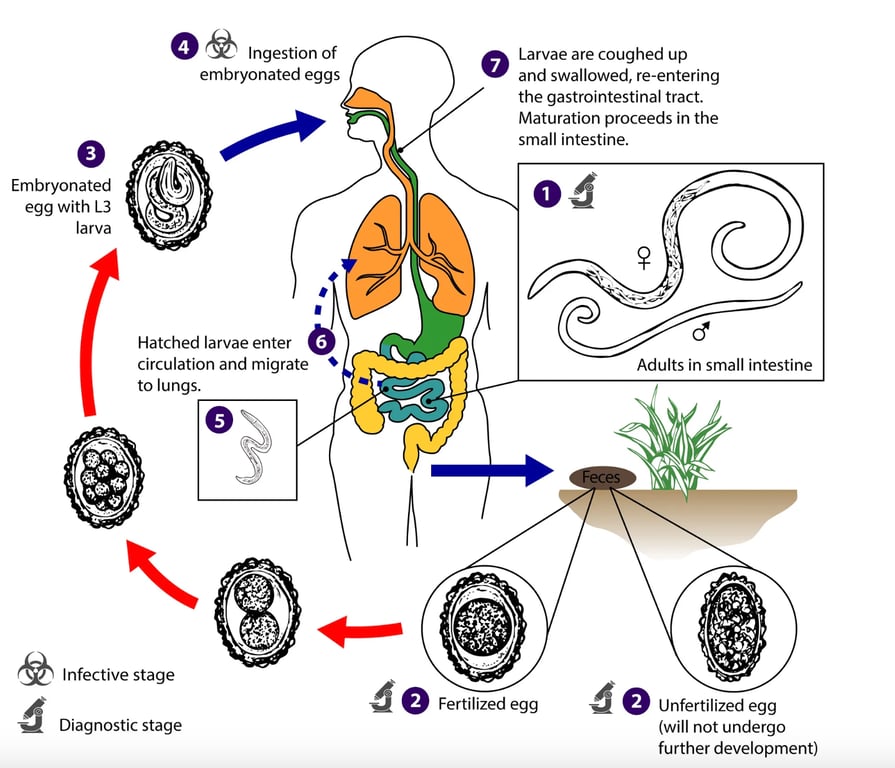 | |
Human roundworm lifecycle. Click on image to enlarge
The severity of symptoms typically correlates with parasite load:
- Low burden: Often asymptomatic or mild gastrointestinal discomfort.
- Moderate burden: Can cause malnutrition, abdominal pain, and growth retardation in children.
- Heavy burden: May result in intestinal obstruction, hepatobiliary or pancreatic involvement, or pulmonary symptoms during the larval migration phase.
Clinical Features
Early phase (larval migration):
- Dry cough, wheezing, and eosinophilic pneumonitis (Löffler’s syndrome)
- Fever and shortness of breath in severe cases
- Abdominal pain, nausea, bloating
- Malabsorption and weight loss (especially in children)
- Intestinal obstruction with severe infections
- Worms visible in stool or vomit in some cases
Diagnosis
Microscopic examination of stool samples to detect characteristic Ascaris eggs. Note in cases of high parasite burden actual worms may be passed in stool or vomit. Due to the large number of eggs produced by each adult female worm (female worms can produce 200,000 eggs a day), examination of a single stool sample is usually diagnostic.
Imaging, such as ultrasound or CT, may be used for suspected intestinal or hepatobiliary complications.
Diagnosis is made by stool microscopy & visualisation of eggs
Treatment
Imidazole therapy e.g. albendazole or mebendazole is the first-line treatmentIn cases of intestinal obstruction, supportive care and sometimes surgical intervention may be required
Mebendazole is the usual treatment of choice