Cardiovascular physiology: Blood vessels
On this page
The vascular system is composed of arteries, arterioles, capillaries, venules and veins.
Arteries and arterioles transport blood from the heart to the tissues. Capillaries are the main site of exchange of gases and metabolites across their thin walls. Venules and veins return blood to the right side of the heart.
Small arteries and arterioles contain relatively more smooth muscle are the primary controllers of blood flow through to the tissues via vasoconstriction and vasodilation.
Arteries and arterioles transport blood from the heart to the tissues. Capillaries are the main site of exchange of gases and metabolites across their thin walls. Venules and veins return blood to the right side of the heart.
Arteries and arterioles
Large arteries act as elastic pulsation-dampening distribution vessels that dampen out oscillations pressure between systole and diastole.Small arteries and arterioles contain relatively more smooth muscle are the primary controllers of blood flow through to the tissues via vasoconstriction and vasodilation.
Small arteries and arterioles are the primary contributors to peripheral vascular resistance
Veins
Veins may be considered thin-walled capacitance and return vessels. They have larger diameter lumens than equivalent arteries and provide less resistance. They have thin distensible vessels and contain approximately 70% of total blood volume.Large veins are considered capacitance vessels acting as the bodies blood reservoir.
Capillaries and venules
Capillaries are the interface between the arterial and venous systems. They (along with venules) are the sites of exchange and return in the microcirculation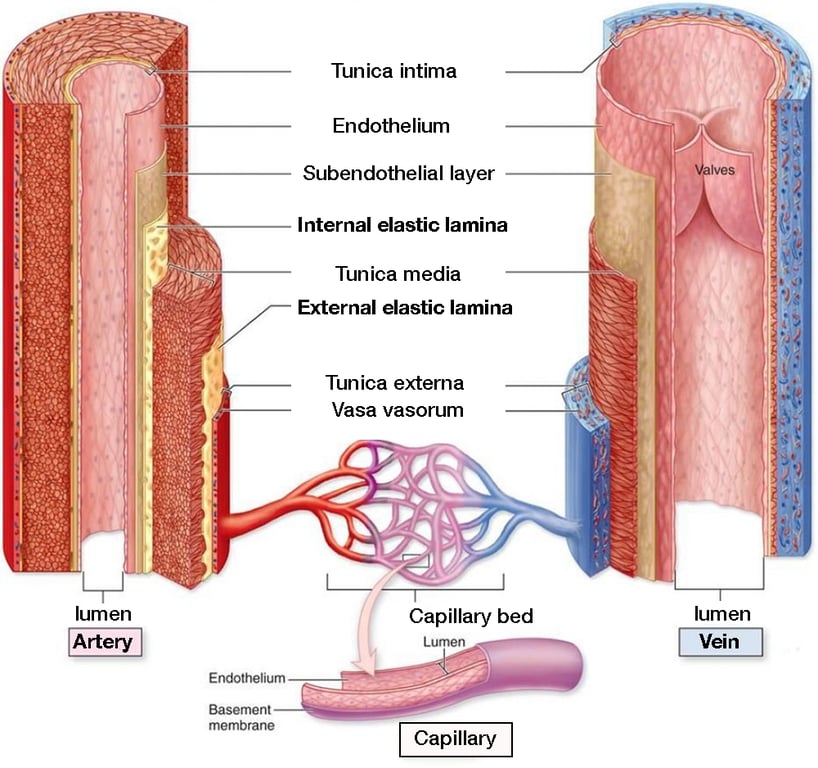 | |
Overview of anatomy of arteries and veins